
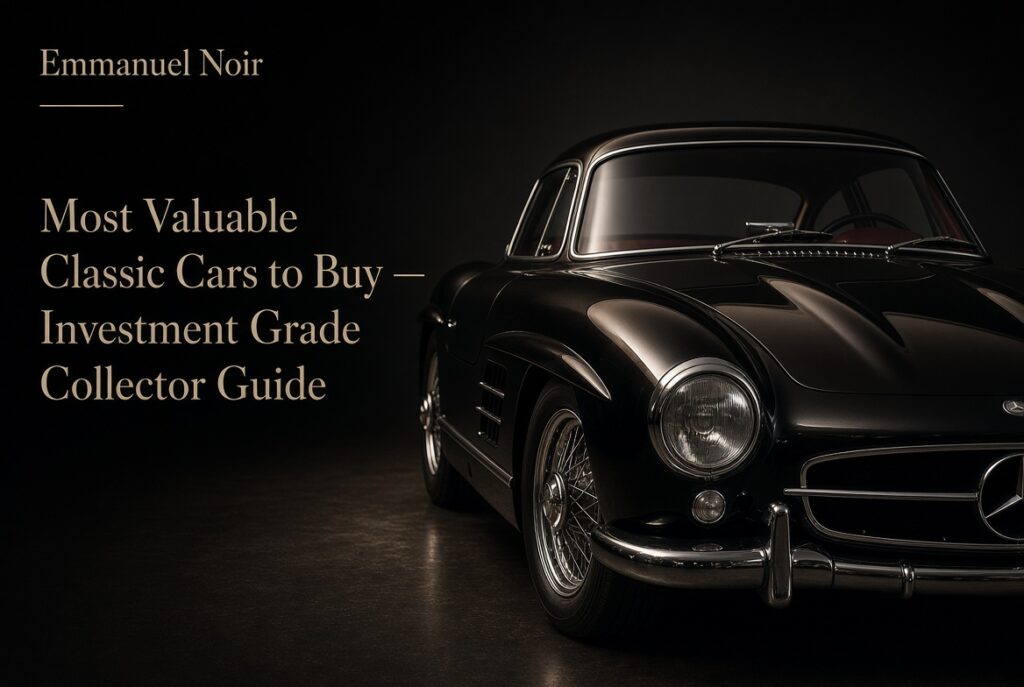
The classic-car market has entered a more selective era. When examining the most valuable classic cars, the question is no longer simply which automobile is rare, beautiful or expensive. Serious collectors are asking which cars possess the combination of provenance, engineering significance, cultural importance, scarcity and market depth that can justify a major acquisition today.
That distinction matters because the phrase most valuable classic cars can describe two very different worlds. At one end are extraordinary automobiles trading for tens of millions of dollars: racing Ferraris, significant Mercedes-Benz competition cars, Shelby Cobra Daytonas and historically important American racing machines. At the other are modern classics and established collector cars where a sophisticated buyer can still identify meaningful opportunities before they reach the highest tier of the market.
The current evidence is compelling. RM Sotheby’s 2026 Monterey auction generated $380 million in sales, with 69 cars exceeding $1 million and 14 surpassing $5 million. Gooding Christie’s followed with more than $159 million at its 2026 Pebble Beach Auctions, including 28 cars sold above $1 million. These results demonstrate that demand for exceptional collector automobiles remains substantial, but they also reveal something more important: the market is rewarding exceptional cars rather than merely old ones.
What Serious Collectors Are Looking For
For Emmanuel Noir readers, that distinction defines the entire conversation. This is not a list of old cars with impressive price tags. It is an examination of the automobiles that serious collectors should understand when considering a high-value classic-car acquisition in the current market.
Collectors looking beyond automobiles should also understand that the same principles recur throughout the world of tangible luxury — provenance, scarcity, condition, documentation and cultural relevance. Those principles sit at the heart of Emmanuel Noir’s Collectors Corner, where collectible automobiles are considered alongside other significant objects whose value extends beyond their material construction.
Quick Reference: The Most Valuable Classic Cars to Watch Now
The phrase “most valuable” requires context. The cars commanding the highest absolute prices are not necessarily the most intelligent acquisitions for every collector. A $40 million competition car occupies a fundamentally different market from a $1.5 million modern classic with strong international demand.
The shortlist below therefore combines blue-chip collector automobiles with modern classics whose market credentials, rarity or cultural importance make them particularly relevant to today’s buyer.
| Collector Car | Why It Matters Now | Current Market Signal |
|---|---|---|
| 1964 Shelby Cobra Daytona Coupe | Motorsport history, extreme rarity and American-European competition heritage | Carroll Shelby’s former Daytona Coupe sold for $42.9 million in 2026 |
| 1954 Mercedes-Benz W 196 R Stromlinienwagen | Grand Prix engineering and extraordinary competition provenance | Sold for $53.1 million at RM Sotheby’s in 2025 |
| 1964 Ferrari 250 LM | Le Mans pedigree, Ferrari competition heritage and exceptional scarcity | Sold for $36.1 million at RM Sotheby’s in 2025 |
| 1963 Chevrolet Corvette Grand Sport | One of America’s most significant competition Corvettes | Sold for $18.705 million at RM Sotheby’s Monterey in 2026 |
| 1954–1957 Mercedes-Benz 300 SL Gullwing | Landmark design, racing-derived engineering and enduring global recognition | Hagerty currently lists a #3 Good example around $1.35 million |
| 1987–1992 Ferrari F40 | Final Ferrari supercar developed during Enzo Ferrari’s lifetime and a defining analog-era machine | Hagerty’s July 2026 guide places a #3 example around $3.12–$3.68 million; recent sales have exceeded $5 million |
| 2004–2007 Porsche Carrera GT | Carbon-fibre construction, naturally aspirated V10 and only 1,270 examples | Hagerty’s 2026 Bull Market List values a #2 example around $1.55 million |
| 1960s Shelby Cobra | Lightweight American-European engineering with major motorsport history | Hagerty lists a 1967 Cobra #3 around $1.15 million |
| 1969–1970 American muscle icons | Cultural significance, factory performance specifications and a deep collector community | Select specifications remain highly sought after, although values vary dramatically by originality |
| Significant pre-war automobiles | Coachbuilt design, provenance and scarcity create an entirely different collecting tier | 2026 Monterey results continued to show strong demand for exceptional pre-war cars |
Auction Records Reveal Where Serious Collectors Are Concentrating
The upper end of the market provides the clearest evidence of where collectors are concentrating. RM Sotheby’s reported the $53,112,190 sale of the 1954 Mercedes-Benz W 196 R Stromlinienwagen in 2025 and a $36,073,245 result for a 1964 Ferrari 250 LM. In 2026, the former Carroll Shelby 1964 Shelby Cobra Daytona Coupe reached $42.9 million at Gooding Christie’s, becoming the most valuable American car ever sold at auction according to the auction house.
Yet the market is not composed solely of million-dollar competition machinery. Hagerty’s 2026 Bull Market List deliberately identified vehicles across a broad spectrum of price points, from relatively accessible enthusiast cars to the $1.55 million Porsche Carrera GT. Hagerty’s analysis emphasized public and private transactions, historical trends, insurance data and buyer behaviour rather than simply ranking cars by auction headline.
That distinction will become increasingly important as this guide moves from the spectacle of the auction room to the mechanics of an intelligent acquisition.
What Makes a Classic Car Truly Valuable?
A valuable classic car is rarely valuable for one reason.
Rarity matters. So does provenance. Originality matters, but so can a properly documented restoration. Racing history can transform a car’s status, while design can sustain desirability long after mechanical specifications have become historically modest.
The most compelling automobiles usually combine several of these characteristics.
A Ferrari with genuine competition history is not merely an old Ferrari. A factory-built homologation special is not equivalent to a standard production model carrying a performance badge. A documented celebrity-owned automobile is different from a similar car with an unverified story. And an original survivor can occupy a different collecting category from an extensively restored example even when both appear equally beautiful.
This is why serious buyers should establish identity and provenance before allowing price to dominate the discussion. Emmanuel Noir’s dedicated guide to how to authenticate and value a classic car before buying examines that process in greater depth, including chassis identification, provenance, originality, restoration evidence, mechanical condition and comparable market transactions.
The central principle is simple: the market does not value a badge in isolation. It values a specific automobile in a specific state with a specific history.
That is why two apparently identical cars can command radically different prices.
One may have its original engine, factory colour, matching transmission, complete ownership history and period photographs. The other may have been restored around a replacement drivetrain with incomplete documentation. From several feet away, they may look almost indistinguishable.
From a collector’s perspective, they are not the same asset.
Key Specifications: The Evidence Behind Collector Value
Before considering individual automobiles, it is useful to establish the specifications that serious collectors should record.
The first is identity.
The exact model, chassis number, production year, body style and factory configuration should be established before valuation begins. On important cars, engine and transmission numbers can become equally significant, particularly when the market places a premium on matching or documented components.
The second is provenance.
Ownership records, factory documentation, period photographs, service invoices, competition history, restoration records and correspondence can collectively establish the car’s historical continuity. No single document necessarily proves everything. The strength comes from multiple pieces of evidence reinforcing one another.
The third is originality.
Original paint, interior materials, mechanical components, factory equipment and period-correct details can materially affect desirability. However, originality should not be confused with neglect. A collector automobile can be highly original yet require substantial mechanical recommissioning.
The fourth is condition.
Condition must be judged mechanically and structurally as well as cosmetically. A spectacular paint finish cannot compensate for corrosion in structural areas, poorly repaired accident damage, an incorrect drivetrain or an unreliable braking system.
The fifth is specification.
This becomes particularly important with cars produced in multiple configurations. A standard road car, competition derivative, lightweight special, homologation model or factory performance variant may share much of its bodywork with another model while occupying a completely different collector tier.
Finally comes market evidence.
A collector should distinguish between an asking price, an auction estimate and a realized transaction. They are not interchangeable. Hagerty’s valuation methodology, for example, incorporates auction results, private sales, dealer activity and asking prices, while emphasizing that condition, originality, documentation and other vehicle-specific characteristics can create substantial differences between apparently similar cars.
For a serious buyer, these six elements form the foundation:
Identity → Provenance → Originality → Condition → Specification → Market Evidence
Only when all six are understood does the purchase price become meaningful.
The Importance of Condition Grades
Classic-car values cannot be interpreted intelligently without understanding condition.
Hagerty uses four condition grades, from #1 Concours through #4 Fair, and stresses that condition classification is essential because values can vary dramatically between vehicles carrying the same year, make and model designation. The company’s methodology also considers factors including originality, number of owners and documentation.
This explains why published values should always be treated as ranges rather than commandments.
A 1954 Mercedes-Benz 300 SL Gullwing in documented #1 condition is not financially equivalent to a mechanically sound but cosmetically ordinary #3 example. Likewise, an original Ferrari F40 with unusually low mileage, complete delivery equipment and exceptional provenance can command a very different figure from a higher-mileage example with a less complete history.
The collector’s task is therefore not to ask, “What is this model worth?”
It is to ask:
What is this particular example worth, given exactly what it is?
The Role of Provenance
Provenance is one of the most misunderstood components of classic-car value.
A famous owner can matter. A racing history can matter enormously. A long period of single-family ownership can also be compelling. Yet provenance only becomes genuinely powerful when it can be demonstrated.
A car accompanied by period photographs, invoices, factory correspondence and consistent ownership records presents a far stronger historical case than one accompanied by an attractive anecdote.
This is particularly important in the upper reaches of the market, where the financial difference between an authentic competition car and a convincing recreation can be enormous.
The 2026 auction results make that point vividly. The $42.9 million Shelby Cobra Daytona Coupe sold by Gooding Christie’s was not valuable simply because it carried the Cobra name. Its importance was tied to its competition history, Carroll Shelby provenance and position within American motorsport history.
Rarity Versus Desirability
Scarcity alone does not create a blue-chip collectible.
A car may be rare because production was limited. It may also be rare because many examples were destroyed, neglected or modified. Those circumstances are not equivalent.
The most durable collector demand tends to gather around cars for which rarity is accompanied by meaning.
That meaning can come from racing success, revolutionary engineering, landmark design, celebrity association, limited production, an important manufacturer or a place in cultural history.
The Shelby Cobra Daytona Coupe demonstrates this perfectly. Its value is not explained by production scarcity alone. It represents an extraordinary chapter in the attempt to defeat Ferrari on the international GT racing stage. Shelby American’s own history records the Daytona Coupe’s role in the 1965 World Manufacturers’ GT Championship, when Shelby defeated Ferrari.
The same principle appears in the American muscle-car market. Emmanuel Noir’s examination of 1970 Chevrolet muscle cars worth collecting shows why factory specification, engine identity, rarity and documentation can transform an apparently familiar performance car into a serious collector proposition.
The lesson extends far beyond Chevrolet.
A collector should always ask why the car is rare, why people care about it and whether that interest has survived more than one market cycle.
Historical Background: How the Modern Collector-Car Market Was Built
The world’s most valuable classic cars did not become valuable overnight.
Their histories stretch across several eras of automotive development: the birth of the grand tourer, the rise of international endurance racing, the golden age of coachbuilding, the emergence of American muscle, the evolution of the supercar and, more recently, the recognition of modern analog-era automobiles as future collectibles.
The post-war period was particularly important.
European manufacturers began translating racing technology into road-going automobiles with unprecedented ambition. Mercedes-Benz’s 300 SL emerged directly from the company’s motorsport programme. Ferrari developed road and competition cars whose boundaries were often blurred. Porsche increasingly treated engineering sophistication as part of its identity.
At the same time, American manufacturers were creating a different collector tradition based around displacement, performance and cultural impact.
By the 1960s, the collector-car landscape had become remarkably diverse.
Mercedes-Benz and the Birth of the Modern Performance Icon
The 1954 Mercedes-Benz 300 SL Gullwing illustrates the extraordinary relationship between competition engineering and road-car design.
Mercedes-Benz developed the production car from its 1952 racing sports car. The unusual gullwing doors were not merely theatrical styling; Mercedes-Benz’s archive explains that they were structurally necessary because the tubular space frame created high side sills that made conventional doors impractical. The production car also introduced mechanical fuel injection, increasing output significantly over the earlier carbureted racing configuration.
Mercedes-Benz built 1,400 Gullwing coupes between 1954 and 1957, including only 29 with lightweight aluminium bodies. That combination of engineering significance, relatively limited production and instantly recognizable design helped establish the 300 SL as one of the defining collector automobiles of the twentieth century.
Today, Hagerty’s valuation data places a #3 Good 1955 Mercedes-Benz 300 SL around $1.35 million, illustrating the substantial distance between the 300 SL and ordinary classic-car territory.
Ferrari and the Competition-Car Legacy
Ferrari created an even more direct relationship between racing success and collector desirability.
The marque’s most significant historic automobiles were rarely designed simply to look beautiful. Their identities were tied to competition, engineering and the pursuit of victory.
The market continues to recognize that history.
In 2025, Gooding Christie’s sold a 1961 Ferrari 250 GT SWB California Spider Competizione for $25,305,000, while a 1964 Ferrari 365 GTB/4 Daytona Competizione reached $8,145,000. RM Sotheby’s also recorded a $36,073,245 sale for a 1964 Ferrari 250 LM in 2025.
These are not ordinary used cars with age premiums.
They are historical objects whose mechanical identity, competition heritage, provenance and scarcity have converged.
Ford, Shelby and the American Challenge to Ferrari
The American collector market developed another defining narrative: the attempt to defeat Europe on its own ground.
Ford’s GT40 programme was born after failed negotiations with Ferrari. Ford subsequently created a dedicated high-performance programme aimed at major road races such as Sebring and Le Mans. The resulting GT40 became one of the defining endurance-racing cars of the 1960s.
The Mark II became the decisive expression of that programme.
Ford’s historical account records that the 1966 GT40 Mark II used a 427-cubic-inch engine producing approximately 485 horsepower in endurance testing, while engineering changes to brakes, suspension, aerodynamics and fuel systems were developed specifically to survive the demands of Le Mans. Ford ultimately won the 1966 race, taking the first three positions.
That racing history has helped establish the GT40 as one of the great American collector automobiles.
It also illustrates a broader rule of the classic-car market:
Competition history can become a form of provenance.
A car does not need a celebrity owner if its own historical record is extraordinary.
The Analog Supercar Becomes Collectible
The collector landscape changed again during the 1980s and 1990s.
Cars such as the Ferrari F40 introduced levels of performance and engineering that had previously belonged almost entirely to racing machinery. The F40’s lightweight construction, twin-turbocharged V8 and uncompromising philosophy created a car that now represents one of the final great expressions of analog Ferrari performance.
Hagerty’s current data shows just how dramatically collector interest has evolved. Its July 2026 valuation for a 1988 Ferrari F40 places a #3 Good example at approximately $3.12–$3.68 million, while its recent sales database records several 2026 transactions above $4 million and one 1991 example at $8.365 million.
That is an important market signal.
The definition of “classic” is expanding.
Collectors are increasingly looking beyond pre-war automobiles and 1960s icons toward cars that represented the final moments of a particular engineering philosophy.
The Porsche Carrera GT and the Modern Classic Era
The Porsche Carrera GT provides perhaps the clearest example.
Produced from 2004 to 2006, only 1,270 examples were built. Porsche’s own parts documentation confirms the limited production run, while Hagerty selected the Carrera GT for its 2026 Bull Market List at a #2-condition valuation of approximately $1.55 million.
Its significance extends beyond rarity.
The Carrera GT combines a naturally aspirated V10, carbon-fibre construction and a manual transmission in a package created during the final years before electronic assistance and electrification fundamentally changed the performance-car landscape.
That makes it more than an expensive Porsche.
It represents a disappearing engineering philosophy.
For today’s collector, that distinction can be powerful.
The Market Has Changed — But the Fundamentals Have Not
The extraordinary results of 2026 should not encourage indiscriminate buying.
If anything, they make discipline more important.
RM Sotheby’s reported that 90 percent of the 199 lots at its 2026 Monterey auction sold, with 69 cars exceeding $1 million. Gooding Christie’s achieved a 94 percent sell-through rate at Pebble Beach, selling 158 lots and recording 28 results above $1 million.
Those figures demonstrate liquidity at the top end, but they do not mean every classic automobile is appreciating.
The market remains highly selective.
Exceptional provenance can command a premium. Exceptional originality can command a premium. Exceptional specification can command a premium.
An ordinary example of a fashionable model is another matter.
That is why the intelligent collector should resist headlines and study the automobile itself.
The question is not whether classic cars are valuable.
The question is which classic cars are valuable for reasons that are likely to remain meaningful after the excitement of the current market has passed.
That is where the serious collecting opportunity begins.
A Collector’s First Principle
The strongest acquisitions usually begin with history rather than price.
Understand what the manufacturer intended.
Understand what makes the particular specification significant.
Understand how many were produced.
Understand what happened to the example in front of you.
Then study what comparable examples have actually achieved.
Only after that should you decide whether the price deserves your attention.
The most valuable classic cars are rarely the ones that merely look expensive.
They are the automobiles whose stories, specifications and evidence continue to withstand scrutiny.
Design & Craftsmanship: Where Collectible Engineering Becomes Art
The finest collector cars occupy an unusual territory between engineering and sculpture. Their value is partly mechanical, but their lasting appeal often comes from the way engineering decisions shaped the physical object.
That is particularly evident in the great European sports cars of the 1950s and 1960s.
The Mercedes-Benz 300 SL is perhaps the clearest example. Its tubular space frame forced Mercedes-Benz to adopt gullwing doors, while its fuel-injected straight-six gave the production car a technological sophistication that distinguished it from conventional grand tourers of the period. The result was not merely a beautiful body placed over a competent chassis. The form emerged from the engineering.
That distinction matters to collectors because design divorced from engineering history can age differently from design that expresses genuine technical purpose.
Ferrari: Form Following Competition
Ferrari’s greatest collector automobiles demonstrate the same principle through a more overtly competitive philosophy.
The 250 LM is a particularly revealing case. Its mid-engine layout represented the changing direction of racing technology, while its relationship to the 250 P and its 1965 Le Mans victory gave the model an unusually powerful historical narrative. Hagerty’s current valuation data places a 1964 Ferrari 250 LM in the approximate $20.17 million to $24 million range for #3 Good condition, illustrating the extraordinary premium attached to a genuine competition Ferrari with exceptional historical significance.
The important point is not the number itself. It is what the number represents.
Only 32 Ferrari 250 LMs were built, according to Hagerty’s model history, and the market places enormous weight on provenance, documentation and originality for competition cars.
This is the anatomy of a blue-chip collectible: limited supply, significant engineering, major competition history and a global collector base capable of competing for the few surviving examples.
Shelby Cobra: Lightweight Brutality With Provenance
The Shelby Cobra follows a different design language.
Where the Ferrari 250 LM expresses European competition sophistication, the Cobra delivers a distinctly Anglo-American interpretation of performance: a compact roadster body, Ford V8 power and a chassis developed around the principle of reducing weight while increasing performance.
Original Shelby Cobras have consequently developed a collector hierarchy of their own.
Hagerty’s 2026 data illustrate the spread. A 1967 Shelby Cobra 427 with the CSX3300–CSX3360 chassis range carries a #3 Good-condition guide of roughly $1.10 million to $1.23 million, while recent genuine examples have sold for substantially more depending on chassis, specification, condition and history. A 1966 Cobra 427, for example, sold for $1.98 million at Mecum in August 2026.
Yet the Cobra market also contains one of the most important warnings for collectors: replicas and continuation cars are not interchangeable with period-built original Cobras.
Hagerty notes that replicas became widespread from the 1970s onward, while Shelby later produced continuation cars using leftover original frames. Those vehicles can offer an alternative ownership proposition, but they occupy a different historical and market category from an original period Shelby Cobra.
For the serious collector, chassis identity is therefore fundamental.
A beautiful Cobra is not necessarily a significant Cobra.
Performance & Ownership: The Cars That Demand Something From Their Owners
There is a temptation to evaluate collector cars solely through appreciation charts and auction results. That approach misses half the reason these automobiles remain desirable.
The greatest collector cars are also extraordinary machines to experience.
They possess steering, braking, throttle response and mechanical feedback that can make modern performance cars feel almost detached by comparison. That does not necessarily make them easier to own. In many cases, the opposite is true.
The Ferrari F40: A Modern Classic With No Interest in Compromise
Few automobiles demonstrate this better than the Ferrari F40.
The F40’s appeal rests partly on its historical position: it was Ferrari’s 40th-anniversary supercar and one of the final road cars associated directly with Enzo Ferrari’s era. But its collector status also comes from the experience it delivers.
The twin-turbocharged V8, low mass, limited electronic intervention and uncompromising cabin create a driving experience that feels fundamentally different from the increasingly computer-managed supercars that followed.
The market has noticed.
Hagerty’s July 2026 valuation placed a 1988 F40 in #3 Good condition at approximately $3.12 million to $3.68 million, with a 38.8 percent annual increase shown in that guide. Recent transactions have ranged much higher for exceptional examples: Hagerty records a 1991 F40 selling for $8.365 million at RM Sotheby’s Monterey in August 2026.
The spread between those figures is instructive.
It demonstrates why a collector should never quote a single model value without identifying year, condition, mileage, originality, provenance and specification.
An F40 may be worth several million dollars.
A particular F40 may be worth substantially more.
Those statements can both be true.
Porsche Carrera GT: The Analog Supercar Becomes a Collector Asset
The Porsche Carrera GT sits at the intersection of classic-car collecting and modern-supercar collecting.
Its naturally aspirated V10, carbon-fibre construction and manual gearbox give it a character that increasingly belongs to automotive history rather than the contemporary showroom.
The market has moved sharply.
Hagerty’s July 2026 data placed a 2005 Carrera GT at approximately $2.10 million to $2.42 million in #3 Good condition. By October, the guide had moved to roughly $2.37 million to $2.72 million, while several 2026 transactions exceeded $3 million. A 5,600-mile example sold for $4.0152 million in October 2026.
This is precisely why the Carrera GT deserves attention from collectors studying the next generation of significant automobiles.
It is no longer simply an expensive used Porsche.
It is becoming a historical reference point for the final generation of uncompromised, naturally aspirated, manual-transmission supercars.
Ownership Costs Are Part of the Acquisition
The purchase price is only the opening figure.
A serious collector should budget for storage, insurance, specialist servicing, tires, fluids, battery maintenance, transportation, detailing, mechanical recommissioning and periodic inspection. Cars that are driven regularly introduce another set of costs, while cars that spend years stationary can create their own mechanical problems.
The ideal ownership strategy therefore depends on the automobile.
A competition Ferrari with extraordinary provenance may belong in a climate-controlled collection and appear selectively at concours events. A Carrera GT may deserve regular use by an experienced driver. A 300 SL may be both a display piece and a grand touring automobile if properly maintained.
The ownership philosophy should follow the car.
That principle is particularly important for older mechanical automobiles because preservation and enjoyment are not always naturally aligned.
A collector who refuses to drive a car may preserve mileage but allow seals, fluids and mechanical systems to deteriorate. A collector who drives without regard to preservation may introduce unnecessary wear to irreplaceable components.
The most sophisticated approach is controlled use.
Drive the car.
Maintain it properly.
Document everything.
And understand that stewardship is part of the ownership experience.
Market Position & Competition: Where the Best Cars Sit Today
The modern classic-car market is no longer a single pyramid with “ordinary classic” at the bottom and “million-dollar Ferrari” at the top.
It is a series of overlapping markets.
There is the accessible enthusiast market.
There is the established blue-chip market.
There is the modern-classic market.
There is the competition-car market.
And above all of them sits the extraordinary provenance market, where individual automobiles can become financial and cultural events in their own right.
Tier One: Blue-Chip Competition Cars
At the summit are cars such as the Ferrari 250 LM, Mercedes-Benz W 196 R, Ferrari 250 GTO and historically significant Shelby competition machinery.
These automobiles are not conventional investments in the sense of a standardized financial instrument. Each is an individual historical object.
Condition matters.
But provenance can matter more.
A competition car with an authentic race history can be worth multiples of a mechanically similar example without that history.
This is why collectors should be wary of relying on model-level valuation alone.
The 1964 Ferrari 250 LM illustrates the point. Hagerty’s guide shows an extraordinary valuation range, while the model’s historical record includes the 1965 Le Mans victory by the NART-entered chassis. Only 32 were produced.
The car’s value is therefore inseparable from its history.
Tier Two: Established Icons
The next tier contains automobiles whose identities are already firmly established among collectors worldwide.
The Mercedes-Benz 300 SL Gullwing is a prime example.
The model’s current market demonstrates the difference between a standard steel-bodied Gullwing and exceptional specifications. Hagerty’s October 2026 guide for the rare 1955 aluminum-bodied 300 SL Gullwing shows a #3 Good value of approximately $6 million to $7.2 million, while ordinary 300 SL examples trade considerably lower.
That distinction is crucial.
A collector should not conclude that every 300 SL is a $6 million automobile.
The market is telling us that the specific configuration can be the story.
A 1957 300 SL Gullwing sold by Gooding Christie’s for $2,012,500 in 2026, for example, was the 1,396th of 1,400 built and retained its matching-numbers engine, while its gearbox was an authentic 300 SL unit but not original to the car.
That single auction result illustrates the level of scrutiny required at this end of the market.
Even a celebrated car can contain nuances that materially affect its desirability.
Tier Three: Modern Analog Icons
The F40 and Carrera GT belong here.
They are young enough to remain usable yet old enough for collectors to recognize that the engineering philosophy they represent is disappearing.
The F40 is defined by turbocharged drama and minimal intervention.
The Carrera GT is defined by its V10, carbon-fibre architecture and manual transmission.
Both possess strong international recognition.
Both have relatively limited production.
And both are increasingly being viewed as representatives of an era rather than simply examples of a model line.
This creates an interesting collecting thesis.
The future classic is not necessarily the oldest automobile in the garage.
It may be the car that best represents the end of an era.
Tier Four: American Performance Icons
The American market deserves equal attention.
Shelby Cobra, Corvette Grand Sport, selected Chevrolet Chevelle and Camaro variants, Ford GT40s and other historically significant American performance cars continue to attract collectors because their stories are inseparable from the development of American performance culture.
Yet this is also a market where specification discipline is essential.
A genuine factory-built performance car with documented provenance is one proposition.
A modified example wearing the same badges is another.
A continuation car is another.
A replica is another.
All may be enjoyable automobiles.
They are not equivalent collector assets.
Hagerty’s current Cobra data demonstrates the dispersion clearly: recent genuine Cobras have traded from hundreds of thousands of dollars into seven figures, depending heavily on chassis and specification.
The sophisticated collector therefore buys the history first and the horsepower second.
What Serious Collectors Are Actually Buying
The strongest pattern across today’s market is not a preference for one manufacturer.
It is a preference for significance.
Collectors are acquiring cars that tell an important story.
That story may be technological.
It may be competitive.
It may be cultural.
It may be connected to a particular designer, manufacturer, racing driver or period.
But it needs to be legible.
This is why an ordinary example of an iconic model can sometimes underperform an exceptional example of a less fashionable one.
The market eventually asks the same question:
Why this car?
The stronger the answer, the stronger the collecting thesis.
Provenance Is Becoming More Important, Not Less
Digital databases have made historic information easier to cross-check, but they have not eliminated the importance of physical documentation.
Factory build sheets, service records, period photographs, old registration documents, racing programmes, correspondence, restoration invoices and specialist reports can collectively establish a car’s identity.
In the most valuable transactions, documentation can become part of the object.
That is particularly true for competition automobiles.
A genuine race history can change the status of a car from an attractive collector automobile into a piece of motorsport history.
Originality Has Become a Strategic Advantage
Restoration is not inherently negative.
A beautifully restored car can be magnificent.
But restoration quality and originality answer different questions.
A restored car tells the story of what the automobile was rebuilt to become.
An original or highly preserved car can tell the story of what actually survived.
Collectors increasingly understand the distinction.
That is why low-mileage, well-preserved examples of important modern classics can command exceptional premiums even when another example has received a more comprehensive cosmetic restoration.
The surviving evidence matters.
The Competitive Landscape: Auction Houses, Specialists and Private Sales
The market is also becoming more sophisticated in how cars change hands.
Major auction houses remain central because they create public price discovery and international competition.
RM Sotheby’s and Gooding Christie’s continue to dominate the upper end of the market, while specialists, marque experts, private dealers and digital platforms serve different segments.
Gooding Christie’s reported more than $159 million in sales at its 2026 Pebble Beach Auctions, with 158 lots sold and a 94 percent sell-through rate. The event’s results included 28 cars selling above $1 million.
For collectors, the significance goes beyond the headline total.
A major auction provides a public record of what sophisticated buyers were willing to pay at a specific moment for a specific car.
That makes auction archives valuable research tools.
But they must be interpreted carefully.
A record price does not automatically establish a new universal value.
It establishes what one buyer paid for one automobile under one set of circumstances.
Why Public Auction Prices Can Mislead
Auction results can be distorted by exceptional provenance, unusually low mileage, unusual specifications, celebrity ownership or intense bidding between two determined collectors.
Conversely, a weak result can reflect poor presentation, an inconvenient sale location, incomplete documentation or mechanical concerns rather than a collapse in the model’s underlying desirability.
This is why serious collectors triangulate.
Study auction results.
Study private-market transactions.
Study specialist opinions.
Study insurance valuations.
Study condition.
Then inspect the actual car.
Hagerty itself emphasizes that its valuation tools draw from auction results, private sales and dealer transactions rather than relying exclusively on auction data.
This is the difference between watching the collector-car market and actually understanding it.
The Emmanuel Noir Collector’s Perspective
The automobiles most worth watching today are not necessarily those with the loudest headlines.
They are the cars where several forms of significance overlap.
A Ferrari F40 has engineering significance, cultural recognition, scarcity and an increasingly powerful analog-era narrative.
A Porsche Carrera GT combines limited production, exceptional engineering and the emotional appeal of a naturally aspirated manual supercar.
A Mercedes-Benz 300 SL possesses landmark design, motorsport ancestry and decades of collector recognition.
A Shelby Cobra carries the mythology of American performance and the historical importance of the Shelby-Ford challenge.
A Ferrari 250 LM represents the purest form of collector-car history: genuine competition pedigree, limited production and an extraordinary Le Mans legacy.
These cars do not all occupy the same price bracket.
They do not carry the same risk.
And they should not be approached with the same acquisition strategy.
But they share one characteristic.
Their significance is understandable without needing a sales pitch.
That is usually a good place to begin when deciding which of the most valuable classic cars deserves a place in a serious collection.
Buying Considerations: How to Buy the Right Classic Car
Knowing which cars matter is only the beginning.
Buying one intelligently requires a different mindset from buying a modern automobile. There is no single specification sheet that can tell you whether a collector car deserves its asking price. The decisive evidence is usually distributed across the chassis, documents, mechanical components, restoration history, market comparables and the seller’s credibility.
For a serious buyer, the acquisition should therefore begin with a dossier rather than a test drive.
1. Establish the Exact Identity of the Car
Start with the chassis number.
Then establish the engine, transmission, body configuration, factory colour, original equipment and production specification wherever documentation permits.
This sounds obvious. At the upper end of the market, however, identity is the foundation upon which everything else rests.
A desirable model with uncertain identity can become an expensive problem. A less fashionable model with impeccable documentation can become a far more compelling acquisition.
This is also where the distinction between an original car, a restored car, a continuation car and a replica becomes critical.
Never allow a seller’s description to substitute for independent verification.
The first document you should want to see is the one that proves exactly what the automobile is.
2. Separate Provenance From Storytelling
Every important classic car has a story.
Only some have documented provenance.
The difference is substantial.
A claimed celebrity owner, racing history or factory connection should be supported by period evidence wherever possible. Registration records, factory correspondence, race results, period photographs, invoices and specialist documentation can collectively turn an anecdote into provenance.
The principle is particularly important when considering the most valuable classic cars, because the premium attached to significant history can be enormous.
A collector should therefore build a provenance timeline:
Factory → First owner → Major events → Subsequent owners → Restoration → Present condition
Any unexplained gap deserves investigation.
3. Inspect the Car Before Negotiating the Price
Photography is useful for preliminary screening.
It is not a substitute for inspection.
Paint thickness, panel alignment, corrosion, underbody repairs, chassis condition, engine numbers, gearbox identity, wiring, suspension components and signs of previous accident damage can all materially change the valuation.
The inspection should ideally involve a marque specialist who has no financial interest in the transaction.
This is particularly important for cars with complex histories or extensive restorations.
A beautifully presented engine bay can conceal incorrect components. A flawless interior can hide structural work. A perfect paint finish can obscure decades of repairs.
The collector should therefore inspect the car as a historian, engineer and buyer simultaneously.
4. Understand What Has Been Restored
Restoration quality is not measured simply by how attractive the car appears.
Ask what was restored.
Ask what was replaced.
Ask what was retained.
Ask which components are original.
Ask whether the restoration followed factory specifications or a later interpretation.
Then ask who performed the work.
A documented restoration by a recognized specialist can be a positive part of a car’s history. An undocumented restoration can introduce uncertainty, even when the finished automobile looks spectacular.
The distinction between preservation and restoration is especially important for historically significant cars.
Sometimes the evidence of age is part of the car’s identity.
Removing every imperfection may produce a more beautiful automobile while simultaneously removing some of its historical character.
5. Study Comparable Sales, Not Just Asking Prices
An asking price tells you what the seller wants.
A completed transaction tells you what a buyer actually paid.
That difference should shape every serious negotiation.
Hagerty’s valuation system combines auction results, private sales and dealer transactions, and its current guidance emphasizes that condition, originality, documentation, rarity and modifications can produce major differences between vehicles carrying the same year, make and model.
The sophisticated buyer should therefore build a comparable-sales sheet containing:
- Same model and generation
- Same or similar specification
- Similar condition
- Similar mileage
- Comparable originality
- Comparable provenance
- Similar restoration status
- Date of sale
- Sale venue
- Realized price
- Any unusual circumstances surrounding the transaction
A $2 million auction result is almost meaningless if the comparison car in your garage has a different chassis history, inferior specification and incomplete documentation.
6. Budget for the Car You Are Actually Buying
The purchase price is only one component of the acquisition.
A sensible collector should reserve capital for:
- Pre-purchase inspection
- Transportation
- Insurance
- Secure storage
- Preventive maintenance
- Specialist servicing
- Tires and consumables
- Mechanical recommissioning
- Unexpected repairs
- Documentation and authentication
- Future preservation
The older and more complex the automobile, the more important this reserve becomes.
A collector who spends every available dollar acquiring the car may discover that ownership itself has become restrictive.
The better strategy is to buy below the maximum theoretical budget and retain enough capital to care for the automobile properly.
7. Decide Whether You Want an Investment, an Experience or Both
This distinction should be made before buying.
Some collectors want a concours-level automobile that will be preserved almost as an artifact.
Others want a car they can drive through the Alps, across the South of France or along California’s coast.
Others want something in between.
There is nothing wrong with any of these approaches.
The mistake is buying one type of car while expecting it to behave like another.
A competition Ferrari may offer extraordinary historical significance but demand greater preservation discipline. A Porsche Carrera GT may offer an extraordinary driving experience while also possessing an increasingly important collector narrative.
The right car is therefore partly determined by the owner’s intended relationship with it.
8. Think in Five- and Ten-Year Horizons
Short-term price movements can be seductive.
They can also be misleading.
The strongest collector thesis usually begins with a much longer question:
Will knowledgeable enthusiasts still understand why this automobile matters ten years from now?
That question filters out much of the noise.
Cars built around temporary fashion may rise rapidly and retreat just as quickly.
Cars with enduring engineering significance, competition history, exceptional design and limited supply have a stronger foundation.
That does not guarantee appreciation.
It simply gives the collector a more defensible reason for owning the car.
For readers comparing classic automobiles with other collectible assets, Emmanuel Noir’s broader most valuable collectibles analysis provides useful context on why rarity, cultural relevance, provenance and market depth matter across collectible categories rather than only in automobiles.
The Cars Serious Collectors Should Watch
The following comparison is not a promise of appreciation and should not be interpreted as a ranking of guaranteed investment returns. It is a collector-oriented assessment of historical significance, rarity, market depth, driving character and the strength of the underlying ownership thesis.
| Automobile | Collector Strength | Principal Attraction | Key Risk | Ideal Collector |
|---|---|---|---|---|
| Ferrari 250 LM | Exceptional | Genuine competition history, Le Mans significance and extreme rarity | Extraordinary acquisition cost and provenance sensitivity | Established blue-chip collector |
| Shelby Cobra Daytona Coupe | Exceptional | Carroll Shelby provenance and major GT racing history | Extremely limited availability and enormous valuation | Museum-level or elite competition collector |
| Mercedes-Benz 300 SL Gullwing | Very strong | Landmark design, racing ancestry and global recognition | Condition and specification can create huge price differences | Design and engineering collector |
| Ferrari F40 | Very strong | Analog supercar experience and Enzo-era significance | High acquisition and maintenance costs | Modern-classic specialist |
| Porsche Carrera GT | Very strong | V10, manual gearbox and carbon-fibre construction | Rising valuations and complex mechanical ownership | Driver-collector |
| Shelby Cobra 427 | Strong | American performance history and lightweight engineering | Replica/continuation confusion and specification variance | American performance collector |
| Corvette Grand Sport | Strong | Rare competition heritage and American motorsport importance | Authenticity and provenance are critical | Motorsport-focused American collector |
| Selected 1970s Muscle Cars | Selective | Cultural importance, factory performance and broad enthusiast base | Large differences between ordinary and documented examples | Emerging collector |
| Significant Pre-War Cars | Exceptional at the top end | Coachbuilding, provenance and historical importance | Specialized knowledge and narrow buyer pool | Specialist historical collector |
The pattern is clear.
The best acquisition is not automatically the most expensive automobile in the table.
It is the automobile whose price, significance, provenance, condition and intended use make sense together.
Where to Buy: Auction, Specialist Dealer or Private Sale?
The purchasing venue can materially affect the quality of information available to you.
Major Auction Houses
Auctions offer transparency that private transactions sometimes lack.
A serious sale creates a public record, exposes the automobile to competing buyers and gives the collector an opportunity to compare the car with other important lots being offered at the same event.
The strongest auction houses also invest heavily in provenance research and specialist cataloguing.
The 2026 Monterey season demonstrated the continuing importance of this ecosystem. RM Sotheby’s reported $380 million in sales, with 69 cars exceeding $1 million and 14 exceeding $5 million. Gooding Christie’s reported more than $159 million at its 2026 Pebble Beach Auctions, with a 94 percent sell-through rate. Together, these 2026 Monterey and Pebble Beach auction results provide useful public evidence of where serious collector demand is concentrating.
Yet auction excitement can work against discipline.
The atmosphere, competition and scarcity of the moment can encourage a bidder to exceed a rational ceiling.
Set the maximum price before bidding.
Then respect it.
Specialist Dealers
A respected specialist can provide access to automobiles that never reach a public auction.
This is particularly valuable for rare Ferraris, historic Porsches, important Mercedes-Benz models and competition cars where relationships and discretion can matter.
The trade-off is that private dealer transactions can offer less public price transparency.
Independent inspection therefore becomes even more important.
The buyer should separate the dealer’s expertise from the dealer’s financial interest.
Both can exist at the same time.
Online Collector Platforms
Online platforms have become increasingly important for the broader collector market.
They offer greater visibility, searchable transaction histories and access to cars outside traditional auction calendars.
For collectors researching the market or looking for more accessible opportunities, Bring a Trailer provides a broad marketplace spanning enthusiast cars, modern classics and significant collector automobiles.
Affiliate disclosure: Emmanuel Noir may earn a commission if a qualifying transaction is completed through this link, at no additional cost to the reader.
The editorial reason for including the platform is straightforward: it is useful for research, comparable sales and discovering cars outside the rarefied top end of the auction market. It should not, however, replace independent inspection or provenance verification.
For readers specifically searching the wider classified market, ClassicCars.com can also be useful as a discovery resource for inventory across different marques, eras and price levels.
Affiliate disclosure: Emmanuel Noir may earn a commission if a qualifying transaction is completed through this link, at no additional cost to the reader.
Neither platform should be treated as an authentication service. The buyer remains responsible for establishing identity, provenance, mechanical condition and contractual terms before completing a purchase.
How to Compare Two Apparently Similar Cars
Suppose two Ferrari F40s are offered at similar prices.
One has 8,000 miles, complete books, original delivery equipment, extensive service documentation and a documented ownership chain.
The other has 3,000 miles but incomplete records, an uncertain paint history and several undocumented mechanical interventions.
The second car may initially appear more attractive.
The first may be the stronger collector acquisition.
This is why mileage should never be interpreted in isolation.
The same principle applies to a Mercedes-Benz 300 SL.
A beautifully restored example with incorrect components may be less desirable to a historically focused collector than an older restoration retaining important original material.
The hierarchy should therefore be:
Identity first → Provenance second → Specification third → Condition fourth → Mileage fifth → Price sixth.
Price matters enormously.
It simply should not be the first question.
Pros & Cons of Buying the Most Valuable Classic Cars
Pros
Historical significance.
The strongest collector cars represent important moments in automotive, racing or design history.
Scarcity.
Genuinely rare automobiles can offer a degree of supply limitation that ordinary luxury goods cannot replicate.
Cultural durability.
The greatest Ferraris, Porsches, Mercedes-Benz and Shelby automobiles have narratives that extend beyond the current market cycle.
Driving experience.
Many modern classics provide mechanical feedback that is increasingly rare in contemporary performance cars.
Global collector demand.
Blue-chip marques attract international buyers, creating a deeper potential market when the automobile is genuinely significant.
Portfolio diversification.
For a sophisticated collector, a physical automobile can represent a different form of ownership from conventional financial assets, although it should never be treated as risk-free diversification.
Cons
High transaction costs.
Acquisition commissions, transportation, inspection, registration and taxes can materially increase the true cost.
Maintenance complexity.
Rare mechanical components can be expensive, difficult or time-consuming to source.
Illiquidity.
A valuable car is not equivalent to cash. Finding the right buyer can take time.
Condition risk.
Two examples of the same model can differ dramatically in value because of condition and originality.
Provenance risk.
Incorrect documentation or disputed history can materially damage collector value.
Market cycles.
Even important cars can experience periods of declining prices.
Storage and insurance.
A serious collection requires professional preservation, security and appropriate insurance.
Emotional buying risk.
The most expensive mistake is often paying too much because you have fallen in love with the story before verifying the car.
Who Should Buy These Cars?
The ideal buyer is not necessarily the person with the largest budget.
It is the person who understands what ownership involves.
The Established Collector
For an established collector, a blue-chip automobile can become the centrepiece of an existing collection.
The strongest candidate is usually a car with a clear historical thesis, excellent provenance and a specification that is difficult to replicate.
At this level, the collector is often buying significance rather than transportation.
The Driver-Collector
A driver-collector may find greater satisfaction in a Ferrari F40, Porsche Carrera GT, Mercedes-Benz 300 SL or carefully selected Shelby Cobra than in an automobile that is too historically significant to drive regularly.
The important question is whether the intended use is compatible with the car’s preservation requirements.
The Emerging Collector
An emerging collector should resist the temptation to leap immediately toward the most expensive name.
A well-documented, historically meaningful automobile at a manageable acquisition cost can provide a better education than an ultra-expensive trophy car.
Learning how provenance works, how restorations are evaluated and how specialists inspect cars is itself part of building a collection.
For those entering the world of collector automobiles, Emmanuel Noir’s existing guide on building a collection with a disciplined budget is useful as a broader framework for thinking about acquisition sequence, capital allocation and long-term collecting rather than buying individual objects in isolation.
LINK IMPLEMENTATION — CONTEXTUAL INTERNAL LINK
Anchor: building a collection with a disciplined budget
Destination: https://emmanuelnoir.com/build-luxury-watch-collection-budget/
HTML: <a href="https://emmanuelnoir.com/build-luxury-watch-collection-budget/">building a collection with a disciplined budget</a>
Although that article examines watches rather than automobiles, the underlying collecting principle transfers well: establish a thesis, understand your budget, acquire quality and avoid allowing one emotional purchase to dictate the entire collection.
Who Should Skip It?
Classic cars are not suitable for every affluent buyer.
You should probably skip a high-value collector-car acquisition if:
- You need immediate liquidity.
- You cannot comfortably fund ongoing maintenance.
- You have no secure storage.
- You are unwilling to commission independent inspections.
- You are relying entirely on future appreciation to justify the purchase.
- You dislike mechanical involvement.
- You are uncomfortable with uncertain resale timing.
- You are buying solely because a recent auction produced a record price.
- You cannot distinguish original, restored, continuation and replica automobiles.
- You have not researched the particular chassis rather than simply the model.
The last point deserves emphasis.
Do not buy “a Ferrari F40.”
Buy a particular Ferrari F40.
Do not buy “a 300 SL.”
Buy a particular 300 SL whose identity, specification, history and condition you understand.
Do not buy “a Shelby Cobra.”
Buy a documented automobile whose chassis and provenance have survived scrutiny.
That is how collectors move from purchasing an object to acquiring an asset with a defensible historical identity.
The Emmanuel Noir Acquisition Framework
Before signing a purchase agreement, the serious collector should be able to answer ten questions:
- What exactly is the chassis?
- What is its documented factory specification?
- Who owned it and when?
- What competition or cultural history does it possess?
- Which major components are original?
- What restoration work has been performed?
- Who performed that work?
- How does the asking price compare with genuinely comparable transactions?
- What will ownership cost over the next five years?
- Would I still want this automobile if its market value remained unchanged?
That final question is the most revealing.
If the answer is yes, the collector is probably buying for the right reason.
If the answer is no, the purchase may be speculation disguised as passion.
The finest classic cars can reward patience, knowledge and stewardship.
They punish haste.
FAQ: Most Valuable Classic Cars
What makes a classic car genuinely valuable?
The most valuable classic cars usually combine several forms of significance rather than relying on age alone. Provenance, documented history, originality, competition pedigree, engineering importance, cultural relevance, rarity and condition all influence how collectors assess an automobile.
A car can be exceptionally old and still have limited collector appeal if its history is unclear or its specification has been heavily altered. Conversely, a relatively young automobile can become highly desirable when it represents an important technological or cultural moment.
The strongest collector cars tend to have a story that can be verified rather than merely repeated.
Are classic cars a good investment?
Classic cars can form part of a broader wealth or collecting strategy, but they should not be treated like conventional financial assets. Values can move sharply, transaction costs can be substantial, and ownership requires insurance, storage, maintenance, specialist knowledge and careful stewardship.
For that reason, the better question is not simply whether a car will appreciate. A serious collector should ask whether the automobile has enduring historical importance, whether its provenance can be established and whether there is sufficient market depth to support future transactions.
The cars with the strongest long-term collector credentials are often those that remain desirable even when short-term market sentiment changes.
Which classic cars have the strongest collector credentials today?
There is no single definitive ranking because different collectors value different forms of significance. However, several automobiles stand out for the depth of their credentials.
The Ferrari 250 LM occupies an extraordinary position because of its competition history and Le Mans connection. The Shelby Cobra and Cobra Daytona represent a defining chapter in American performance and international racing. The Mercedes-Benz 300 SL combines landmark design with motorsport ancestry, while the Ferrari F40 represents one of the most important final expressions of Ferrari’s analog supercar era.
The Porsche Carrera GT belongs to a younger generation, yet its naturally aspirated V10, manual transmission, carbon-fibre construction and limited production give it an unusually strong collector narrative.
Is the Ferrari F40 one of the most valuable classic cars to buy?
The Ferrari F40 deserves serious consideration, although its appeal extends beyond its market price.
It represents the closing chapter of an important Ferrari era and combines a lightweight construction philosophy, twin-turbocharged V8 performance and an uncompromising road-car character. Its connection to Enzo Ferrari’s final years at the company adds another layer of historical significance.
For a collector who wants a car that can be enjoyed as well as displayed, the F40 is particularly compelling. The challenge is finding an example with credible provenance, correct specification, strong documentation and a restoration history that does not compromise its identity.
Is the Porsche Carrera GT becoming a modern classic?
Yes, the Carrera GT has many of the characteristics collectors now associate with modern classics.
Its naturally aspirated V10, six-speed manual gearbox, carbon-fibre monocoque and limited production place it firmly within a generation of analogue performance cars that is becoming increasingly difficult to reproduce.
However, buyers should resist the temptation to treat scarcity alone as proof of future appreciation. The quality of the individual example, maintenance history, specification and provenance remain fundamental.
Is it better to buy a classic car at auction or privately?
Neither route is automatically superior.
Auction houses provide transparency through published estimates, cataloguing, bidding history and public results. They can also expose buyers to important cars that rarely appear through conventional retail channels.
Private transactions can offer more time for inspection and negotiation, particularly when the seller has extensive documentation and a long ownership history. However, the buyer may have less public information about comparable transactions.
In either case, independent inspection and verification should come before emotional commitment.
How much should I budget beyond the purchase price?
The acquisition price is only the beginning.
A serious collector should account for transportation, insurance, secure storage, servicing, tires, fluids, specialist mechanical work, detailing, documentation and unexpected repairs. Rare or competition-derived automobiles can require specialist parts and technicians, making ownership costs considerably different from those of an ordinary road car.
A prudent acquisition budget therefore includes a reserve for ownership rather than allocating every available dollar to the purchase itself.
Is mileage more important than provenance?
Mileage matters, but it should never be evaluated in isolation.
A very low-mileage car with questionable history can be less desirable than a higher-mileage example with continuous documentation, correct mechanical work and largely original components. Likewise, some historically significant cars accumulated substantial mileage because they were actually driven and enjoyed.
The right question is whether the mileage makes sense within the automobile’s documented life.
Should a first-time collector buy one of the most valuable classic cars?
A first-time collector does not necessarily need to begin with a seven- or eight-figure automobile.
Learning how provenance works, understanding condition grading, developing relationships with specialists and experiencing the realities of maintenance can be more valuable than immediately pursuing the most expensive car available.
For many emerging collectors, a carefully chosen established classic or modern classic can provide a better education than an ultra-rare automobile whose ownership requires a large professional support network.
Conclusion: Buy the Car You Can Understand, Verify and Preserve
The market for the most valuable classic cars has become more sophisticated because collectors have become more sophisticated.
The old formula of rarity plus age is no longer sufficient. Today’s serious buyer must understand the complete automobile: its chassis identity, specification, ownership history, competition record where applicable, restoration work, mechanical condition and position within the wider collector market.
That is why the greatest opportunities are not always found at the top of an auction catalogue.
Sometimes they appear in a car whose historical importance has been temporarily overshadowed by fashion. Sometimes they emerge in a modern classic before a broader collecting audience fully recognizes its significance. And sometimes the best decision is simply to walk away from a beautiful automobile whose documentation cannot support its price.
The Ferrari 250 LM represents the extreme end of historical and competition significance. The Shelby Cobra embodies a uniquely American chapter in performance history. The Mercedes-Benz 300 SL demonstrates how engineering and design can remain relevant across generations. The Ferrari F40 captures the emotional character of an era that is disappearing from new-car production. The Porsche Carrera GT shows how a modern automobile can already possess the ingredients of future collector importance.
None should be purchased merely because someone predicts that its price will rise.
The strongest acquisitions are cars that a collector would still be proud to own if the market stood still for a decade.
That distinction separates collecting from speculation.
Emmanuel Noir Verdict
For the collector with the resources to pursue the very highest tier, the Ferrari 250 LM remains one of the most compelling expressions of automotive history ever created. Its significance is not dependent on current fashion. It is embedded in competition history, scarcity and provenance.
For the collector seeking a more usable modern-era icon, the Ferrari F40 offers an extraordinary balance of cultural importance, engineering character and scarcity. It remains one of the clearest expressions of the analogue supercar philosophy.
For the driver-collector, the Porsche Carrera GT deserves serious attention. Its naturally aspirated V10 and manual transmission give it an increasingly distinctive position in a market dominated by automated, turbocharged performance cars.
For design-led collectors, the Mercedes-Benz 300 SL Gullwing remains almost impossible to ignore. Its visual identity is inseparable from the history of post-war sports-car design.
And for collectors drawn to American racing mythology, the Shelby Cobra and especially the Cobra Daytona occupy a category of their own.
But Emmanuel Noir’s final recommendation is more fundamental than any individual model.
Do not buy the car with the most impressive headline.
Buy the car with the strongest combination of provenance, significance, condition, documentation and personal conviction.
A great collection should not look like an auction catalogue assembled in a hurry. It should reveal the collector’s understanding of history.
The Final Word
The most valuable classic cars are ultimately valuable because they represent something that cannot be recreated.
Technology can be reproduced. Materials can be sourced again. Performance can be exceeded.
History cannot.
The responsibility of the serious collector is therefore not simply to acquire an exceptional automobile. It is to preserve the evidence of why that automobile mattered in the first place.
“The finest collector car is not merely an object you own. It is a piece of history you have been trusted to preserve.”
— Emmanuel Noir
Affiliate Disclosure
Emmanuel Noir may earn a commission when readers use certain partner links to explore collector-car marketplaces. These relationships do not determine our editorial judgments, rankings or recommendations. Every vehicle discussed should be independently researched and professionally inspected before purchase.