
Introduction
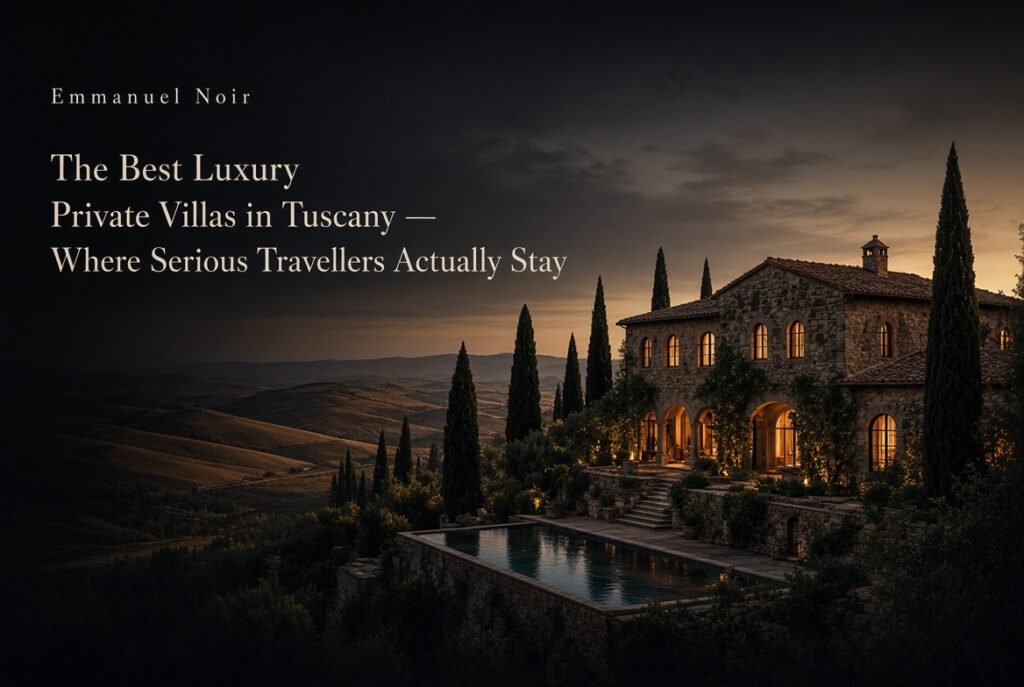
The best luxury private villas Tuscany offers do not need to announce themselves. The landscape does the work: cypress-lined roads disappearing over ochre hills, stone farmhouses softened by centuries of weather, vineyards running toward distant medieval towers, and long afternoons in which lunch seems to have no reason to end. For affluent travellers, however, the question is no longer simply where to visit. It is where to stay when privacy, architecture, service and a genuine sense of place matter more than a famous hotel address.
That is where these exceptional private residences begin to separate themselves from ordinary holiday rentals. The finest properties are not merely large houses with swimming pools. They are carefully positioned estates, restored historic residences and professionally managed retreats where architecture, landscape, hospitality and discretion operate as one experience. For a broader view of the destination, our Luxury Travel collection provides the wider Emmanuel Noir perspective on exceptional journeys.
This guide approaches Tuscany from the perspective of the serious traveller rather than the casual villa browser. The emphasis is on location, privacy, architectural character, service, access, atmosphere and the practical details that determine whether a beautiful property actually feels exceptional once the photographs have disappeared and the stay begins.
What Serious Travellers Should Look For
Tuscany rewards this level of scrutiny. The region contains several distinct experiences: the Renaissance gravity of Florence, the vineyard country of Chianti, the historic atmosphere around Siena, the celebrated landscapes of Val d’Orcia and the quieter northern territories near Lucca and Pisa. Each creates a different proposition for a private villa.
The official tourism authority describes Val d’Orcia as a landscape of hills, vineyards, olive groves, cypress trees, villages and historic monuments, with the area recognised as a UNESCO World Heritage cultural landscape. That distinction matters because the view from a villa is not decorative background. In Tuscany, the landscape is part of the property.
For travellers unfamiliar with the mechanics of villa selection, Emmanuel Noir’s guide to booking a luxury private villa holiday provides the practical foundation for evaluating staffing, privacy, management, cancellation terms and what is genuinely included in the rate.
The distinction is important. A Tuscan villa can be visually extraordinary and operationally mediocre. Conversely, a less theatrical property can become unforgettable because its staff understand discretion, its kitchen works beautifully, the beds are exceptional, the pool is maintained without intrusion, and every arrival has been anticipated.
This is therefore not a list ranked by the number of bedrooms or the size of the swimming pool. It is an editorial selection framework for identifying the properties and locations that deserve serious consideration when the objective is a private Tuscan stay with substance.
Quick Reference: Best Luxury Private Villas in Tuscany
| Villa / Estate | Best For | Location Character | Standout Quality | Ideal Traveller |
|---|---|---|---|---|
| Villa Mangiacane | Exclusive-use estate stays | Chianti, near Florence | Historic architecture, privacy, pools and service | Families, groups, celebrations |
| Villa La Massa Residences | Florence with private-residence character | Arno / Florence hills | Independent villas with hotel-level service | Couples, families, culture-led travellers |
| Borgo Santo Pietro private villas & suites | Wellness, gastronomy and countryside | Near Siena | Estate setting, gardens, farm-to-table hospitality | Couples, families, wellness travellers |
| Villa Monticelli | Val d’Orcia landscape | Sarteano | Private pool, views and countryside setting | Families and groups seeking seclusion |
| Carefully selected Tuscan villa rentals | Flexibility and variety | Chianti, Val d’Orcia, Florence hinterland and beyond | Choice of size, staffing and location | Experienced independent travellers |
The shortlist deliberately includes different forms of private-villa living. Some properties are standalone residences; others are estates offering villa accommodation within a larger hospitality operation. That distinction should never be hidden. A private villa with hotel-level infrastructure is a fundamentally different proposition from a completely independent farmhouse.
Key Specifications: What Defines a Serious Tuscan Villa
The first specification is location. Not simply “Tuscany”, but the precise landscape outside the gate.
A villa in the Chianti hills creates a different journey from one in Val d’Orcia. A residence near Florence makes Renaissance art and restaurants easier to reach. A remote estate south of Siena may offer greater tranquillity but demand more driving. The correct choice depends on whether the villa itself is the destination or a private base from which the region will be explored.
The second specification is privacy. Serious travellers should ask whether the property is genuinely private, whether neighbouring buildings overlook the gardens, whether staff circulation is discreet and whether the pool and outdoor dining areas belong exclusively to the booking.
The third is service. “Concierge” can mean anything from a responsive local contact to a fully staffed hospitality operation with chefs, housekeeping, drivers and itinerary planning. Those are not equivalent experiences.
The fourth is architectural integrity. Tuscany is particularly rewarding when the building belongs to the landscape rather than merely sitting inside it. Stone, terracotta, timber, frescoes, aged plaster, gardens and traditional proportions often create more enduring atmosphere than a newly built residence filled with fashionable furniture.
The fifth is operational reliability. Air conditioning, pool maintenance, Wi-Fi, kitchen equipment, hot water, security, housekeeping and transportation arrangements may sound mundane. In practice, they determine whether the villa feels effortless.
Historical Background: Why Tuscany Became a Villa Destination
The Tuscan villa has a deeper history than the modern luxury-rental market.
The region’s landscape was shaped by centuries of agriculture, aristocratic estates, religious institutions, merchant wealth and Renaissance patronage. Around Florence, the Medici villas remain among the clearest architectural expressions of that relationship between wealth, land and cultural life. Tuscany’s official tourism authority identifies twelve Medici Villas and two gardens as UNESCO World Heritage properties.
The modern private villa evolved from this older tradition. Historic residences and agricultural estates were gradually restored for contemporary use, while newer properties adopted the visual language of Tuscan architecture. The strongest examples do not attempt to recreate history theatrically. They preserve the qualities that made the original buildings compelling while adding modern infrastructure discreetly.
That is why the best luxury private villas Tuscany offers often feel less like conventional holiday accommodation and more like temporary ownership of a particular way of life.
You wake beneath old timber beams. Breakfast arrives in a garden. A driver collects you for a winery appointment. Dinner takes place beneath a pergola. The following morning is deliberately unscheduled.
The luxury lies in the absence of friction.
Tuscany by Region: Where Should You Actually Stay?
Chianti: The Best Balance of Wine, Landscape and Access
Chianti is perhaps the most versatile choice for a first serious Tuscan villa stay.
The countryside provides the visual language most travellers associate with Tuscany while remaining relatively practical for exploring Florence, Siena and the region’s celebrated wine estates. For travellers who want countryside seclusion without sacrificing access to culture, Chianti is difficult to beat.
Villa Mangiacane is one of the more distinctive examples. Located in the Chianti region near Florence, the estate includes two independent residences — Palazzo Machiavelli and Villa Mazzei — with extensive gardens, two outdoor pools and private areas. Its official site also highlights concierge services, daily housekeeping, a private spa and a gym.
That combination is significant. Villa Mangiacane is not simply selling square footage. It offers the architecture of an historic Tuscan estate with the operational infrastructure expected from contemporary luxury hospitality.
Florence Hills: When Culture Matters as Much as Seclusion
For travellers who intend to divide their time between countryside and Florence, the hills immediately outside the city can be more intelligent than choosing a remote estate.
Villa La Massa demonstrates the model particularly well. Its estate contains independent villas and apartments among olive trees and cypresses, while guests retain access to the services of the larger property. The two principal villas include the 649-square-metre Villino and the 600-square-metre Casa Colonica, with the property describing both as private residences surrounded by the Tuscan landscape.
This is the kind of accommodation that works for travellers who want a private base without completely surrendering hotel infrastructure.
Florence remains close enough for museum mornings, serious shopping and late dinners, while the villa provides a quieter retreat at the end of the day.
Val d’Orcia: The Most Cinematic Choice
If the primary objective is the landscape itself, Val d’Orcia deserves serious attention.
South of Siena, the region’s rolling hills, cypress trees, vineyards, farmhouses and medieval settlements create the archetypal Tuscan panorama. Visit Tuscany confirms its UNESCO cultural-landscape status and identifies Pienza, Montalcino, San Quirico d’Orcia, Castiglione d’Orcia and Radicofani among its defining communities.
The trade-off is access. You are choosing atmosphere over convenience.
For a couple or family planning long lunches, winery visits, slow mornings and extended evenings at the property, that may be precisely the point.
Near Siena: The Estate Experience
The countryside around Siena offers some of Tuscany’s most compelling combinations of heritage, gastronomy and rural tranquillity.
Borgo Santo Pietro is particularly notable because its hospitality model extends beyond accommodation. The estate near Siena encompasses a historic villa, gardens, organic farming, vineyards, restaurants, cooking experiences and a spa. Its accommodation includes secluded garden and pool suites, while the property describes its central building as a 13th-century villa.
It is not the same proposition as renting an entirely independent country house. It is better understood as a private-residence experience supported by sophisticated estate hospitality.
For travellers who value food, wellness and service as highly as privacy, that distinction can be an advantage rather than a compromise.
The Standout Properties
1. Villa Mangiacane — For the Grand Tuscan Estate Experience
Villa Mangiacane is the strongest choice on this list for travellers who want the villa itself to become part of the story.
Its setting in Chianti places it within reach of Florence while maintaining the atmosphere of a rural estate. The property consists of Palazzo Machiavelli and Villa Mazzei, offering different scales of accommodation within the same historic environment. The estate also includes private spa facilities, pools, gardens and staff services.
The attraction is not simply historical architecture. It is the way the estate creates a complete environment.
A morning can begin with breakfast in the gardens, move into a private cultural itinerary in Florence, return for an afternoon beside the pool and end with dinner beneath the Renaissance loggia.
For multigenerational groups and milestone celebrations, that flexibility is difficult to replicate in a conventional hotel.
2. Villa La Massa — For Florence Without the Hotel Routine
Villa La Massa offers a more polished compromise between villa privacy and established hotel service.
Its independent villas sit among olive trees and cypresses outside Florence, with the estate offering in-house culinary experiences, wellness facilities and tailored services. The property traces its origins to the 13th century and became a luxury hotel in 1948.
For travellers who intend to spend meaningful time in Florence, the location is particularly attractive. You can retreat from the city without disconnecting from it.
The villa model is also useful for families or friends who want shared living space rather than adjoining hotel rooms.
3. Borgo Santo Pietro — For Gastronomy, Wellness and Rural Stillness
Borgo Santo Pietro is less about theatrical exclusivity and more about depth of experience.
The estate near Siena combines accommodation with a working agricultural environment, gardens, vineyards, restaurants, a cooking school and a holistic spa. Its rooms and suites include more secluded pool and garden options for travellers who want greater privacy without leaving the estate’s service infrastructure.
This makes it particularly compelling for couples and families who regard food and wellness as central elements of a Tuscan escape.
The property also illustrates an important point about villa travel: sometimes the best private residence is not the most isolated one. Access to an excellent kitchen, attentive staff, spa facilities and local expertise can create greater overall value than absolute solitude.
4. Villa Monticelli — For the Val d’Orcia Purist
Villa Monticelli in Sarteano represents a different idea of Tuscan luxury: space, privacy and landscape.
Current booking information describes the property as a luxury villa in the heart of Tuscany with a private pool, gym and panoramic views toward Val d’Orcia.
The attraction here is not proximity to a grand hotel ecosystem. It is the ability to inhabit the countryside on your own terms.
That makes properties of this kind particularly appealing to experienced villa travellers who understand that privacy sometimes means giving up immediate access to hotel amenities.
5. The Right Villa Rental — When Variety Beats Permanence
Not every traveller needs a named estate.
For some, the better strategy is to compare a carefully selected group of private villas according to dates, group size, staffing, pool privacy, location and cancellation terms. This approach can reveal exceptional residences that do not possess the brand recognition of the major estates.
For travellers who want to compare live availability rather than commit to one property immediately, Tuscany villa availability can be a practical starting point.
Design & Craftsmanship: What Makes a Tuscan Villa Exceptional?
A villa can be expensive without being beautiful.
That distinction becomes obvious in Tuscany because the region has such a strong architectural vocabulary. The finest residences usually feel rooted in their surroundings. Their materials appear to belong there. Their gardens frame rather than compete with the landscape. Their interiors acknowledge history without becoming theatrical replicas.
Stone is particularly important. So are timber ceilings, terracotta floors, aged plaster, handmade ceramics, antique furniture and natural textiles.
Yet authenticity does not mean discomfort.
The modern luxury villa should provide excellent bathrooms, climate control, reliable internet, sophisticated kitchens, quality mattresses and discreet technology. The achievement lies in integrating those necessities without allowing them to dominate the visual identity.
Villa La Massa offers a particularly clear example of this balance. Its residences combine traditional Tuscan materials with contemporary comforts, while its independent villas are designed around privacy and generous space.
The same principle applies outdoors.
A swimming pool should feel positioned within the landscape rather than dropped into it. Dining terraces should take advantage of the light. Gardens should provide both visual beauty and usable privacy.
At the highest level, architecture becomes choreography.
The arrival is quiet. The entrance conceals the view. The first major room opens toward the countryside. A terrace draws you outside. A pool creates another axis. At sunset, the landscape becomes the final piece of the architecture.
That is craftsmanship in spatial form.
Performance & Ownership Experience: The Luxury You Notice Least
The most important test of a private villa begins after check-in.
Does the air conditioning work?
Does breakfast arrive when requested?
Is the pool perfectly maintained?
Can the concierge secure a table at the restaurant you actually wanted?
Does housekeeping enter without disrupting your privacy?
Can the villa arrange a driver when plans change?
Does someone respond when the wine fridge stops cooling?
These questions may sound operational rather than glamorous. They are, in fact, the foundation of luxury hospitality.
Emmanuel Noir’s earlier research on villa booking makes the same distinction: staffing, maintenance, communication, included services and booking flexibility can determine the real quality of a villa experience far more reliably than photography alone.
For travellers who want to understand the complete planning process, our luxury holiday planning guide examines destination selection, budgeting, timing, transfers and the broader architecture of a well-designed trip.
The best villas therefore operate almost invisibly.
You should not spend your holiday managing the villa.
Someone else should be managing it.
Market Position & Competition: Villa, Hotel or Private Estate?
The private villa competes with more than other villas.
It competes with the five-star hotel, the boutique country house, the private estate and, increasingly, the serviced residence.
A hotel remains superior for travellers who value multiple restaurants, a full spa, daily social energy and predictable service. A villa becomes stronger when privacy, space and flexible schedules dominate.
The choice also changes according to group size.
For two people, an exceptional suite can be more rational than renting a ten-bedroom estate.
For three generations travelling together, the calculation can reverse completely. Separate bedrooms, shared living areas, a private pool and flexible dining can create a far more coherent experience than occupying multiple hotel rooms.
This is why the phrase “best luxury private villas Tuscany” cannot have one universal answer.
The best property is determined by the life you intend to live there.
Buying Considerations: How to Choose the Right Tuscan Villa
The first question is not how much the villa costs.
It is how you intend to use it.
1. Decide Whether the Villa Is the Destination
If the villa itself is the centrepiece of the trip, prioritise architecture, grounds, privacy, pool design, dining and service.
If the property is primarily a base for exploring Florence, Siena, wineries and restaurants, accessibility becomes more important.
This distinction alone can eliminate half the wrong properties.
2. Calculate the Real Group Size
A villa advertised for twelve people is not necessarily comfortable for twelve adults.
Examine bedroom configuration, bathrooms, dining capacity, indoor living space and outdoor seating. Privacy between bedrooms can also matter greatly when several couples or generations travel together.
3. Establish the Service Model
Ask explicitly:
- Is housekeeping daily?
- Is breakfast included?
- Is there a private chef?
- Is the chef included or charged separately?
- Is concierge service available?
- Can private drivers be arranged?
- Who handles maintenance?
- Is pool heating included?
- Are groceries stocked before arrival?
Never assume.
4. Study the Micro-Location
A villa described as “near Florence” can mean very different things.
Likewise, “in Chianti” does not reveal whether the property sits beside a main road, down a narrow lane or on an isolated estate.
Study driving times rather than straight-line distances.
5. Examine Privacy Before Aesthetics
The greatest luxury in Tuscany may be the view you cannot see from the neighbouring property.
Look for private entrances, substantial grounds, screened terraces, independent pools and separation from other accommodation.
6. Think About Seasonality
Summer is the obvious choice, but it is not the only compelling period.
Late spring can bring cooler temperatures and fresh landscapes. September combines warmth with a more settled rhythm. Autumn brings harvest season, changing light and a different culinary atmosphere.
The villa should be judged against the season in which you actually intend to use it.
7. Compare the Total Experience, Not the Nightly Rate
A cheaper villa may become expensive if it requires private transport for every meal and excursion.
A more expensive estate may prove better value if it includes breakfast, concierge support, wellness facilities, housekeeping and easier access to experiences.
Price is a data point.
It is not the experience.
Where to Book: Direct, Specialist or Luxury Booking Platform?
There is no universal winner.
Direct booking can provide the clearest communication with the property and may offer specific benefits or flexibility. Specialist agencies can provide additional vetting and destination expertise. Large booking platforms can provide useful market visibility and availability comparisons.
For readers seeking a curated luxury accommodation marketplace rather than a broad inventory search, luxury villa stays through Mr & Mrs Smith can be another useful comparison point.
The key is to compare like with like. A professionally managed estate, an independent farmhouse and a serviced hotel villa may all appear under the word “villa”, yet the actual experience can be radically different.
Comparison Table: The Best Luxury Private Villas Tuscany Travellers Should Consider
| Property / Model | Privacy | Service | Architecture | Best For | Main Trade-Off |
|---|---|---|---|---|---|
| Villa Mangiacane | Excellent | Excellent | Exceptional historic character | Groups, families, celebrations | Less remote than southern Tuscany |
| Villa La Massa residences | Excellent | Excellent | Historic Florentine elegance | Florence + countryside | More connected to the city |
| Borgo Santo Pietro | Very high | Exceptional | Historic estate character | Wellness, gastronomy, couples | Estate hospitality rather than total isolation |
| Villa Monticelli | Excellent | More independent | Tuscan rural character | Val d’Orcia, families, groups | Less hotel-style infrastructure |
| Independent villa rental | Variable | Variable | Highly variable | Experienced travellers | Due diligence required |
Pros & Cons
Pros
Privacy. Your group controls the environment.
Space. Living rooms, gardens, pools and dining areas create a residential experience that hotel rooms rarely reproduce.
Flexibility. Meals, excursions and daily rhythms can be shaped around the travellers rather than hotel schedules.
Architecture. Tuscany offers access to historic estates and landscapes that form part of the experience themselves.
Multigenerational appeal. Villas can bring families together without forcing everyone into identical rooms or rigid schedules.
Local immersion. The best properties provide access to wine, food, crafts, villages and cultural experiences beyond the conventional tourist circuit.
Cons
Operational variability. Not every villa delivers professional hospitality.
Transport dependence. Rural properties can require a car or private driver.
Seasonality. Some villas are at their best during specific periods of the year.
Hidden costs. Heating, pool services, chef fees, groceries, transfers and cleaning can sometimes sit outside the headline rate.
Less spontaneous service. A completely private villa may not have a restaurant, spa or concierge desk a few steps away.
Due diligence. The more independent the property, the more responsibility falls on the traveller to verify the details.
Who Should Choose a Luxury Private Villa in Tuscany?
A private villa is particularly well suited to travellers who:
- value privacy over social atmosphere;
- travel with family or friends;
- intend to stay for a week or longer;
- want flexible dining;
- appreciate architecture and landscape;
- plan wine and culinary experiences;
- prefer a residential environment to a conventional hotel;
- want the property itself to become part of the journey.
It is also ideal for milestone occasions.
A significant birthday, anniversary, family reunion or intimate celebration can feel far more personal in a private estate than inside a conventional resort.
Who Should Skip It?
A private villa may not be the right choice for travellers who:
- want a walkable city centre;
- prefer several restaurants within the property;
- require extensive daily spa and fitness facilities;
- dislike driving or arranging transfers;
- travel for only two or three nights;
- prefer the predictability of a large international hotel;
- do not want to think about property logistics.
There is no virtue in choosing a villa simply because it sounds more exclusive.
The correct luxury choice is the one that removes friction from your particular journey.
A Note on Luxury Property Ownership
There is a natural temptation to move from renting a Tuscan villa to considering ownership.
That decision deserves an entirely different level of analysis. A second home introduces taxes, maintenance, insurance, staffing, property management, liquidity and succession considerations that do not exist when you simply arrive, enjoy the property and leave.
For readers considering that transition, Emmanuel Noir’s luxury second home ownership guide examines when ownership genuinely makes sense and when sophisticated travellers may be better served by continuing to rent exceptional residences.
The same discipline applies if the property is being considered partly as an investment. Our luxury real estate investment guide examines scarcity, micro-location, operating costs, liquidity and the difference between buying a beautiful property and buying a sound asset.
A Tuscan villa can be an extraordinary lifestyle asset. That does not automatically make it an extraordinary investment.
Keep those two ideas separate.
Frequently Asked Questions About the Best Luxury Private Villas in Tuscany
What is the best area of Tuscany for a private villa?
It depends on the purpose of the trip. Chianti offers one of the strongest combinations of countryside, wine and access to Florence and Siena. Val d’Orcia is the stronger choice for landscape and seclusion. The Florence hills suit travellers who want countryside privacy while remaining close to the city.
How far in advance should I book a luxury villa in Tuscany?
For peak summer travel and highly sought-after estates, six to twelve months is a sensible planning horizon. Shoulder-season travel can offer greater flexibility, but the most distinctive properties can still book well ahead.
Are luxury villas in Tuscany suitable for families?
Yes. In fact, families are among the strongest candidates for private villas because shared living spaces, multiple bedrooms, private pools and flexible dining can work exceptionally well for multigenerational travel.
Is it better to stay near Florence or deeper in the countryside?
Choose Florence’s outskirts if culture, shopping and restaurants are central to the itinerary. Choose deeper countryside if the villa, landscape, food and slow travel are the primary purpose.
What should I ask before booking a private villa?
Confirm the exact bedroom configuration, staffing, housekeeping, chef arrangements, pool operation, heating or air conditioning, cancellation policy, security deposit, taxes, transport options and what is included in the published price.
Are Tuscan villas better than luxury hotels?
Not universally. Villas are stronger for privacy, space and flexibility. Hotels are stronger for extensive facilities, multiple dining venues and predictable service. The right choice depends on how you intend to travel.
What is the most important factor when choosing a Tuscan villa?
Location.
A beautiful interior can be changed. A disappointing setting cannot. The landscape, privacy, access and surrounding environment should therefore be evaluated before decorative details.
Conclusion: The Villa Should Become Part of the Journey
The best luxury private villas Tuscany offers are not defined by marble bathrooms, oversized swimming pools or a dramatic nightly rate.
They are defined by coherence.
The architecture belongs to the landscape. The landscape belongs to the journey. The service is present without becoming intrusive. The kitchen makes local food feel personal. The pool feels private. The bedrooms become quiet retreats. The surrounding countryside gives every day its own rhythm.
That is why properties such as Villa Mangiacane, Villa La Massa and Borgo Santo Pietro deserve attention. They understand that luxury accommodation is not simply a larger version of a hotel room.
It is an environment.
And Tuscany is one of the few destinations where the environment itself carries centuries of cultural weight.
The serious traveller should therefore resist the temptation to choose the most photographed villa.
Choose the one whose location, architecture, privacy and service fit the way you actually want to spend your days.
Because in Tuscany, the finest luxury is rarely the thing that announces itself first.
It is the feeling that everything was exactly where it needed to be.
Emmanuel Noir Verdict
The best luxury private villas Tuscany offers should be judged as complete experiences rather than accommodation products.
For grand historic atmosphere and group travel, Villa Mangiacane stands out.
For Florence access combined with private-residence character, Villa La Massa is exceptionally compelling.
For gastronomy, wellness and estate hospitality, Borgo Santo Pietro offers a particularly deep experience.
For travellers who want the landscape above all else, the Val d’Orcia remains difficult to surpass.
Our verdict is simple:
Choose the landscape first.
Choose the architecture second.
Choose the service model third.
Then examine the price.
A truly exceptional Tuscan villa should make you forget you are booking accommodation.
It should feel as though you have temporarily stepped into another life.
“The finest places do not simply accommodate a journey. They become part of the memory of having lived it.”
— Emmanuel Noir
Affiliate Disclosure
This article contains affiliate links. Emmanuel Noir may earn a commission from qualifying purchases or bookings made through certain links, at no additional cost to the reader. Editorial selection remains independent, and affiliate relationships do not determine our recommendations.