
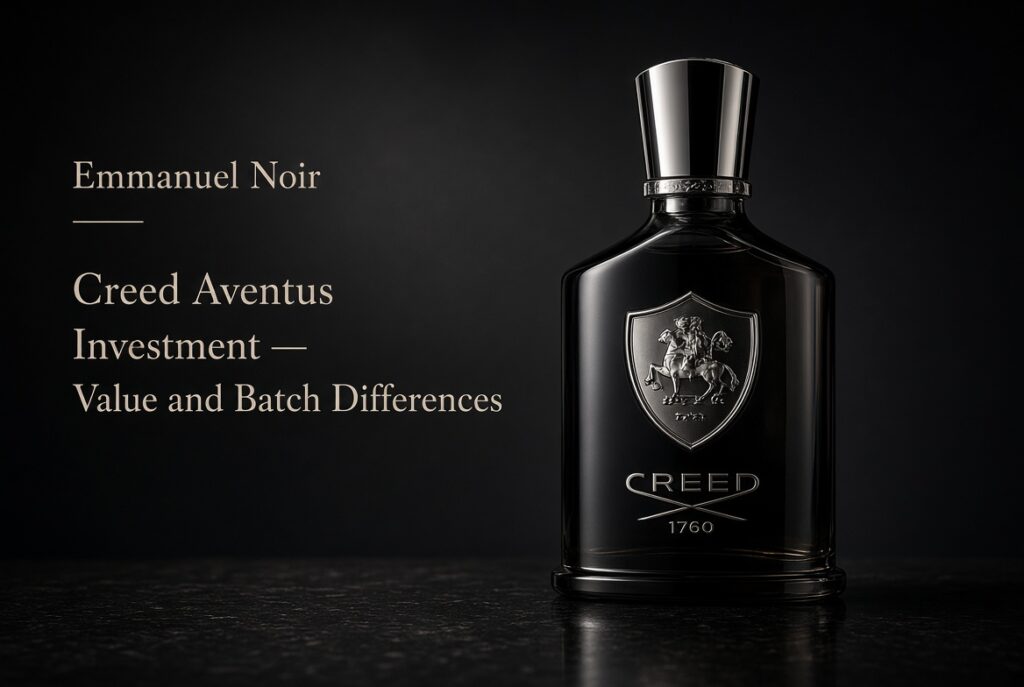
There are fragrances that become popular, fragrances that become signatures, and then there are fragrances that become objects of pursuit. Creed Aventus belongs to the third category. Since its launch in 2010, it has developed an unusually persistent mythology around its composition, production batches, performance and scarcity. That mythology has helped create a secondary market in which the batch number on a bottle can influence what collectors are willing to pay. For anyone researching creed aventus investment, that distinction is where the story begins.
A bottle of perfume is not a conventional financial asset. Most fragrances lose value once opened, and retail pricing does not guarantee secondary-market recovery. Yet Aventus occupies an unusual position because collectors do not always value every bottle equally. Production period, batch code, packaging, condition, provenance and perceived olfactory character can all influence desirability.
Why Aventus Became a Collectible
The result is a fragrance market with its own vocabulary: vintage Aventus, modern Aventus, batch hunting, bottle provenance and secondary-market premiums. Some distinctions are grounded in observable differences between bottles; others remain matters of enthusiast interpretation. Understanding that boundary is essential.
For Emmanuel Noir readers exploring the wider world of Luxury Fashion, fragrance belongs in the same conversation as watches, jewellery, tailoring and collectible accessories: not because every purchase appreciates, but because certain objects acquire meaning, scarcity and cultural recognition beyond their original retail function.
Aventus is therefore best understood not as a guaranteed financial investment, but as a case study in how a luxury product can develop an independent market after leaving the boutique. A recognisable creation, a large enthusiast base, perceived variations between production periods and a finite supply of older bottles can create a collector hierarchy that the original retail shelf never intended to establish.
That distinction defines this guide. The objective is not to promise appreciation. It is to explain why some Aventus bottles command attention, why batch differences matter to collectors, how the secondary market treats them, and where the boundary lies between genuine collectible value and fragrance folklore.
Quick Reference: Creed Aventus Investment
| Attribute | Details |
|---|---|
| Fragrance | Creed Aventus |
| House | Creed |
| Category | Eau de Parfum |
| Original launch | 2010 |
| House heritage | Creed traces its origins to 1760 |
| Signature profile | Pineapple, bergamot, apple, blackcurrant, birch, jasmine, oakmoss, vanilla and ambergris |
| Collector focus | Batch code, production period, condition, provenance and perceived olfactory character |
| Secondary-market principle | Older and particularly sought-after bottles can trade differently from current-production bottles |
| Investment status | Collectible luxury fragrance, not a conventional financial asset |
| Primary risk | Paying a rarity premium without independently establishing authenticity, condition and market demand |
Creed’s official Aventus materials identify the fragrance as having launched in 2010 and describe its profile around pineapple, bergamot, apple, blackcurrant, birch, jasmine, oakmoss, vanilla and ambergris. The Maison also states that Aventus is produced using its Millésime process, with ingredients hand-weighed, macerated and matured in its facilities in France.
Key Specifications: What Makes Aventus Collectible?
Aventus is often discussed as though the bottle itself were the entire object of value. It is not.
For collectors, the more interesting object is the combination of fragrance, production history and provenance. A 100 ml bottle with a known production code, original presentation, high remaining fill level and credible purchase history is a different proposition from an anonymous partial bottle being offered without documentation.
The batch code is particularly important because Aventus enthusiasts have spent years cataloguing differences between production runs. Community discussions identify recurring variations in the balance between pineapple, smoke, woods, moss, sweetness and perceived longevity. Those observations are extensive, but they should be treated as enthusiast evidence rather than an official Creed grading system. Basenotes’ long-running Aventus guide, for example, documents substantial community discussion of batch-to-batch variation while also stressing the subjective nature of determining whether one batch is “better” than another.
This is the first principle of the Creed Aventus investment thesis:
The market does not necessarily value every Aventus bottle equally simply because every bottle carries the same name.
The House of Creed: A Heritage Built Before Aventus
The story begins long before Aventus.
Creed traces its origins to 1760, when James Henry Creed established the House on Conduit Street in London. According to the Maison’s own heritage account, Creed initially built its reputation as a tailoring house serving British royalty and aristocracy before its identity evolved toward fragrance and French haute perfumery.
That history matters because Aventus was not introduced into an empty cultural space. It inherited a house narrative built around tailoring, bespoke creation and craftsmanship.
The transformation from tailoring to fragrance also gives Creed an unusually useful luxury vocabulary. The House describes its approach through the language of materials, technique, handwork and savoir-faire. Its current heritage presentation continues to emphasise seven generations of craftsmanship and the Art of Millésime.
For a collector, provenance begins with the house itself. A fragrance can become collectible because of scarcity, but scarcity becomes considerably more meaningful when the object belongs to a recognisable and historically established luxury house.
Aventus Arrives in 2010
Aventus entered the market in 2010 and quickly developed an identity that was unusually easy to recognise.
Creed’s official description presents Aventus as a contemporary fragrance built around a combination of fruit, citrus, woods and aromatic depth. The Maison identifies pineapple, bergamot and apple among its opening notes, followed by birch and jasmine, with oakmoss, vanilla and ambergris in the base.
That structure helped create the fragrance’s most important commercial asset: recognisability.
Aventus could be discussed in the language of luxury perfumery, but it could also be recognised by enthusiasts through a handful of distinctive associations. Pineapple became inseparable from the conversation. So did smoke, birch, projection and the elusive question of which production batch a wearer had encountered.
This is where the secondary-market story begins.
A fragrance does not need to be officially limited to become scarce in a collector’s mind. Once consumers begin attaching different characteristics to different production periods, bottles cease to be interchangeable.
The name remains Aventus.
The collector question becomes:
Which Aventus?
The Aventus Batch Code Became Part of the Product
Most luxury consumers buy fragrance by house, name, size and concentration.
Aventus collectors often go further.
They look at the code.
That small identifier, normally found on the packaging and bottle, became one of the most discussed pieces of information in the Aventus community. Enthusiast forums developed extensive records of production codes and subjective impressions, allowing collectors to compare bottles from different years and production runs. Basenotes’ Aventus guide describes the way enthusiasts use the code to identify production periods and compare the character of different batches.
This created an unusual phenomenon.
The production code stopped being merely a manufacturing reference and became part of the market language.
A collector could ask whether a bottle was from an earlier production period. A seller could identify the code in a listing. A buyer could search specifically for a production run associated with a particular olfactory profile.
In other words, the bottle acquired metadata.
That is an important distinction when analysing Creed Aventus investment. The collectible proposition is not simply “old perfume equals valuable perfume.” Instead, value can emerge when a production identifier becomes meaningful to a sufficiently large community of buyers.
Batch Differences: What Collectors Actually Mean
The phrase batch difference is frequently used as though it describes an officially documented sequence of Creed formulas.
The reality is more nuanced.
Creed itself emphasises batch selection, natural ingredients and its Art of Millésime process. Its official Aventus material states that batches are hand-mixed, macerated and matured at the House’s facilities in Ury, France. The Maison presents this process as part of the fragrance’s craftsmanship and consistency.
Collectors, however, report that Aventus bottles from different periods can smell noticeably different.
Long-running fragrance communities have described differences involving pineapple intensity, smokiness, woods, moss, sweetness and perceived performance. Some enthusiasts associate earlier bottles with greater smoke or depth, while other batches are described as fruitier, brighter or more linear. These are useful observations for understanding collector behaviour, but they remain community assessments rather than an official Creed hierarchy of superior and inferior batches.
That distinction matters enormously.
A collector can reasonably say:
“This batch has a reputation for a smokier profile.”
It is much harder to establish as fact:
“This batch is objectively better.”
The first statement describes a market perception.
The second makes a universal quality judgment.
For an investment-oriented buyer, the difference between those two claims can be worth hundreds of dollars.
The Vintage Aventus Question
Within fragrance circles, vintage Aventus has become a powerful phrase.
It generally refers to older production, particularly bottles from the early years of the fragrance. The precise boundaries vary between enthusiasts, and the term does not represent a single official Creed classification.
What makes early Aventus interesting is not merely age.
It is the combination of age, scarcity and collective memory.
A bottle produced in the early 2010s cannot simply be replaced by purchasing the current bottle from a Creed boutique. Even when two bottles share the Aventus name, collectors may perceive differences in their composition, development or performance.
That creates a classic collector dynamic:
The past becomes an object that the present cannot reproduce perfectly in the marketplace.
Whether those differences arose from ingredient availability, natural variation, regulatory changes, formula adjustments, maturation, production methods or a combination of factors is a more complicated question than the secondary market sometimes suggests.
A responsible collector therefore treats “vintage” as a market category rather than a guarantee of superiority.
The Regulatory Factor Behind Formula Discussions
One reason Aventus batch conversations are difficult to simplify is that fragrance formulas exist within a changing regulatory environment.
The fragrance community has long discussed the effect of International Fragrance Association restrictions and ingredient changes on Aventus, particularly around the character of smoke and performance. Basenotes’ detailed Aventus guide describes community interpretations of formula changes around the early 2010s and later production periods. Those accounts are useful historical evidence of what enthusiasts believe they experienced, but they should not be confused with a complete official Creed formulation history.
This is why the language surrounding batch differences must remain disciplined.
There is a meaningful distinction between:
documented regulatory change
and
collector-perceived olfactory change.
There is also a third category:
secondary-market mythology.
Aventus sits at the intersection of all three.
That intersection is one of the reasons it became collectible.
A Fragrance That Developed Its Own Market
Most perfume resale is brutally simple.
The bottle is opened. Some liquid disappears. The buyer loses interest. The seller accepts a discount.
Aventus introduced another possibility.
A buyer could search for a specific production period rather than simply the lowest price.
That changes the economics.
Current-production Aventus is available directly from Creed. Older bottles are not. A current bottle therefore competes with the boutique, while an older bottle competes primarily with other collectors.
The distinction is fundamental.
A current bottle has a retail anchor.
A sought-after older bottle can have a collector anchor.
The two prices may diverge.
Current secondary-market data illustrates the scale of Aventus’ activity. ScentLedger’s September 2026 Creed database lists Aventus as its most-traded Creed fragrance, with 511 verified listings and a median resale figure of approximately $200 across the tracked dataset. That figure is a market reference, not a guaranteed valuation for any particular bottle, and it aggregates bottles with different conditions, fills, production periods and provenance.
That distinction is crucial.
A median tells us that a market exists.
It does not tell us that every bottle belongs to the same market segment.
Why Aventus Can Behave Differently From Ordinary Fragrance
Aventus possesses several characteristics that can reinforce collector behaviour.
First, it has a long production history relative to its modern cult status.
Second, the fragrance has a large enthusiast community capable of identifying and discussing individual production codes.
Third, older bottles cannot simply be reordered from Creed.
Fourth, the House continues to sell current Aventus, creating a direct reference point against which older bottles can be compared.
Finally, the fragrance’s reputation is strong enough that buyers actively search for particular versions rather than merely searching for the cheapest bottle.
Those factors create the architecture of a secondary market.
They do not guarantee appreciation.
But they explain why a fragrance can become collectible in the first place.
Creed Aventus After the Kering Era
The ownership history of Creed adds another layer to the collector conversation.
On March 31, 2026, L’Oréal announced that it had completed its acquisition of Kering Beauté, including the House of Creed. The transaction places Creed within L’Oréal’s portfolio while the House continues to operate as a luxury fragrance brand.
For collectors, ownership transitions can become part of provenance discussions, but it is too early to assume that the 2026 change automatically creates a collectible premium for pre-transition bottles.
The sensible approach is to document the transition without manufacturing scarcity around it.
A bottle does not become valuable merely because ownership changed.
Its value still depends on what buyers actually want.
The Collector’s First Rule
The first rule of Aventus collecting is simple:
Never buy the story before you buy the evidence.
A seller may describe a bottle as rare, vintage, smoky, powerful, discontinued or belonging to a legendary batch.
Those descriptions can be useful.
They are not proof.
The collector should instead establish:
- the exact batch or lot identification
- whether the bottle and packaging correspond
- remaining fill level
- physical condition
- provenance
- authenticity
- production period
- current market references
- whether the alleged batch premium is actually visible in completed sales
This is where Creed Aventus investment becomes a discipline rather than a romantic idea.
The collector is not merely buying perfume.
The collector is buying an object whose market value depends on evidence, reputation and demand.
And once those three forces meet, the red-hot question is no longer simply what Aventus smells like.
It is which Aventus the market is willing to pay for.
Design & Craftsmanship: Why Aventus Is More Than a Bottle
The investment conversation around Aventus becomes shallow when it focuses only on batch codes.
Before a bottle becomes collectible, it must first be desirable.
That desirability begins with the fragrance itself: the composition, the materials, the presentation, the reputation of the House and the ritual surrounding ownership. Aventus has succeeded because it operates simultaneously as perfume and cultural object. The bottle is recognisable, the name is established and the fragrance has generated a vocabulary of its own among enthusiasts.
Creed’s official presentation of Aventus places particular emphasis on its Millésime approach, describing a process in which ingredients are carefully weighed, combined and matured before the fragrance reaches the bottle. That craftsmanship narrative matters because collectible value rarely develops around an object whose identity is entirely detached from its physical creation. (creedfragrance.com)
The Millésime Philosophy
Creed uses the term Millésime to describe an approach associated with careful ingredient selection, maturation and production.
The concept has an obvious resonance with collectors.
In wine, vintage matters because a year can represent a particular combination of climate, harvest and production conditions. In fragrance, the analogy is less literal. A perfume is not wine, and a batch code should not automatically be interpreted as a vintage classification.
Yet the vocabulary is revealing.
When a fragrance house places emphasis on production, maturation and materials, collectors naturally become more interested in the circumstances surrounding individual bottles.
Creed’s own description of its Millésime process states that each batch is hand-weighed, macerated and matured at its facilities in Ury, France. The Maison also describes Aventus as being crafted in France. (creedfragrance.com)
That does not prove that every batch smells dramatically different.
It does, however, explain why the idea of production history can carry weight within the Creed collector community.
Materials and the Aventus Signature
Aventus is built around contrast.
The official composition combines bright fruit and citrus with darker woods and moss. Pineapple, bergamot and apple create the opening impression, while birch contributes the smoky association for which many enthusiasts know the fragrance. Jasmine sits within the heart, while oakmoss, vanilla and ambergris are listed among the base notes. (creedfragrance.com)
That architecture is important to the secondary market because recognisability is one of the foundations of collectibility.
A collector cannot create a premium merely by declaring an anonymous bottle rare.
There must be something the market already understands.
Aventus has that recognition.
Its name communicates a particular olfactory territory before the bottle is even opened. The pineapple association, the smoky facet, the masculine-leaning reputation and the House identity all contribute to an object that can be discussed without requiring the buyer to smell it first.
That is a powerful characteristic in any collectible category.
The Bottle as a Luxury Object
Aventus is not presented like an experimental niche fragrance whose packaging is designed to disappear behind the composition.
The bottle is part of the identity.
Its dark glass, metallic detailing, shield-shaped presentation and equestrian imagery establish a visual language consistent with Creed’s broader heritage narrative.
For an ordinary fragrance buyer, packaging primarily performs a practical function.
For a collector, packaging becomes part of provenance.
The original box, label condition, cap, fill level and presentation can all affect how confidently another buyer can assess a bottle. Once a fragrance enters the secondary market, those details stop being cosmetic.
They become evidence.
This is one reason unopened bottles command a different psychological position from heavily used bottles, even when both contain the same fragrance.
Performance & Ownership: Where the Investment Thesis Becomes Complicated
Performance is one of the most debated subjects in Aventus collecting.
Collectors frequently discuss projection, longevity, opening character, dry-down and how long the fragrance remains perceptible on skin and clothing. Those observations can influence the desirability of a batch, but performance is particularly vulnerable to subjective perception.
Skin chemistry matters.
Application matters.
Storage matters.
Climate matters.
Even the wearer’s expectations matter.
Consequently, performance should never be treated as a simple numerical specification.
A bottle described online as “beast mode” may perform differently on another person’s skin. A supposedly weak batch may perform adequately in a colder climate. A fragrance that appears to disappear quickly from the wearer may remain noticeable to people nearby.
The secondary market therefore rewards reputation, but a sophisticated buyer should still test the actual fragrance whenever possible.
Why Storage Matters
Perfume is not an indestructible collectible.
Heat, light, oxygen and poor storage conditions can affect fragrance over time. A bottle that has been stored for years in a cool, dark environment is not necessarily equivalent to a bottle that has spent those same years on a sunny bathroom shelf.
That matters even more when the buyer is paying a premium for an older Aventus bottle.
Age alone does not establish quality.
Condition does.
A collector should therefore ask where a bottle was stored, whether the cap and atomiser remain intact, how much liquid remains and whether the presentation has suffered damage.
For a sealed bottle, the packaging can provide another layer of evidence. For an opened bottle, the liquid level and physical condition become part of the valuation conversation.
The Batch-Code Premium
The most fascinating aspect of the Aventus market is that the batch code can influence the price before the fragrance has been smelled.
This is unusual.
In most consumer categories, a manufacturing code is invisible to the buyer’s valuation process. With Aventus, the code can become a search term.
A collector may have a preferred production period.
Another buyer may specifically seek a particular olfactory profile.
A third may simply want an older bottle because it represents an earlier chapter in the fragrance’s history.
The result is a form of micro-segmentation.
Instead of one Aventus market, there are several overlapping Aventus markets.
Current retail Aventus sits at one end.
Older bottles with documented provenance sit at another.
Within that older segment, certain production periods can attract disproportionate attention.
This is precisely why Creed Aventus investment should be analysed as a collector market rather than as a conventional investment product.
The Psychology of Batch Hunting
Batch hunting is not merely a search for an older date.
It is a search for a remembered experience.
Many collectors encounter Aventus through a particular bottle, perhaps purchased years earlier, and associate that bottle with a distinctive balance of fruit, smoke, woods and performance. When the bottle eventually runs low, the collector may attempt to reproduce the experience by finding the same production code or a nearby one.
The emotional logic is powerful.
The buyer is not simply purchasing 100 ml of perfume.
The buyer is attempting to recover a version of an experience.
That is one of the mechanisms through which secondary markets become detached from primary retail.
The boutique sells the product.
The collector market sells the history attached to the product.
When Rarity Becomes Valuable
Rarity alone is not enough.
A bottle can be extremely difficult to find and still have little meaningful demand.
The more important question is whether scarcity intersects with desire.
A rare Aventus batch becomes commercially interesting when enough collectors believe that the batch possesses a desirable characteristic. The market then has three components:
Scarcity + Recognition + Demand
Remove scarcity and the premium can disappear because buyers have alternatives.
Remove recognition and the buyer may not understand why the bottle matters.
Remove demand and rarity becomes an academic fact rather than a market force.
This is the central principle behind collectible fragrance.
The rarest bottle is not necessarily the most valuable.
The most valuable bottle is the one for which enough buyers are prepared to compete.
Market Position & Competition
Aventus occupies an unusual position within modern luxury fragrance.
It competes with established houses such as Tom Ford, Maison Francis Kurkdjian, Parfums de Marly and other niche and luxury fragrance brands.
But Aventus has a different kind of competitive advantage.
It has a mature enthusiast culture around the product itself.
A consumer can discuss a Tom Ford fragrance by name, a Maison Francis Kurkdjian fragrance by composition and a Parfums de Marly fragrance by house identity.
Aventus can be discussed by batch.
That single difference changes the collector conversation.
Aventus vs. Other Luxury Fragrances
| Characteristic | Creed Aventus | Other luxury fragrance releases |
|---|---|---|
| Collector language | Strong batch-code culture | Usually centred on edition, discontinuation or house |
| Production-period discussion | Particularly prominent | Varies substantially by brand |
| Secondary-market interest | Established enthusiast market | Highly variable |
| Recognition | Strong | Depends on house and fragrance |
| Vintage discussion | Significant | Stronger for some discontinued fragrances |
| Authentication importance | High | High across luxury fragrance |
| Investment suitability | Collector-oriented | Highly product-specific |
| Main value driver | Demand, provenance, production history and perceived character | Varies by fragrance, rarity, house and demand |
The comparison should not be read as a ranking.
A discontinued fragrance from another house can be considerably more scarce than Aventus. A limited edition can have clearer provenance. A historic perfume may have stronger archival significance.
Aventus’ distinction is that a large and active enthusiast culture has developed around the production history of a fragrance that remains in production.
That is unusual.
The Secondary Market Has Its Own Hierarchy
Once a bottle leaves authorised retail, the buyer begins evaluating more than the fragrance.
The hierarchy becomes:
Authenticity → Condition → Provenance → Production period → Demand
Each element answers a different question.
Authenticity asks:
Is this actually Creed Aventus?
Condition asks:
What state is the bottle in?
Provenance asks:
Where did it come from?
Production period asks:
When was it made?
Demand asks:
Does anyone actually want this particular bottle?
Only after those questions are answered does price become meaningful.
This is why a cheap bottle can be expensive in disguise.
If the provenance is weak, the batch cannot be established, the fill level is poor or the bottle is questionable, a low asking price may simply compensate for higher uncertainty.
Conversely, a premium price can be rational when the bottle has strong provenance, excellent condition and a production period that has demonstrable demand.
Authentication Is Part of the Investment Case
Luxury fragrance authentication is becoming more important as secondary-market prices rise.
The problem is straightforward: once buyers begin paying premiums for particular production periods, counterfeiters have an economic reason to imitate those bottles.
The collector therefore needs to understand more than batch lore.
Packaging details, bottle construction, labels, typography, cap fit, atomiser, box, production markings and seller provenance can all contribute to an authenticity assessment.
A batch code alone is not enough.
That principle is familiar in watch collecting, where authentication requires examining the complete object rather than relying on one serial number. Emmanuel Noir explores that broader discipline in its guide to authenticating pre-owned luxury watches, where provenance and physical inspection are treated as complementary parts of secondary-market diligence.
The same principle applies here: the code is evidence, not a complete authentication system.
The Importance of Provenance
Provenance is often underestimated in fragrance collecting because perfume appears more disposable than watches, jewellery or art.
The secondary market tells a different story.
A sealed bottle accompanied by its original presentation and credible purchase history is easier to evaluate than an opened bottle with no documentation. A collector who purchased a bottle directly from an authorised retailer can establish a stronger chain of ownership than someone selling an anonymous bottle acquired years earlier.
That does not mean provenance guarantees authenticity.
It means provenance reduces uncertainty.
And uncertainty has a price.
When two bottles appear similar but one has credible documentation and the other does not, the better-documented bottle can command greater confidence even before scent profile enters the discussion.
Why the Creed Aventus Investment Story Is Different From a Watch
The comparison with watches is useful but imperfect.
A Rolex or Patek Philippe has a mechanical movement, reference number, service history, case condition and often an extensive auction record.
A fragrance has none of those things.
Its liquid is consumed.
Its packaging can deteriorate.
Its scent can be experienced differently by different people.
And once the bottle is opened, the remaining quantity becomes a visible part of its value.
That creates a natural ceiling on the investment thesis.
Aventus can be collectible.
It can command a premium.
It can develop differentiated prices between production periods.
But it should not be treated as though it possesses the same market infrastructure as a major Swiss mechanical watch.
That distinction protects the collector from overcapitalising a fragrance purchase.
The Real Competition Is Time
The greatest threat to an Aventus collector is not necessarily another fragrance.
It is time.
Every opened bottle becomes smaller.
Every damaged box becomes less complete.
Every undocumented bottle becomes harder to authenticate.
Every enthusiast interpretation can change.
And every new production run can alter the reference point against which older bottles are judged.
This makes preservation important.
A collector who treats Aventus as an object of long-term interest should think about storage from the beginning. A cool, dark environment, stable temperatures and protection from unnecessary heat and light are sensible fundamentals.
The objective is not to freeze a bottle in time.
It is to prevent avoidable deterioration.
The Collector’s Edge: Knowledge Before Scarcity
The most sophisticated Aventus collector is not necessarily the person with the oldest bottle.
It is the person who understands why a particular bottle is desirable.
That requires separating four concepts:
Age
A bottle can be old without being sought after.
Rarity
A bottle can be scarce without having meaningful demand.
Reputation
A batch can have a strong enthusiast reputation without that reputation translating into completed-sale premiums.
Market evidence
Actual transactions provide stronger evidence than asking prices or forum mythology.
This final distinction deserves particular attention.
A seller’s asking price is an invitation.
A completed transaction is evidence.
For anyone researching Creed Aventus investment, that difference should become second nature.
The Premium Is in the Story — But the Market Must Confirm It
Aventus demonstrates one of luxury’s most fascinating economic phenomena.
A product can acquire a history that becomes almost as valuable as its original function.
The fragrance begins as something to wear.
Then it becomes something to remember.
Then collectors begin cataloguing it.
Then sellers begin identifying it by production code.
Eventually, buyers may be willing to pay different prices for bottles that retail under the same name.
That is how a secondary market is born.
But a story alone cannot sustain a premium indefinitely.
The market must confirm it.
If collectors stop paying for a particular batch, its reputation becomes historical rather than commercial. If demand continues, the premium can persist.
The difference between those two outcomes is not determined by Creed’s marketing department.
It is determined by buyers.
And that is precisely why Aventus deserves to be studied as a collectible luxury object rather than merely another bottle of perfume.
Buying Considerations: How to Approach Creed Aventus Investment
The phrase creed aventus investment can be useful only if it is approached with discipline. Aventus is still an actively produced fragrance, not a discontinued asset with a fixed supply. Creed’s current official boutique continues to sell Aventus in multiple sizes, while its broader Aventus collection remains in active production.
That distinction changes the buying strategy. A collector is not simply purchasing an older bottle and waiting for scarcity to do the work. The collector is evaluating production period, batch identity, condition, fill level, provenance, packaging, authenticity and the price paid relative to comparable bottles.
Buy the Fragrance First, the Thesis Second
The most important question is deceptively simple: would you still want the bottle if its resale value never increased?
If the answer is no, the purchase begins from the wrong foundation. Aventus can develop collector premiums around particular batches, but those premiums depend on a relatively specialised community of buyers. They are not guaranteed, and they can disappear when the asking price moves beyond what the market is prepared to support.
A fragrance should therefore earn its place in a collection through enjoyment before it earns a place through speculation. That principle is particularly important with Aventus because the current house continues to produce and sell the original fragrance. Creed’s official product page currently describes Aventus as an ongoing signature and notes that its batches are hand-mixed, macerated and matured at the house’s facilities in Ury, France.
Understand What the Secondary-Market Number Actually Means
Current secondary-market data provides a useful reference point, but it should not be mistaken for a formal valuation.
ScentLedger’s September 2026 Aventus data shows a median of roughly $200 across more than 500 listings, while its 100ml dataset reports a median around $210. The platform explicitly states that these are listing prices rather than confirmed completed-sale prices. That distinction matters. An asking price demonstrates what a seller wants; a completed transaction demonstrates what a buyer accepted.
For that reason, a serious collector should compare several signals rather than anchor to one headline figure. Look at comparable bottle size, fill level, batch, packaging, condition, seller reputation and the date of the listing. A 100ml bottle with an identifiable vintage batch should never be evaluated against an arbitrary median that combines modern bottles, partial bottles and decants.
The Official Retail Price Is Your Reference Point — Not Your Exit Price
Creed’s current official US pricing should be checked directly before any purchase decision because retail pricing can change. More importantly, retail price establishes the replacement cost of a new bottle; it does not establish what an older bottle is worth on the secondary market.
The distinction is visible in current market data. ScentLedger’s broader Aventus guide places the secondary-market median substantially below current boutique retail, while individual vintage examples can trade at materially different levels.
For buyers researching the current product rather than a vintage bottle, the official Creed Aventus collection provides the cleanest reference for present-day sizes, variants and packaging.
Why Bottle Size Changes the Calculation
Aventus exists in several sizes, and the price-per-millilitre relationship can vary significantly. That makes bottle size more than a cosmetic choice for collectors.
A larger bottle may appear attractive on a per-millilitre basis, but a collector buying for future resale must also consider liquidity. A buyer searching for a vintage 100ml bottle may have a much easier comparison process than someone trying to sell an unusually large flacon to a narrower audience.
Current ScentLedger data illustrates this difference: its September 2026 dataset separates 30ml, 50ml, 90ml, 100ml and 200ml listings and shows substantial differences in median price per millilitre. It also cautions that the figures reflect secondary-market listings rather than verified completed transactions.
For a collector building a focused Aventus archive, consistency can therefore be more useful than sheer volume. Several well-documented bottles with comparable formats may be easier to understand and eventually trade than a miscellaneous collection assembled purely around low acquisition prices.
What to Look For in a Collectible Aventus Bottle
The strongest purchase candidates are not necessarily the oldest bottles available. They are the bottles for which the story can be demonstrated.
1. A Legible and Consistent Batch Code
The batch code is the beginning of the investigation, not the conclusion.
Aventus collectors have spent years documenting production codes and discussing perceived differences between batches. Basenotes’ long-running Aventus discussions show how deeply the subject has become embedded in the collector community, including attempts to identify production years and compare individual batches.
Yet a batch code by itself cannot establish authenticity. A counterfeit bottle can carry a copied or fabricated code. The code must therefore be considered alongside the bottle, packaging, typography, construction, fill level, seller history and provenance.
2. Original Packaging
For an ordinary fragrance purchase, the box can feel secondary.
For a collectible bottle, it becomes part of the evidence.
Original packaging can help establish provenance, provide a second location for identifying information and make the object more complete for a future collector. Long-running Aventus authentication discussions repeatedly emphasise caution around unusually cheap bottles, missing boxes and questionable provenance. These are community observations rather than formal Creed authentication standards, but they demonstrate why experienced buyers treat the complete presentation as part of the evaluation.
3. Fill Level
A vintage bottle with exceptional history but very little juice remaining is not equivalent to a full or near-full example.
The relationship is not linear. A rare bottle can retain considerable collector interest even after substantial use, but the quantity remaining directly affects what a buyer can acquire and enjoy. Current community discussions show collectors regularly estimating value by remaining millilitres, particularly when evaluating older bottles.
The sensible approach is to photograph the bottle clearly, assess the remaining liquid conservatively and compare it with bottles of similar fill levels. Never assume that a vintage code compensates automatically for severe depletion.
4. Storage History
Fragrance is not a metal watch or a sealed piece of jewellery. The contents can change.
Heat, light and poor storage conditions can affect fragrance over time, making storage history particularly important for older Aventus bottles. Collector discussions repeatedly warn about bottles exposed to temperature extremes and about older juice that no longer performs as expected.
A bottle that spent years in a cool, dark environment presents a different proposition from one stored in a hot garage or exposed to direct sunlight. When provenance is available, storage history belongs in the valuation conversation.
The Four-Level Aventus Buying Framework
A useful way to approach the market is to divide potential purchases into four broad levels.
| Level | Typical profile | Primary appeal | Main risk |
|---|---|---|---|
| Current bottle | Recently produced, authenticated, complete | Wearing and collecting | Limited scarcity |
| Older bottle | Earlier production, identifiable batch | Historical interest | Condition and storage |
| Sought-after vintage | Recognised production period with collector demand | Scarcity and community interest | High acquisition premium |
| Exceptional provenance piece | Rare bottle with strong history, condition and documentation | Collectibility | Narrow buyer pool |
These categories are not formal market grades. They are a practical framework for thinking about what you are actually buying.
That distinction matters because the word “vintage” can create an emotional premium before the evidence has been examined. A bottle being old does not automatically make it desirable, and a highly discussed batch does not automatically make every surviving example valuable.
How to Avoid Paying the Collector’s Premium Twice
The greatest danger in an Aventus purchase may not be buying the wrong batch.
It may be buying the right batch at the wrong price.
A collector who pays an extreme premium because a particular production code has become fashionable needs a future buyer willing to share that enthusiasm. If the next buyer values the bottle simply as an older Aventus, the premium can narrow dramatically.
This is why acquisition discipline matters more than the excitement of discovery. A bottle purchased at a reasonable price has more room for market fluctuation than one purchased after an aggressive bidding contest.
Compare Like With Like
Never compare a vintage 100ml bottle with a modern 50ml bottle simply because both are labelled Aventus.
The comparison should account for:
- production period;
- batch code;
- bottle size;
- remaining fill;
- packaging;
- condition;
- authenticity evidence;
- provenance;
- seller reputation;
- asking price;
- and, where available, completed-sale evidence.
This is particularly important because current market aggregators may combine different formats and conditions into a single median. ScentLedger’s current Aventus data, for example, separates bottle sizes and distinguishes bottles from decants.
The Collector’s Checklist Before Payment
Before purchasing a potentially collectible Aventus bottle, the inspection should be methodical rather than emotional.
Before You Buy
Confirm the batch code. Photograph the code and compare it with the seller’s description.
Inspect the bottle. Look for construction details, labels, cap, engraving, atomiser and overall finishing.
Inspect the box. Check whether the packaging corresponds with the claimed production period and whether the presentation appears consistent.
Measure the fill. Do not rely solely on the seller’s description of “nearly full.”
Ask about storage. A credible seller should be able to explain where and how the fragrance was kept.
Review provenance. Receipts, original purchase details and a coherent ownership history can strengthen confidence.
Check the seller. A compelling batch code does not compensate for an unreliable seller.
Compare the price. Search for several comparable examples instead of accepting the first attractive listing.
Allow for authentication risk. If the evidence is incomplete, the uncertainty should be reflected in what you are prepared to pay.
The objective is not to eliminate every uncertainty. It is to understand the uncertainty before money changes hands.
When a Current Aventus Bottle Makes More Sense
Not every collector needs to enter the vintage market.
For many buyers, a current bottle from an authorised source offers something that a vintage bottle cannot: certainty about what is being purchased, a contemporary retail experience and the ability to evaluate the fragrance on skin before committing to a larger collection.
Creed itself recommends experiencing Aventus for yourself because longevity and development vary according to individual skin chemistry. Its current FAQ also notes that the fragrance remains available through the official online boutique and Creed locations.
This is where the exclusive luxury fragrances perspective becomes useful: collecting should begin with a clear understanding of the fragrance itself, not merely its reputation among resellers.
Who Should Consider an Aventus Collection?
Aventus makes the most sense as a collectible for someone who appreciates both the fragrance and the culture surrounding it.
That buyer may enjoy researching production codes, comparing olfactory profiles, preserving bottles and documenting provenance. The pleasure comes partly from the object itself and partly from understanding why one bottle exists where another does not.
A collector can also build a more restrained archive rather than attempting to own every batch. One well-preserved bottle from a personally meaningful period may have more significance than a shelf crowded with speculative purchases.
The Enthusiast
If you simply love Aventus, start with a bottle you intend to wear.
That may sound obvious, but it protects the collection from becoming an exercise in price watching. The fragrance remains the reason for ownership, while any future resale premium becomes secondary.
The Collector
If you already understand Aventus and want to explore its production history, older bottles can offer a richer collecting experience.
The key is patience. Study batch discussions, compare examples and learn how condition changes the market before purchasing anything described as “rare.”
The Speculator
This is where caution becomes essential.
Aventus has a secondary market, but it is not equivalent to a publicly traded security or a conventional investment product. There is no guaranteed liquidity, no universal price discovery mechanism and no assurance that today’s collector preference will remain tomorrow’s.
A purchase can appreciate. It can also stagnate, decline or become difficult to sell at the desired price.
That is why the phrase creed aventus investment should be interpreted as a collecting thesis rather than a promise of financial return.
What Can Destroy the Value of an Aventus Bottle?
Several factors can overwhelm the appeal of a desirable batch.
Counterfeit construction is an obvious problem. Poor storage can compromise the juice. Severe evaporation reduces the remaining quantity. Damaged packaging can weaken provenance. An inflated asking price can erase any theoretical scarcity premium. And a seller who cannot establish a credible ownership history introduces another layer of uncertainty.
There is also a subtler risk: narrative inflation.
Once collectors begin describing a batch as legendary, exceptional or rare, the story can become more valuable than the evidence. The disciplined buyer separates documented facts from community reputation.
That principle applies beyond fragrance. In any collectible market, provenance should support the story rather than replace it.
The Price Discipline That Serious Collectors Use
A practical approach is to establish three numbers before making an offer:
The replacement price: what an equivalent current bottle costs new.
The market reference: what comparable secondary-market bottles are actually being offered for.
The personal ceiling: the maximum amount you are comfortable paying even if the bottle never appreciates.
The third number is the most important.
Without it, a collector can become trapped by scarcity psychology. A rare bottle can feel impossible to leave behind precisely because it is rare. That emotional pressure is exactly when price discipline matters most.
Current ScentLedger data provides a useful example of why this framework works. Its September 2026 Aventus dataset records a broad range of listing prices across different bottle sizes, while the site’s broader Creed data places Aventus among the most-traded Creed fragrances. Those figures demonstrate market activity, not guaranteed investment performance.
The Case for Documentation
If an Aventus bottle is being acquired with collectibility in mind, document it from the beginning.
Keep photographs of the bottle, box, batch code and fill level. Retain receipts where available. Record the date and source of purchase. If the fragrance has a known ownership history, preserve that information.
Documentation does two things.
First, it protects the collector’s own records.
Second, it gives a future buyer something more valuable than an enthusiastic description: evidence.
This is one of the clearest differences between a fragrance collection and a casual shelf of bottles. The collector begins creating provenance before the market ever asks for it.
The Final Buying Principle
The strongest Aventus purchase is rarely the bottle with the most dramatic story.
It is the bottle whose story can be demonstrated.
A recognisable batch, sound condition, credible provenance, sensible price and secure storage create a far more defensible collecting proposition than an expensive bottle purchased solely because someone called it rare.
Aventus became unusual because fragrance enthusiasts began treating production differences as meaningful. The secondary market then gave those preferences monetary expression. But the market remains dependent on taste, trust and evidence.
That makes Aventus fascinating.
It is not valuable simply because it is old.
It is not collectible simply because it says Creed.
And it is not an investment merely because someone paid more for an earlier bottle.
Its appeal lies in the intersection of fragrance, history, scarcity, community knowledge and provenance — a combination that has allowed a modern perfume to acquire an unusually sophisticated collecting culture.
Creed Aventus Investment: What the Market Can — and Cannot — Tell You
The fascination with Aventus does not come from a simple equation of age plus scarcity. Its collecting culture developed because enthusiasts began assigning meaning to details that ordinary fragrance buyers might overlook: production periods, batch codes, formulation discussions, bottle condition, provenance and the sensory character associated with particular releases.
That makes creed aventus investment an unusual proposition. The market exists, but its value signals remain partly cultural. A bottle becomes interesting because collectors care about it. Collectors care because they believe its history, character or scarcity matters. And secondary-market prices emerge when another buyer agrees strongly enough to pay for that distinction.
The cycle can create genuine premiums. It can also create exaggerated expectations.
For the collector, the difference between those two outcomes comes down to evidence.
A Market of Knowledge Rather Than Simple Scarcity
Traditional collectibles often depend heavily on finite supply. A discontinued watch reference, for example, has a relatively fixed number of surviving examples.
A fragrance is more complicated.
Even when an older Aventus batch becomes increasingly difficult to find, the house continues producing Aventus. New bottles enter the market every year. Collectors therefore compare not only age and scarcity but also perceived scent profile, community reputation, condition and historical significance.
This creates a market in which knowledge can matter almost as much as rarity.
The collector who understands why a particular bottle attracts attention can make a more informed purchase than someone who simply searches for the oldest code available.
Why “Vintage” Is Not Enough
The word vintage has extraordinary persuasive power in luxury markets.
It suggests history. It suggests scarcity. It suggests authenticity.
But none of those qualities should be assumed merely because a bottle is old.
A vintage Aventus bottle can have poor storage, substantial evaporation, damaged packaging or questionable provenance. Conversely, a comparatively modern bottle can be exceptionally well preserved and fully documented.
The meaningful question is therefore not:
How old is it?
It is:
What can be demonstrated about it?
That shift from age to evidence is one of the most important disciplines a collector can develop.
Aventus and the Psychology of Collecting
The secondary market also reveals something deeper about luxury collecting.
Collectors rarely purchase objects for utility alone. They purchase history, identity, craftsmanship, scarcity and the pleasure of knowing something that the wider market may overlook.
Aventus fits that psychology unusually well.
The fragrance itself is recognisable. The bottle is visually consistent. The house has a long heritage. And the community surrounding the fragrance has developed an extensive vocabulary for discussing batches, production periods and perceived differences.
That creates an environment in which research becomes part of ownership.
A collector may spend hours examining a batch code before ever opening the bottle. Another may compare an older formulation with a contemporary release. Someone else may preserve a bottle unopened because the object has become more interesting as an artefact than as something to wear.
None of those behaviours automatically make the bottle financially valuable.
They do, however, explain why Aventus has developed a collecting culture that extends beyond conventional fragrance consumption.
The Difference Between Collecting and Hoarding
A serious collection should have a reason for existing.
Without one, accumulation can quickly replace curation.
An Aventus collection might be organised chronologically, by production period, by bottle format or around particular batches that have personal significance. It might contain only three bottles. It might contain twenty.
The number is less important than the logic.
A carefully documented group of bottles with a clear collecting thesis can tell a much stronger story than a large accumulation of random purchases.
For readers interested in the broader philosophy of acquiring luxury objects with long-term relevance, our luxury wardrobe investment guide explores the same distinction between buying more and buying with intention.
Frequently Asked Questions About Creed Aventus Investment
Is Creed Aventus a good investment?
Aventus should not be treated as a conventional financial investment.
There is an established secondary market, and certain bottles can command premiums based on production period, batch reputation, condition, provenance and collector demand. However, those factors do not guarantee appreciation or liquidity.
A more accurate description is collectible luxury with potential resale value.
That distinction protects the buyer from treating a fragrance purchase as though it were a guaranteed appreciating asset.
Which Creed Aventus batches are the most valuable?
There is no universally accepted list of the most valuable Aventus batches.
Certain production periods and codes have acquired strong reputations within enthusiast communities, but collector preferences can differ. Asking prices also vary significantly according to bottle size, condition, fill level, packaging and provenance.
A batch code should therefore be treated as one part of the evaluation rather than an automatic valuation certificate.
Does an older Aventus bottle always smell better?
No.
Perceived quality is subjective, and fragrance performance can vary because of skin chemistry, storage conditions and individual sensory preference. Community discussions frequently compare older and newer Aventus releases, but those comparisons represent collector experience rather than a universal scientific ranking of formulations.
The safest approach is to distinguish documented formulation or production information from personal reports about how a particular batch smells.
Does Aventus appreciate in value over time?
Some individual bottles can command higher prices than comparable contemporary retail examples, but appreciation is not guaranteed.
Secondary-market data can demonstrate asking-price differences and market activity, but asking prices are not the same as completed transactions. The collector should therefore avoid treating a marketplace listing as proof that a bottle has appreciated by the advertised amount.
Condition, provenance, scarcity and demand all influence the eventual result.
Is buying a sealed Aventus bottle better than buying a used one?
Not automatically.
A sealed bottle may offer stronger presentation and potentially clearer provenance, but its value still depends on authenticity, production period, storage history and market demand.
A well-preserved partial bottle from a desirable production period can be more interesting to a collector than an ordinary sealed bottle with little documented history.
Should I buy Aventus directly from Creed?
For buyers seeking a current bottle, purchasing through an official source can provide a straightforward route to a contemporary product and reduces some of the uncertainty associated with secondary-market authentication.
Creed’s official FAQ explains where customers can purchase its fragrances and provides information about the brand’s current retail channels. For collectors entering the world of Aventus, the official Creed fragrance buying guide is therefore a useful starting point before comparing secondary-market examples.
How should I store a collectible Aventus bottle?
Keep it away from direct sunlight and significant temperature fluctuations.
A cool, dark and stable environment is preferable to a bathroom, windowsill, vehicle, attic or other location exposed to heat and changing humidity.
For bottles acquired specifically as collectibles, retain the original box where possible and photograph the bottle, batch code and fill level when you acquire it.
What should I check before buying vintage Aventus?
At minimum, examine:
- batch code;
- bottle construction;
- packaging;
- fill level;
- condition;
- storage history;
- seller reputation;
- provenance;
- comparable market listings;
- and the price relative to similar examples.
If several pieces of evidence conflict, slow down rather than allowing the rarity of the bottle to make the decision for you.
Can a counterfeit Aventus bottle have a real batch code?
Yes.
A batch code should never be treated as proof of authenticity on its own. Collectors should evaluate the complete object, including bottle details, packaging, construction, provenance and seller history.
This is especially important when a supposedly rare bottle appears at a price that is dramatically below comparable examples.
Is Aventus better viewed as a fragrance or a collectible?
It can be both.
That dual identity is precisely what makes Aventus unusual.
As a fragrance, it is one of Creed’s defining modern releases. As a collectible, it has developed a secondary market in which enthusiasts examine production differences, batch histories and individual bottles.
The two identities should not be confused, however. Collectible status does not remove the fact that Aventus remains a fragrance intended to be experienced.
The Future of the Aventus Secondary Market
The next chapter of Aventus collecting will likely depend on documentation.
As more bottles change hands, provenance becomes increasingly valuable. Collectors who preserve receipts, photographs, packaging and ownership history create a stronger record for the future.
Digital marketplaces may also make price discovery easier. At the same time, greater visibility can encourage speculative pricing. When a handful of expensive listings circulate repeatedly, the perception of value can become detached from actual transaction behaviour.
That is why completed sales, when available, deserve greater attention than ambitious asking prices.
The market will also continue to change as contemporary Aventus bottles accumulate their own history. A bottle that is ordinary today may become historically interesting decades from now. But that outcome cannot be assumed in advance.
The collector’s task is not to predict which bottle will become legendary.
It is to acquire intelligently enough that the collection remains compelling even if the market never agrees with the original thesis.
What Makes Aventus Worth Collecting?
The answer is ultimately larger than resale value.
Aventus represents a rare intersection of modern fragrance design and collector culture. Its reputation was not created solely by marketing. It was reinforced through years of enthusiast discussion, comparison, experimentation and secondary-market activity.
The bottle therefore carries several layers of meaning.
There is the fragrance itself.
There is Creed’s history.
There is the production history of individual bottles.
There is the mythology created by collectors.
And there is the financial question created when scarcity and desire meet.
The last element may be the most tempting, but it is not necessarily the most important.
For a serious collector, the pleasure is often found in understanding why an object matters before asking what it might be worth.
The Emmanuel Noir Verdict: Collect the Story, Not the Hype
Aventus has achieved something unusual in modern perfumery: it has become a subject of collecting rather than simply a product of consumption.
That does not make every bottle an investment.
It does make the market worth studying.
The strongest creed aventus investment strategy is therefore not to chase the oldest bottle, the loudest batch claim or the highest asking price. It is to understand the market before entering it, establish a personal price ceiling, verify authenticity, preserve provenance and buy bottles that remain desirable to you even without a future premium.
That approach also changes the meaning of rarity.
True rarity is not merely the number of bottles remaining. It is the combination of scarcity, condition, provenance, desirability and a buyer willing to recognise all five.
Aventus has demonstrated that a fragrance can develop that kind of cultural and commercial gravity.
Whether an individual bottle ultimately appreciates is another question.
The collector does not control that outcome.
What the collector can control is the quality of the acquisition.
Buy the evidence. Understand the history. Preserve the bottle. And let the market tell the rest of the story.
Final Collector’s Checklist
Before committing to a potentially collectible Aventus bottle, ask:
1. Do I genuinely want the fragrance?
If the answer is no, the investment thesis is already carrying too much weight.
2. Can I verify the bottle?
A batch code is useful, but authentication requires the complete object.
3. Is the condition appropriate for the price?
Fill level, packaging, storage and physical condition all matter.
4. Is the asking price supported by comparable examples?
Never allow one dramatic listing to define the market.
5. Is the provenance credible?
The stronger the documentation, the easier it becomes to explain the bottle’s history.
6. Would I still be comfortable owning it if the price never increased?
If the answer is yes, the purchase begins from a much stronger foundation.
7. Am I buying rarity or simply paying for the word “vintage”?
Those are not the same thing.
8. Have I left room for uncertainty?
Every secondary-market collectible carries some degree of uncertainty. The goal is to understand it rather than ignore it.
Conclusion: When a Fragrance Becomes a Collectible
Creed Aventus began as a fragrance.
The market transformed it into something more complicated.
Over time, collectors began examining batches, production periods, bottle condition and provenance with the same attention normally associated with watches, handbags, cars and other luxury objects. Secondary-market pricing then gave those distinctions a monetary dimension.
That evolution is what makes Aventus worth studying.
It demonstrates how luxury value can emerge from a combination of craftsmanship, narrative, scarcity, community knowledge and desire. It also demonstrates why a collectible should never be reduced to its resale price.
The most interesting Aventus bottle is not necessarily the most expensive.
It may be the one whose history you can prove.
The one you understand.
The one you are happy to keep.
And, perhaps years from now, the one another collector understands well enough to want.
That is where the real distinction lies between collecting a fragrance and simply buying one.
Dark. Refined. Extraordinary.
“The most interesting Aventus bottle is not necessarily the most expensive. It may be the one whose history you can prove.”
— Emmanuel Noir
AFFILIATE DISCLOSURE
Some links in this article may be affiliate links. If you purchase through an affiliate link, Emmanuel Noir may receive a commission at no additional cost to you. Editorial selection is based on relevance to the subject and reader utility; affiliate relationships do not determine the conclusions expressed in this article.