
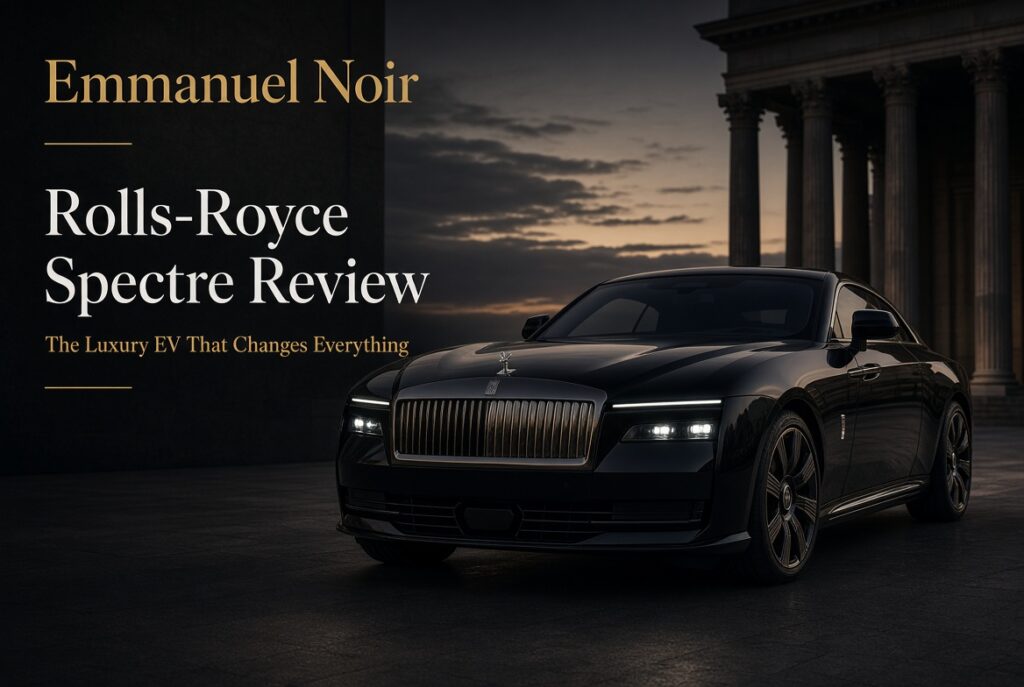
The Rolls-Royce Spectre review begins with a question that reaches beyond horsepower, battery capacity or acceleration: can an electric car preserve the extraordinary sense of occasion that has defined Rolls-Royce for generations? With the Spectre, the answer is not simply a matter of replacing a combustion engine with electric motors. It is about translating an established philosophy of silence, effortless movement, meticulous craftsmanship and personal expression into a new automotive era.
For decades, the marque’s greatest achievement has been its ability to make engineering disappear behind an experience of almost improbable composure. The Spectre extends that philosophy into an imposing, fully electric grand touring coupé, combining a dramatic fastback silhouette with an exceptionally quiet cabin and extensive opportunities for bespoke commissioning. Its electric powertrain is not merely a concession to changing expectations; it offers a particularly natural expression of the Rolls-Royce character.
More Than an Electric Rolls-Royce
Yet an acquisition at this level demands more than admiration. Buyers must weigh the Spectre’s extraordinary cabin, distinctive presence and effortless acceleration against its substantial price, considerable dimensions, charging requirements and the practical limitations of electric grand touring. The ownership equation also changes according to where the car will live, how frequently it will travel long distances and whether the buyer values personalisation more highly than outright performance.
The latest development matters, too. Rolls-Royce has introduced Spectre Series II, with engineering refinements, revised charging performance and an expanded bespoke palette. The manufacturer quotes a potential range of up to 390 miles (628 km) under the WLTP test cycle for the updated model; that figure must not be confused with the different EPA estimates published for US-market versions.
This distinction sits at the heart of an informed Rolls-Royce Spectre review: the most impressive specification is not necessarily the one that best predicts life with the car. Real-world range, wheel choice, local charging infrastructure and the exact model year all influence the experience.
For readers exploring the wider intersection of prestige motoring and advanced engineering, our luxury electric vehicles worth buying feature provides a broader view of the emerging electric luxury landscape.
The Spectre also belongs within a wider editorial conversation about premium technology and its effect on modern living. Explore our Tech & Gadgets collection for further perspectives on considered innovation, sophisticated equipment and technology that earns its place in an exceptional lifestyle.
The verdict that follows is intended for the prospective owner rather than the casual admirer. We examine the Spectre as a complete luxury acquisition: its design and engineering, its place among electric grand tourers, the realities of charging and ownership, and the considerations that separate a compelling showroom experience from a genuinely rewarding long-term purchase.
Rolls-Royce Spectre at a Glance

Exterior presence: monumental proportions, restrained detailing and a fastback roofline.

Interior character: traditional Rolls-Royce craftsmanship with contemporary digital technology.
BODY STYLE
Ultra-luxury electric coupé
POWERTRAIN
Fully electric, dual-motor AWD
SEATING
Four occupants
CHARACTER
Serenity before spectacle
UPDATED MODEL
Spectre Series II
KEY DIFFERENTIATOR
Bespoke personalisation
Rolls-Royce Spectre Key Specifications
Specifications vary by model year, market, wheel configuration and equipment. The following reference separates the manufacturer’s latest WLTP information from US-market estimates, rather than treating different testing standards as directly interchangeable.
| Specification | Reference information |
|---|---|
| Powertrain | Fully electric |
| Drive configuration | All-wheel drive |
| Body configuration | Two-door, four-seat coupé |
| Battery | Large-format lithium-ion battery; capacity and usable energy should be confirmed for the exact model year and market |
| Original Spectre US EPA-estimated range | Approximately 266–277 miles, depending on configuration, as reported for the 2026 model |
| Spectre Series II published WLTP range | Up to 390 miles (628 km), manufacturer-quoted maximum |
| Updated Series II charging improvement | Up to 14% reduction in charging times, according to Rolls-Royce |
| Construction | Rolls-Royce Architecture of Luxury |
| Suspension philosophy | Air suspension and electronically managed chassis systems designed around comfort and composure |
| Personalisation | Extensive Rolls-Royce Bespoke commissioning |
| Seating capacity | Four |
The distinction between EPA and WLTP is commercially important. EPA figures are generally more relevant when evaluating a vehicle for US use, while WLTP figures are the appropriate reference for many European-market specifications. Neither guarantees the distance a particular owner will achieve in every journey. Ambient temperature, motorway speeds, terrain, wheel selection, climate control and driving habits can all affect electric range. Rolls-Royce itself acknowledges these variables in its official Spectre charging and range guidance.
Price and Specification: What Buyers Should Understand
The Spectre occupies a rarefied financial tier, where the published starting price is only the beginning of the acquisition calculation. Model year, regional pricing, taxation, bespoke paintwork, interior materials, wheel options and commissioned details can materially alter the final figure. In the US, Car and Driver has listed a 2026 model range of approximately $397,750–$467,750, but these figures should be treated as a market reference rather than a quotation for a specific vehicle.
That distinction matters because the Rolls-Royce proposition is unusually personal. Two Spectres can share the same fundamental engineering while expressing very different tastes through their colours, veneers, upholstery, embroidery and other commissioned details. A carefully restrained specification may communicate as much discernment as a lavish one; the right choice depends on the owner’s aesthetic and intended use.
The sensible approach is to compare fully configured vehicles rather than headline prices. Buyers should request a market-specific quotation, confirm the exact model-year specification, and assess any bespoke expenditure separately from the car’s core mechanical and electrical equipment.
The Historical Background: Rolls-Royce Enters the Electric Era
Rolls-Royce’s relationship with electrification did not begin with the Spectre. In 1900, Charles Rolls experienced an electric vehicle built by the inventor Ferdinand Porsche and expressed enthusiasm for electric propulsion, while recognising that battery technology and charging infrastructure were not yet sufficiently developed for widespread use. The story is often recalled as an early indication that quiet, smooth electric movement was compatible with the marque’s emerging philosophy.
More than a century later, the conditions changed. Battery technology advanced, charging networks expanded, and electric motors demonstrated their ability to deliver immediate torque with minimal mechanical noise. For a manufacturer whose identity rests on serenity and effortless progress rather than theatrical engine character, electrification offered a particularly intriguing opportunity.
Rolls-Royce presented the Spectre in 2022 as its first fully electric production motor car. Rather than adapting a conventional combustion-engine model, the company developed it around its proprietary Architecture of Luxury, a platform intended to support the marque’s signature ride quality, substantial proportions and extensive customisation. The result was a large electric coupé that retained the visual authority expected of a Rolls-Royce while introducing a new form of propulsion.
The company’s official Spectre model overview describes the car through its combination of responsive electric performance, composed handling and sculptural design. These priorities reveal the intended role of the vehicle: not to compete solely on acceleration figures or touchscreen features, but to preserve the distinctive experience of travelling in a Rolls-Royce.
From the Original Spectre to Spectre Series II
The introduction of Spectre established the marque’s first fully electric production model. Series II builds on that foundation with technical and aesthetic revisions rather than a wholesale change of character.
In its 2026 announcement, Rolls-Royce highlighted revised battery-cell technology, a potential WLTP range increase of up to 18% to 390 miles, charging times reduced by up to 14%, and additional opportunities for bespoke interior and exterior commissions. The manufacturer also announced enhancements for Black Badge Spectre Series II, including a maximum power output of 500 kW in Infinity Mode and up to 1,100 Nm of torque in Spirited Mode. These Black Badge figures should not be attributed to every Spectre configuration.
The update reinforces an important point for prospective owners: the Spectre is evolving, and the exact version under consideration matters. A buyer comparing an earlier car with a newly commissioned Series II should examine its regional range certification, charging specification, equipment and pricing independently.
That is especially true for a vehicle expected to serve as a long-term expression of personal taste. The latest technical improvements may make the newer model more appealing, but the value of an existing example will also depend on its specification, condition, mileage, provenance and the terms of the particular transaction.
At its best, the Spectre represents a thoughtful interpretation of the electric future: modern propulsion in service of a very old luxury ideal. Whether that ideal justifies the price becomes clearer when the design, craftsmanship and driving experience are examined in detail.
Design and Craftsmanship: A Different Expression of Rolls-Royce


The Rolls-Royce Spectre does not attempt to make electric propulsion look futuristic for its own sake. Its design draws authority from proportion, surface treatment and the confidence to leave visual excess behind. The long bonnet, expansive bodywork, steeply raked windscreen and sweeping fastback roof establish a silhouette that feels unmistakably Rolls-Royce while distinguishing the coupé from the marque’s more upright saloons and SUVs.
This is an important part of the Spectre’s appeal. Many electric vehicles advertise their technological credentials through aggressive lighting signatures, sculpted aerodynamic details and conspicuously digital interiors. The Spectre takes another route. Its technology serves a visual language built around presence, formality and understated confidence.
The Exterior: Presence Without Ostentation
The imposing front end remains central to the Spectre’s identity. Its illuminated Pantheon grille creates a distinctive nighttime signature, while the split headlamp arrangement gives the car a composed, architectural face. The long bonnet and carefully controlled body surfaces suggest traditional grand touring proportions, even though the powertrain beneath them is entirely electric.
The absence of a conventional engine does not make the Spectre visually anonymous. Instead, it gives the design team freedom to develop a different relationship between the front structure, cabin and passenger compartment. The result retains the impression of a substantial motor car without relying on a large combustion engine to justify its proportions.
Wheel design, paintwork and exterior detailing have an outsized influence on the final character. A dark, monochromatic commission can make the Spectre appear almost architectural, with the bodywork emerging from shadow. A lighter finish can reveal the car’s long surfaces and emphasise the precision of its proportions. Neither approach is inherently superior; the decision is whether the car should command attention through contrast or through restraint.
The Spectre’s considerable dimensions also deserve practical consideration. Its width and long doors can make narrow parking spaces, older garages and crowded urban streets less convenient than the elegant silhouette suggests. Buyers should assess the places where they will actually use the car, not just the open roads on which it looks most natural.
The Interior: A Private World of Materials and Light


Inside, the Spectre returns to the qualities that distinguish the marque from many technology-led competitors: material depth, carefully managed light, tactile surfaces and an environment designed to feel personal rather than theatrical.
The dashboard integrates digital instrumentation and infotainment without allowing screens to dominate the cabin’s visual identity. Leather, veneers, metal finishes and carefully coordinated colours create continuity across the interior. The impression is less that of entering a conventional electric vehicle and more that of stepping into a private, meticulously commissioned space.
The available Starlight Doors extend Rolls-Royce’s fascination with illuminated interiors, using points of light to evoke a celestial pattern across the door panels. The illuminated fascia and other Bespoke options allow owners to develop a coherent visual theme, from discreet monochromatic elegance to a more expressive individual commission.
However, the most compelling feature is not any single decorative option. It is the relationship between the materials, the seating position, the sound environment and the way the car manages movement. The interior must remain comfortable and composed over an extended journey, not merely impress during a brief showroom visit.
Prospective owners should therefore spend time with the exact specification they intend to order. Leather colour, veneer finish, seat configuration and exterior paint can transform the atmosphere of the car. Equally, the final specification should reflect how the owner dresses, travels and lives with the vehicle, rather than simply reproducing the most dramatic image from a configurator.
Bespoke Commissioning: The Difference Between Expensive and Personal
Rolls-Royce has long treated individual commissioning as a defining part of its business. The Spectre carries that tradition into the electric era, offering buyers the opportunity to select combinations of materials, finishes, colours and details that reflect their own preferences.
The distinction matters at this price level. A costly specification is not automatically a considered one. A carefully chosen exterior colour, a restrained interior palette and a small number of meaningful details may produce a more coherent result than selecting every available visual flourish.
Commissioning should begin with a clear idea of the intended character. Should the Spectre feel formal and architectural, warm and residential, or contemporary and expressive? Once that decision is made, the exterior and interior can work together rather than compete for attention.
There is also a financial consideration. Bespoke expenditure should be treated primarily as payment for personal enjoyment, not as a guaranteed addition to resale value. Highly individual combinations may appeal strongly to the right future buyer, but a narrower audience may prefer a more conventional specification. The safest approach is to choose details that will continue to satisfy the original owner without relying on a future premium.
Performance and Ownership: Effortless Power, Carefully Managed


The Spectre’s performance is best understood through the way it delivers power rather than through acceleration alone. Its electric motors provide immediate torque, allowing the large coupé to gather speed with very little mechanical drama. There is no conventional transmission changing gears, no engine note building toward a crescendo and no need to work the powertrain to access its response.
That character suits the Rolls-Royce philosophy. The car feels most convincing when acceleration arrives smoothly and confidently, as though the vehicle is responding to an understated request rather than performing for an audience.
Acceleration and Road Manners
The standard Spectre’s performance figures vary with model year and market specification, but the original model was widely reported with approximately 430 kW of power and 900 Nm of torque. Its acceleration is formidable for a car of this size, yet the more meaningful achievement is the way that power is delivered.
The Black Badge variant takes a more forceful approach. Its additional output and selectable performance modes introduce a sharper dimension to the Spectre without abandoning its underlying grand touring purpose. For buyers who want the fullest expression of Rolls-Royce electric performance, it offers a more assertive alternative. However, its extra capability does not automatically make it the better choice for an owner whose priorities are quiet progress and everyday refinement.
The chassis also plays a significant role. Air suspension, electronically controlled damping and sophisticated body-control systems work together to manage the car’s considerable mass. The aim is not to make the Spectre feel artificially light, but to keep its movements controlled and its occupants insulated from unnecessary disturbance.
On a smooth road, that approach can create an unusually serene driving experience. On broken surfaces, tight urban streets or poorly maintained roads, the car’s weight and dimensions remain physical realities. A test drive should include the road conditions the owner encounters most frequently, rather than being limited to a short, polished demonstration route.
The Quietness Advantage
Electric propulsion removes the engine vibration and combustion noise that accompany a conventional luxury car. Rolls-Royce has developed the Spectre around this inherent advantage, refining sound insulation and the overall cabin environment to preserve the marque’s characteristic calm.
Silence, however, is not absolute. Tyre noise, road surfaces, wind and the sound of the surrounding environment remain present. The car’s weight, wheel specification and tyre choice can influence the acoustic experience, so buyers should evaluate the exact configuration rather than assume every Spectre will feel identical.
This is where the Spectre makes its strongest argument for electric luxury. Its powertrain and traditional emphasis on refinement reinforce one another. Rather than adding a new technology that changes the car’s character, electrification deepens a quality that Rolls-Royce has cultivated for generations.
Real-World Range and Charging
Range is one of the most important ownership questions, even for buyers who have several vehicles and rarely need to depend on a single car. The Spectre’s published range depends on its model year, market, wheels and test cycle. The Series II’s quoted maximum of up to 390 miles under WLTP testing is encouraging, but it should not be treated as a universal real-world result.
Long motorway journeys, cold weather, sustained high speeds and extensive use of cabin heating or cooling can reduce achievable range. The owner’s charging arrangements matter just as much. A dedicated home charger makes routine use far more convenient, while access to reliable charging at a second residence or regular destination can simplify longer journeys. For owners considering how residential energy generation, battery storage and vehicle charging can work together, our guide to luxury solar homes and sustainable living explores the wider home-energy ecosystem.
For buyers who travel frequently between cities, a charging plan should be part of the purchase decision. That means identifying suitable charging stops along common routes, understanding the vehicle’s actual charging behaviour and allowing for conditions that affect charging speed. A published peak charging rate alone does not determine how quickly a battery will replenish during an entire stop.
The Spectre is particularly persuasive as a car that begins most days fully charged at home. It is less effortless when an owner must regularly improvise around unreliable public charging or undertake long journeys without suitable facilities. Neither situation makes the car inherently unsuitable, but the difference between the two can materially affect ownership satisfaction.
Maintenance, Depreciation and Long-Term Costs
Electric propulsion removes several conventional engine-related maintenance requirements, including engine-oil changes and many components associated with combustion and exhaust systems. It does not eliminate maintenance costs.
Tyres, brakes, suspension components, cabin systems, bodywork and electronic equipment still require attention. The Spectre’s mass and performance can place considerable demands on tyres, while large bespoke wheels and specialised parts may carry costs that exceed those of ordinary premium vehicles. Insurance, repair access and the availability of suitable service facilities should also enter the ownership calculation.
Battery durability deserves a similarly measured assessment. A prospective buyer should review the applicable battery warranty, vehicle warranty, service history and any available battery-health information. These details become especially important when considering a pre-owned example.
Depreciation is harder to forecast with confidence. The Spectre combines a recognised luxury marque with a relatively new electric model category, bespoke configurations and a rapidly evolving market for premium EVs. Those factors make future values uncertain. A highly individual specification may be deeply satisfying to its first owner without commanding a corresponding premium in the secondary market.
The prudent assumption is that the Spectre is an acquisition for use and enjoyment, not a guaranteed financial asset. Anyone considering a pre-owned example should compare actual asking prices and transaction evidence, confirm its specification and condition, and evaluate the total cost of ownership rather than relying on claims of exceptional value retention.
Market Position and Competition: Where the Spectre Stands
The Rolls-Royce Spectre occupies a distinctive position in the electric luxury market because its primary competition is not defined by price or acceleration alone. It competes for buyers who expect their cars to communicate identity, provide exceptional comfort and deliver a sense of occasion that extends beyond the journey itself.
That distinction separates the Spectre from technically accomplished electric sedans and performance-oriented grand tourers. Some rivals emphasise digital innovation, others prioritise handling or outright speed. Rolls-Royce instead places the experience of being transported in a meticulously commissioned environment at the centre of its proposition.
Rolls-Royce Spectre vs Mercedes-Benz EQS
The Mercedes-Benz EQS approaches electric luxury from a different direction. Its emphasis falls on long-distance efficiency, digital integration, passenger space and the benefits of a purpose-developed electric platform. The EQS sedan is therefore a relevant alternative for buyers who want a sophisticated electric vehicle for frequent journeys, business travel and daily use.
Mercedes-Benz has also continued to advance the EQS’s technology. Its 2027 model announcement in April 2026 highlighted an available WLTP range of up to 925 km for the European specification and DC charging capability of up to 350 kW. Those figures belong to the announced EQS specification and should not be compared directly with Spectre figures without accounting for different body styles, markets and testing conditions.

Mercedes-Benz Media
The difference is ultimately philosophical. The EQS makes a strong case through technology and long-distance capability. The Spectre places greater emphasis on bespoke craftsmanship, a distinctive coupé silhouette and the particular atmosphere associated with Rolls-Royce ownership.
Explore the manufacturer’s Mercedes-Benz EQS technology and specifications to assess the alternative from the perspective of charging capability, range and digital innovation.
Rolls-Royce Spectre vs Bentley’s Electric Future
Bentley represents a different but relevant point of comparison. Its Continental GT tradition combines grand touring performance, richly appointed interiors and a strong relationship between driver and machine. However, the Continental GT’s current generation uses a plug-in hybrid powertrain rather than the Spectre’s fully electric architecture.
Bentley has also been developing its first fully electric vehicle, planned as a luxury urban SUV. Its published strategy and launch timetable have evolved, making it important to distinguish announced future products from vehicles that customers can actually order and take delivery of.
For a buyer deciding between these marques, the essential question is whether the preferred experience centres on a traditional grand tourer’s more involving driving character or the Spectre’s quiet, all-electric interpretation of effortless progress. The two philosophies overlap in craftsmanship and exclusivity, but they do not deliver the same ownership experience.
Bentley’s Beyond100+ electrification strategy provides useful context for understanding how the marque is approaching electric and hybrid luxury.
Rolls-Royce Spectre vs Black Badge Spectre
The choice between the standard Spectre and Black Badge Spectre may be more relevant to some buyers than a comparison with another manufacturer.
Black Badge introduces a more assertive interpretation of the same fundamental concept. Its performance modes, darker visual treatments and more forceful character appeal to owners who want the traditional Rolls-Royce environment with an additional sense of energy.
Spectre Series II Black Badge can deliver up to 500 kW in Infinity Mode and up to 1,100 Nm of torque in Spirited Mode, according to Rolls-Royce. These figures apply to the specified Black Badge configuration, not every Spectre.
The standard car remains the more natural choice for buyers who place the greatest emphasis on tranquillity, composure and discreet elegance. Black Badge suits those who want a more dramatic expression of the marque without sacrificing the core qualities that make the Spectre distinctive.
Rolls-Royce Spectre Competitive Comparison
| Consideration | Rolls-Royce Spectre | Mercedes-Benz EQS | Bentley’s grand touring approach |
|---|---|---|---|
| Core philosophy | Bespoke electric luxury | Technology-led electric luxury | Performance-led grand touring |
| Body style | Two-door coupé | Four-door sedan | Two-door coupé or convertible |
| Propulsion | Fully electric | Fully electric | Current Continental GT: plug-in hybrid |
| Cabin emphasis | Materials, craftsmanship and serenity | Digital integration and passenger comfort | Traditional craftsmanship and driver engagement |
| Personalisation | Extensive Bespoke commissioning | Broad premium equipment and customisation | Mulliner commissioning options |
| Principal appeal | Exclusivity and effortless movement | Range, technology and everyday usability | Grand touring character and performance |
| Best suited to | Buyers seeking a distinctive electric flagship | Buyers prioritising technology and frequent travel | Buyers who prefer a more traditional touring experience |
The comparison is qualitative rather than a claim that every specification or price is equivalent. Body style, model year, market availability and equipment can materially change the value proposition.
Does the Spectre Justify Its Position?
The Spectre makes its strongest case when judged against the expectations of its intended owner. It does not need to be the fastest electric vehicle, the longest-range model or the most technologically elaborate cabin in order to succeed.
Instead, its appeal rests on the integration of design, materials, silence, acceleration and personalisation. Those qualities are difficult to reduce to a specification sheet, yet they are precisely what distinguishes a significant luxury acquisition from a merely expensive vehicle.
There are compromises. The Spectre’s dimensions complicate some urban environments, charging remains a consideration on extended journeys, and bespoke expenditure may not be recovered at resale. Buyers who prioritise maximum efficiency, digital features or a more involving driving experience may find another vehicle better aligned with their needs.
For those who want an electric car that feels like a natural continuation of Rolls-Royce’s established luxury philosophy, however, the Spectre is one of the most compelling propositions in the segment.
The final judgement depends on how well the car fits the owner’s life. In Part 2, we will examine the practical buying considerations, ownership trade-offs, detailed comparison framework, advantages and disadvantages, and the profiles of buyers for whom the Spectre makes the most sense.
Buying the Rolls-Royce Spectre: What Matters Before You Commit
A Rolls-Royce Spectre purchase should begin with a clear understanding of how the car will be used, not with the most elaborate specification available. At this level, the difference between a satisfying acquisition and an unnecessarily complicated one often comes down to practical details that receive less attention than paintwork, interior finishes or performance figures.
The Spectre is designed to make ordinary journeys feel exceptional. To achieve that consistently, however, the ownership environment must support the car’s particular strengths. Charging access, road conditions, parking arrangements, passenger requirements and the intended ownership period all deserve careful consideration.
1. Choose the Right Spectre Configuration
The first decision is whether the standard Spectre or Black Badge Spectre better suits your expectations.
The standard model is the natural choice for buyers who prioritise quiet progress, understated elegance and the traditional Rolls-Royce interpretation of luxury. It has ample performance for its intended role, and its character does not depend on exploiting the car’s full acceleration capability.
Black Badge offers a more assertive alternative. Its additional performance, distinctive styling and more forceful driving modes appeal to owners who want a greater sense of occasion from behind the wheel.
Neither configuration is inherently the superior acquisition. The right choice depends on whether you value composure above all else or want a more dramatic interpretation of electric grand touring.
Before ordering, ask the dealer to confirm the exact model year, powertrain specification, market-specific range figures, standard equipment and options. Do not assume that an online specification for one market describes the car available in another.
2. Evaluate Your Charging Environment
Home charging is one of the strongest advantages an electric luxury car can offer. A Spectre that begins most mornings with a suitable charge can make everyday travel exceptionally convenient.
Before committing, consider the following:
- Private parking: Is there a secure, convenient place to charge the vehicle overnight?
- Electrical installation: Can the property support a suitable charger, and what installation work or approvals are required?
- Second residences: Will charging be available at holiday homes, country properties or other frequently visited destinations?
- Long-distance travel: Are dependable charging stations available along your regular routes?
- Public charging: Do the networks serving your area provide compatible connectors, dependable access and suitable payment arrangements?
A buyer living in a well-equipped private residence may find electric ownership considerably easier than someone who relies exclusively on public charging.
If you live in an apartment, lease your parking space or regularly travel between properties, establish the charging arrangements before signing a purchase agreement. Convenience should be a verified feature of the ownership plan, not an assumption made after delivery.
3. Treat Range as a Planning Figure, Not a Promise
The Spectre Series II’s manufacturer-quoted maximum range of up to 390 miles under the WLTP test cycle is an important reference point. However, it does not guarantee that every owner will achieve that distance.
High motorway speeds, cold temperatures, steep gradients, large wheels and heavy use of climate control can affect range. Buyers in the United States should pay particular attention to the EPA estimate for the exact vehicle they intend to purchase.
A useful test is to model your three most common journeys:
- Your ordinary weekly driving.
- Your longest regular journey.
- Your most demanding seasonal journey, such as a winter motorway trip.
Allow a sensible reserve rather than planning to arrive at a charger with almost no remaining battery capacity. This is especially important when travelling through areas with fewer charging options.
The Spectre works best when charging can be integrated into an established routine. If every long journey requires detailed contingency planning, the car may still be desirable, but its ownership experience will be less effortless.
4. Commission the Car for Long-Term Satisfaction
Bespoke commissioning is one of the Spectre’s defining attractions. Yet the financial discipline required when choosing options remains important.
Start with a coherent design direction. Decide whether the car should communicate dark restraint, warm sophistication or a more expressive contemporary identity. Then select the exterior colour, upholstery, veneers, wheels and illuminated details accordingly.
A carefully integrated specification can feel more distinctive than a collection of expensive options selected independently.
Consider the following priorities:
- Exterior finish: Choose a colour that suits the car’s proportions and the environments in which it will be used.
- Interior palette: Select materials and colours that remain appealing across different seasons and lighting conditions.
- Wheels and tyres: Consider ride comfort, replacement costs, local road conditions and the effect of wheel choice on efficiency.
- Personalisation: Invest in details that deliver genuine satisfaction rather than assuming they will increase resale value.
- Future ownership: If resale flexibility matters, consider how unusual colour combinations and highly individual finishes may affect the pool of potential buyers.
The most successful commission is not necessarily the most expensive. It is the one that feels coherent, personal and enduring.
5. Understand the Full Cost of Ownership
The purchase price represents only one part of the financial commitment. Insurance, charging, tyres, servicing, repairs, depreciation and eventual resale all influence the total cost of owning a Spectre.
Request a written ownership estimate from the supplying dealer and your insurer. Where possible, obtain comparable quotations for the standard and Black Badge versions.
| Cost category | What to investigate |
|---|---|
| Purchase price | Exact market-specific price, taxes and delivery charges |
| Bespoke options | Full cost of each commission and whether it affects delivery timing |
| Insurance | Premium, excess, replacement provisions and repair conditions |
| Charging | Home installation, electricity tariffs and public charging costs |
| Tyres | Approved specifications, replacement prices and expected availability |
| Servicing | Scheduled maintenance, local dealer access and service package terms |
| Repairs | Warranty coverage, exclusions and specialist repair availability |
| Depreciation | Comparable used examples and realistic future resale scenarios |
| Financing | Interest rate, deposit, fees, balloon payment and total amount payable |
A particularly important consideration is depreciation. The Spectre is a high-value vehicle in a changing electric-car market. Future resale prices may respond to newer battery technology, revised specifications, changes in buyer preferences and the supply of pre-owned vehicles.
No responsible assessment should promise that the Spectre will retain a particular percentage of its purchase price. Instead, calculate ownership costs using conservative assumptions and treat any stronger resale outcome as a potential benefit rather than a certainty.
6. Inspect a Pre-Owned Spectre Carefully
A pre-owned Spectre can offer access to the marque’s electric flagship without the financial commitment of a newly commissioned vehicle. However, a lower asking price does not automatically represent better value.
Begin with the car’s full specification, service history, mileage, ownership record and warranty status. Confirm whether any remaining manufacturer coverage transfers to the next owner and whether it includes the battery and high-voltage components under the relevant terms.
A specialist inspection should also examine:
- Battery-health information available for the vehicle.
- Charging operation and any recorded charging-system faults.
- Tyre condition, wear patterns and approved replacement specifications.
- Suspension behaviour and any warning messages.
- Bodywork, paint finish and evidence of previous repairs.
- Operation of interior electronics, lighting and bespoke features.
- The accuracy of the advertised specification against the vehicle identification number and original order documentation.
The condition of bespoke finishes deserves particular attention. Replacing or repairing specialised interior materials, paintwork or trim can be expensive, and the cost may not be obvious from photographs.
Compare asking prices for vehicles with similar model years, mileage, equipment and condition. Where possible, obtain transaction evidence rather than relying solely on advertised prices. A meaningful discount should reflect the car’s condition, specification and warranty position—not simply the seller’s urgency.
Rolls-Royce Spectre vs Its Alternatives: The Buying Decision
The following comparison places the Spectre alongside three relevant alternatives. It focuses on the ownership proposition rather than presenting every vehicle as a direct substitute.
Rolls-Royce Spectre
The bespoke electric flagship
Best for buyers who value extraordinary personalisation, a serene cabin, unmistakable presence and a distinctive coupé silhouette.

Mercedes-Benz EQS
The technology-led luxury alternative
Best for buyers who prioritise electric range, digital features, sedan practicality and frequent long-distance use.

Bentley Continental GT
The traditional grand tourer
Best for buyers who favour a more driver-focused touring experience, traditional grand touring proportions and a plug-in hybrid powertrain in the current generation.

Porsche Taycan Turbo GT
The performance-first electric alternative
Best for buyers who prioritise rapid acceleration, sharper handling and a more overtly performance-oriented driving experience.
These vehicles occupy different positions in the market, and equipment, range, prices and availability vary by model year and region. The Taycan Turbo GT is included as a performance benchmark, not as a direct equivalent in size, cabin character or commissioning philosophy.
The central question is not which car wins every specification comparison. It is which one delivers the experience you want every time you enter it.
The Advantages and Disadvantages of the Rolls-Royce Spectre
The Spectre’s appeal is substantial, but a premium purchase deserves an equally clear view of its limitations.
Pros: What Makes the Spectre Exceptional
1. Electric propulsion suits the Rolls-Royce philosophy. The immediate torque and absence of conventional engine vibration reinforce the marque’s longstanding emphasis on effortless progress.
2. Exceptional cabin ambience. Materials, lighting, sound insulation and bespoke detailing combine to create an environment that feels distinctly different from a technology-led mass-market EV.
3. A commanding exterior identity. The coupé proportions and distinctive front treatment make the Spectre recognisable without depending on conventional supercar styling.
4. Extensive personalisation. Buyers can commission a vehicle that reflects their own preferences rather than simply selecting from a limited list of standard colour combinations.
5. Impressive acceleration. The electric powertrain provides substantial performance without requiring the driver to pursue high engine speeds or manage conventional gear changes.
6. Convenient everyday charging when properly planned. For owners with private charging, regular journeys can begin with a full battery and require fewer routine stops.
7. A distinctive position in luxury motoring. The Spectre offers a fully electric interpretation of the Rolls-Royce experience rather than attempting to imitate the character of a conventional performance EV.
Cons: The Compromises Worth Understanding
1. A very high acquisition cost. The purchase price, options, insurance and specialist ownership expenses place the Spectre beyond the reach of all but a narrow group of buyers.
2. Large exterior dimensions. Narrow streets, compact parking spaces and older garages can make routine use less convenient.
3. Charging remains part of the ownership equation. Public charging reliability, route planning and seasonal range changes can affect the experience of long-distance travel.
4. Substantial weight. The Spectre’s size and battery mass influence tyre wear, road behaviour and the physical sensation of driving compared with lighter performance cars.
5. Uncertain future resale values. Bespoke specifications and an evolving electric luxury market make depreciation difficult to forecast.
6. Bespoke options may not be recovered at resale. Highly individual finishes can increase personal enjoyment without necessarily increasing the next buyer’s willingness to pay.
7. Not the most driver-focused alternative. Buyers seeking the sharpest steering response or the most engaging track-oriented performance may prefer a different vehicle.
Who Should Buy the Rolls-Royce Spectre?

The Spectre makes the strongest case for an owner who values the experience of travelling as much as the act of driving. Its ideal buyer is comfortable with the acquisition and ownership costs, has suitable charging arrangements and wants a car that communicates taste through design, craftsmanship and personalisation.
The Established Luxury-Car Owner
For someone already familiar with Rolls-Royce ownership, the Spectre offers a way to embrace electric propulsion without abandoning the qualities that attracted them to the marque. Its cabin atmosphere, substantial road presence and bespoke possibilities remain central to the experience.
The transition makes particular sense for owners who primarily use their cars for local journeys, formal occasions and longer trips that can be planned around dependable charging.
The Design-Conscious Collector
The Spectre may also appeal to a collector who views a car as an expression of design and cultural change. Its significance lies partly in the intersection of Rolls-Royce heritage and the move toward electric propulsion.
That does not make it a guaranteed collectible investment. Future desirability will depend on production history, condition, specification, market demand and the evolution of luxury EVs. Buyers should distinguish historical interest from evidence of financial appreciation.
The Technology-Conscious Luxury Buyer
For an affluent buyer who wants an advanced electric powertrain without a conspicuously gadget-led cabin, the Spectre offers a compelling balance. Its technology is present, but the overall experience remains centred on comfort and craftsmanship. Buyers who value the same restraint in their residential environment may also appreciate our guide to luxury smart-home systems, which examines how lighting, climate, security and energy management can work together without allowing technology to dominate the home.
It is particularly attractive for owners with private parking, dependable home charging and access to a Rolls-Royce service network.
The Owner Who Wants a Distinctive Grand Tourer
The Spectre suits drivers who cover meaningful distances but prefer a relaxed, insulated experience to an overtly sporting one. Its acceleration is powerful, yet its personality is most convincing when speed arrives smoothly and the cabin remains composed.
A proper test drive should confirm that this interpretation of grand touring matches the buyer’s expectations.
Who Should Skip the Rolls-Royce Spectre?
The Spectre will not suit every wealthy buyer, and acknowledging that fact is part of responsible luxury buying guidance.
Skip it if you cannot charge conveniently. If your regular routine depends on unreliable public chargers or frequent journeys through areas with limited infrastructure, another vehicle may be more practical.
Skip it if you want maximum driving involvement. The Spectre is engineered around refinement, not as a substitute for a lightweight sports car. Buyers who prioritise steering feedback, circuit performance or an intensely involving chassis should consider more focused alternatives.
Skip it if your regular environment is physically restrictive. Tight parking, narrow access roads and a small garage can turn a large luxury coupé into a daily inconvenience.
Skip it if you expect bespoke spending to generate a reliable profit. Personalisation is best regarded as an expenditure for enjoyment. Future buyers may not share your taste, and the used market cannot guarantee recovery of the cost.
Skip it if you need maximum family practicality. Although the Spectre accommodates four occupants, its two-door layout is less convenient than a spacious luxury sedan or SUV for frequent rear-seat access, child-seat use or bulky luggage.
Skip it if the purchase would compromise financial flexibility. The Spectre should sit comfortably within a broader financial plan. The purchase price is only one part of the commitment, and maintaining adequate reserves for insurance, maintenance and other obligations remains essential.
The Final Buying Test: Does It Fit Your Life?
Before placing an order, arrange an extended test drive if possible. Experience the car on the roads you use most often, assess the ease of entry and exit, inspect rear-seat access and test the parking arrangements at home.
Ask the dealer to demonstrate the charging process, explain the applicable battery and vehicle warranties, and provide a written quotation for the precise configuration. Confirm the local range certification rather than relying on a headline figure from another market.
Finally, compare the Spectre with at least one alternative chosen for a different reason. A Mercedes-Benz EQS can test whether you would prefer a more technology-led luxury EV. A Bentley Continental GT can clarify whether traditional grand touring character matters more than a fully electric powertrain. A Porsche Taycan can establish whether you would rather prioritise driving involvement.
If the Spectre remains the most compelling choice after those comparisons, the decision is more likely to reflect a genuine fit than the influence of a remarkable showroom experience.
The best luxury acquisition is not the vehicle with the longest options list or the most dramatic specification. It is the one whose character continues to reward its owner long after the novelty has faded.
Rolls-Royce Spectre Review: Frequently Asked Questions
The following answers address the practical questions most likely to influence a prospective Spectre buyer, from real-world range and charging to ownership costs, model selection and long-term desirability.
1. Is the Rolls-Royce Spectre worth buying?
The Rolls-Royce Spectre is worth considering if you value exceptional craftsmanship, a serene cabin, bespoke personalisation and effortless electric performance more highly than outright driving involvement or maximum practicality.
Its strongest argument is the way electric propulsion complements Rolls-Royce’s established emphasis on refinement. However, the high acquisition cost, charging requirements and uncertain depreciation mean that it should be purchased primarily for the ownership experience rather than as a guaranteed financial investment.
2. How far can the Rolls-Royce Spectre travel on a full charge?
Rolls-Royce quotes a maximum WLTP range of up to 390 miles (628 km) for Spectre Series II. Actual distance depends on the exact specification, driving speed, temperature, terrain, wheel choice and use of cabin heating or cooling.
US buyers should consult the EPA estimate for the precise model year and configuration. WLTP and EPA figures use different testing procedures, so they should not be treated as interchangeable.
3. How much does a Rolls-Royce Spectre cost?
The price depends on the model year, market, tax treatment, configuration and selected bespoke options. As a US reference, published estimates for the 2026 model have placed the range at approximately $397,750–$467,750, before any market-specific changes or individually commissioned additions.
Buyers should obtain a written quotation from an authorised dealer. The final cost can differ substantially from the advertised starting price once personalisation, taxes, insurance and other ownership expenses are considered.
4. How long does it take to charge a Rolls-Royce Spectre?
Charging time depends on the available power supply, the vehicle’s charging capability, battery temperature, the starting state of charge and the charging station’s performance.
Home charging is generally most convenient for routine use because the car can replenish its battery while parked overnight. Public DC fast charging is more relevant to longer journeys, although peak charging power does not represent the rate maintained throughout an entire session.
Prospective owners should confirm the charging specification for their exact vehicle and test the charging facilities they expect to use regularly.
5. Is the Rolls-Royce Spectre fully electric?
Yes. The Spectre is a battery-electric vehicle. It uses electric motors and a rechargeable traction battery rather than a petrol engine or plug-in hybrid powertrain.
This distinguishes it from the current Bentley Continental GT, which uses a plug-in hybrid system. Buyers comparing the two should consider whether fully electric driving or the flexibility of a hybrid touring car better suits their regular journeys.
6. What is the difference between the standard Spectre and Black Badge Spectre?
The standard Spectre focuses on effortless performance, comfort and traditional Rolls-Royce refinement. Black Badge introduces a more assertive interpretation through distinctive styling and enhanced performance characteristics.
For Spectre Series II Black Badge, Rolls-Royce quotes up to 500 kW in Infinity Mode and up to 1,100 Nm of torque in Spirited Mode. These figures apply to the specified Black Badge configuration rather than the standard car.
The best choice depends on whether the owner prefers the quieter expression of luxury or a more forceful driving character.
7. Is the Rolls-Royce Spectre suitable for everyday driving?
It can be, particularly for owners with private parking, convenient charging and routes that accommodate its size. Electric propulsion can make routine journeys quiet and straightforward, while the cabin provides a comfortable environment for commuting and longer trips.
However, the Spectre’s dimensions, long doors and substantial width can complicate parking in tight urban spaces. Buyers should test the vehicle in their actual parking environment and consider rear-seat access if passengers frequently travel with them.
8. Is the Rolls-Royce Spectre a good investment?
The Spectre has potential historical significance as Rolls-Royce’s first fully electric production motor car, but that does not establish it as a sound financial investment.
Future resale value will depend on condition, mileage, specification, production history, demand for luxury EVs and the development of newer models. Bespoke options may increase personal satisfaction without generating an equivalent premium in the secondary market.
A prudent buyer should budget for depreciation and acquire the car because its design and driving experience justify the expenditure.
9. Is the Rolls-Royce Spectre better than the Mercedes-Benz EQS?
Neither is universally better. The Spectre places greater emphasis on bespoke commissioning, coupé design, craftsmanship and the distinctive atmosphere associated with Rolls-Royce ownership.
The Mercedes-Benz EQS is more appropriate for buyers who prioritise a luxury sedan format, digital integration, passenger practicality and technology-led electric travel.
The choice depends on whether the buyer wants an individually commissioned grand touring experience or a more conventional luxury electric vehicle designed around everyday usability.
10. Should you buy a new or pre-owned Rolls-Royce Spectre?
A new Spectre offers the opportunity to commission the car to personal taste, obtain the applicable new-vehicle warranty and select the latest available specification. A pre-owned example may reduce the initial acquisition cost and provide access to a carefully specified vehicle without waiting for a new commission.
The used car should be assessed for battery health, service history, warranty coverage, tyre condition, charging operation and the condition of bespoke materials. Compare like-for-like examples and obtain a specialist inspection before committing.
The right decision depends on whether personalisation and a new-car experience justify the price difference.
Conclusion: A New Interpretation of Electric Luxury
The Rolls-Royce Spectre demonstrates that electrification does not require a luxury manufacturer to abandon its established identity. In this case, electric propulsion reinforces qualities the marque has pursued for generations: smooth progress, exceptional cabin composure and the ability to make engineering feel almost invisible.
Its appeal extends beyond acceleration or the novelty of a battery-electric powertrain. The design carries considerable presence, the interior offers extensive opportunities for personal expression, and the driving experience prioritises calm rather than constant stimulation. For the right owner, those qualities make the Spectre more than an expensive electric coupé.
Nevertheless, a balanced Rolls-Royce Spectre review must recognise the practical compromises. The car is large, expensive to acquire and maintain, dependent on a suitable charging environment, and exposed to the uncertainty of a developing luxury EV market. Bespoke options should be chosen for enjoyment rather than speculative resale gains.
The most important consideration is therefore not whether the Spectre is the most capable electric vehicle on every measurable dimension. It is whether its distinctive combination of craftsmanship, silence, performance and personalisation matches the owner’s priorities.
For someone with reliable charging, the financial means to absorb ownership costs and a genuine appreciation for Rolls-Royce’s philosophy, the Spectre presents a persuasive vision of electric grand touring. For a buyer seeking maximum practicality, sharper sports-car handling or a predictable financial return, other vehicles may be more appropriate.
The Spectre succeeds because it does not attempt to make luxury feel faster, louder or more complicated. It makes the experience of travelling feel considered, composed and deeply personal.
The Emmanuel Noir Verdict

Rolls-Royce Spectre
The electric grand tourer for those who place serenity, craftsmanship and individuality above spectacle.
DESIGN
Exceptional
REFINEMENT
Outstanding
VALUE RETENTION
Uncertain
Our recommendation
The standard Spectre is the more natural choice for buyers seeking the purest expression of Rolls-Royce serenity. Black Badge suits owners who prefer a more assertive interpretation of the same philosophy. In either case, suitable charging and a carefully considered specification are essential.
The Spectre is a compelling achievement because it understands what electric propulsion can contribute to the Rolls-Royce experience. It offers immediate power without unnecessary drama, a carefully composed cabin and an exterior that communicates authority through proportion rather than visual noise.
Its greatest strength is the coherence of the whole. The powertrain, design, materials and bespoke commissioning work toward the same objective: making every journey feel deliberate and unhurried.
Yet exclusivity does not exempt a vehicle from practical scrutiny. Buyers should investigate charging access, local service support, insurance, warranty terms and likely depreciation before committing. They should also test the car on familiar roads and ensure its size suits their daily environment.
The Emmanuel Noir verdict: The Rolls-Royce Spectre is worth owning when the experience matters more than the specification sheet. It is not the universal answer to electric luxury, nor should it be purchased on the assumption that rarity guarantees appreciation. Its achievement is more nuanced: it translates a century-old philosophy of effortless motoring into a thoroughly modern form.
For the discerning owner who values that distinction, the Spectre is a remarkable expression of what electric luxury can become.
“True luxury is not measured by how loudly a machine announces its power, but by how effortlessly it makes every moment feel exceptional.”
— Emmanuel Noir
Affiliate Disclosure
Emmanuel Noir is committed to independent, reader-focused editorial coverage. This article is intended to inform prospective luxury-car buyers through analysis of design, engineering, ownership considerations and market positioning.