
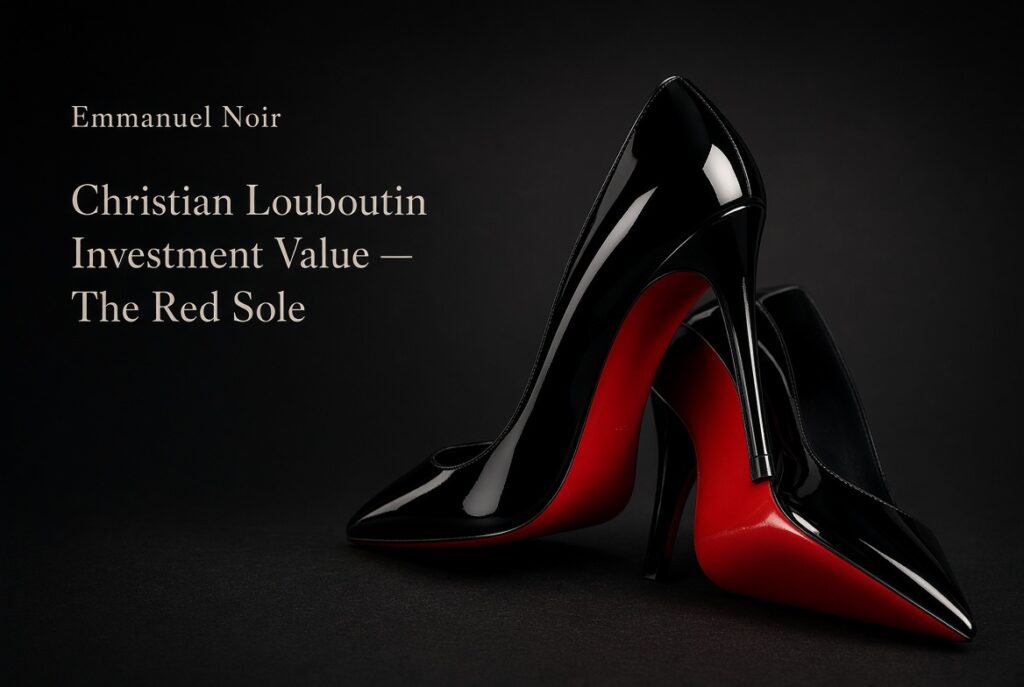
There are shoes that complete an outfit, and there are shoes that announce themselves before their wearer has crossed the room. Christian Louboutin belongs to the latter category. The flash of red beneath a black pump is not merely decorative; it is one of fashion’s most recognizable visual signatures. For collectors and style-conscious buyers, that recognition raises a more interesting question: what is the Christian Louboutin investment value once the box leaves the boutique and the shoes enter the secondary market?
The answer requires some restraint. Christian Louboutin footwear should not be treated like a publicly traded security, a rare watch with transparent auction indices, or a gemstone whose value can be assessed through established grading systems. Most Louboutin shoes do not automatically appreciate, and current resale listings demonstrate substantial discounts from original retail prices. The investment case is therefore better understood through brand recognition, model desirability, condition, scarcity, provenance, and liquidity rather than an assumption of guaranteed capital growth. Current resale markets show both the strength of the brand and the limits of the investment thesis.
For the reader building a considered wardrobe rather than a speculative portfolio, that distinction matters. A Louboutin can possess residual value, strong cultural recognition and a comparatively identifiable design language while still depreciating after purchase. The sophisticated approach is not to ask whether every red sole is an investment. It is to identify which Louboutin characteristics give certain pairs a better chance of preserving value than others.
If the broader philosophy of your wardrobe is part of the equation, Emmanuel Noir’s guide to Fashion & Style overview provides the appropriate wider framework: investment-minded fashion begins with enduring design, versatility and disciplined acquisition rather than simply paying more for a recognizable name.
Quick Reference: Christian Louboutin Investment Value
| Factor | Collector’s Perspective |
|---|---|
| Maison | Christian Louboutin |
| Founded | 1991, Paris |
| Signature | Contrasting red lacquered outsole |
| Red sole introduced | 1992 |
| Key heritage | Parisian footwear, theatrical design, celebrity and red-carpet visibility |
| Notable silhouettes | Pigalle, So Kate, Kate and other established pumps |
| Current retail reference | Core Kate and So Kate pumps currently begin around $945 in the U.S. |
| Secondary-market reality | Prices vary sharply by model, condition, size, material and marketplace |
| Primary value drivers | Condition, recognizability, demand, rarity, colourway, completeness and provenance |
| Investment classification | Collectible luxury footwear rather than a guaranteed appreciating asset |
| Best acquisition philosophy | Buy the strongest design and condition you genuinely want to own |
Current official pricing illustrates the gap between primary and secondary markets. Christian Louboutin currently lists core Kate and So Kate pumps from approximately $945 in the United States, while secondary-market examples can trade materially below original retail. That spread is not evidence against the brand; it is evidence that Christian Louboutin investment value is highly model- and condition-dependent.
Key Specifications: What Actually Creates Value?
The red sole attracts the eye, but the secondary market does not value every pair equally.
1. Model Recognition
A recognizable silhouette generally gives a buyer a clearer point of reference than an obscure seasonal design. Louboutin’s established pump families, particularly the Pigalle, Kate and So Kate, benefit from having a defined identity within the Maison’s history.
The So Kate, for example, remains part of the Maison’s core offering, with the current U.S. collection listing its 120 mm patent calf-leather pump at approximately $945. Christian Louboutin identifies the Kate as a signature silhouette inspired by Kate Moss, with the original Kate introduced in 2012 and So Kate following in 2013.
That continuity matters. In collectible fashion, a recognizable silhouette gives the secondary buyer something more tangible than novelty alone: a design they already understand.
2. Condition
Few variables are more important.
A red sole that has been heavily walked, scratched, repainted or structurally damaged does not carry the same appeal as an exceptionally preserved pair. This is particularly important with Louboutin because the signature outsole is simultaneously the shoe’s most recognizable feature and one of the areas most exposed to wear.
Current resale inventories illustrate the dispersion. The RealReal lists Christian Louboutin pumps with estimated retail prices around $945 to $1,045 at substantially different resale prices depending on condition, while individual examples range from good and fair condition through excellent examples.
For a collector, the lesson is simple: condition is not cosmetic bookkeeping. It is part of the asset.
3. Original Packaging and Completeness
Boxes, dust bags, receipts where available and other original accessories can strengthen buyer confidence. They may also help establish provenance and make a pair easier to present when it eventually returns to the market.
That does not mean packaging magically creates value. A damaged pair with a perfect box remains a damaged pair. Instead, completeness works alongside condition and authenticity.
4. Material and Colourway
Patent leather, suede, exotic materials, embroidery and embellishment can create very different secondary-market dynamics. Yet rarity alone should never be confused with demand.
A highly unusual shoe may be difficult to resell precisely because fewer buyers want it. A restrained black patent pump with the unmistakable red sole may attract a broader audience than a dramatic seasonal creation, even when the latter originally commanded a higher price.
That distinction is central to any serious Christian Louboutin investment value analysis: scarcity has meaning only when the market wants the scarce object.
5. Size
Luxury footwear has a structural limitation that watches and jewellery do not. A shoe must fit.
That makes the addressable buyer pool narrower than it is for a universally wearable object such as a handbag, watch or bracelet. A highly desirable pair in an uncommon size may therefore take longer to sell, while a desirable size can attract considerably more competition.
For collectors, this creates an unusual form of market risk: the shoe can be culturally important yet commercially illiquid.
The Birth of the Red Sole
Every serious discussion of Louboutin’s secondary market begins in Paris in 1992.
Christian Louboutin had opened his first boutique in the Galerie Véro-Dodat in 1991. The following year, while working on a prototype of the Pensée model, he felt that the black outsole weakened the visual energy of the design. According to Christian Louboutin’s history of the red sole, his assistant was wearing vivid red nail polish. Louboutin took the polish and applied it to the sole, transforming the otherwise conventional underside into a visual signature.
It was an unusually small intervention with unusually large consequences.
The brilliance was not simply the colour. It was placement. The red appeared beneath the shoe, visible only intermittently as its wearer moved. The signature therefore became intimate and theatrical at once: concealed while standing still, revealed while walking.
That quality helped separate Louboutin from designers whose identity depended primarily on logos, hardware or monograms. The brand could announce itself without placing its name across the upper.
And that is where the investment argument begins.
A collectible fashion object needs recognition. Louboutin created recognition in a part of the shoe that competitors could not easily ignore.
From Design Detail to Brand Asset
Over time, the red outsole evolved from an aesthetic gesture into a powerful identifier of the Maison.
That evolution has an important legal dimension. In 2008, Christian Louboutin registered the red lacquered outsole as a U.S. trademark. The subsequent dispute with Yves Saint Laurent established an important distinction: the Second Circuit ruling on the Louboutin red sole trademark recognized trademark protection for the contrasting red lacquered outsole as a distinctive symbol associated with Louboutin, while limiting the protection where the outsole and the rest of the shoe were monochromatic.
This is more than a legal footnote in a collector’s guide.
It demonstrates that the red sole had achieved something exceptionally valuable in fashion: brand identification independent of a visible wordmark.
The court’s analysis specifically found that the red lacquered outsole had acquired secondary meaning when it contrasted with the remainder of the shoe. In trademark terminology, secondary meaning refers to consumers coming to associate a product feature with a particular source or brand.
For the secondary market, that recognition can matter because buyers do not need to be experts in every Louboutin collection to understand what they are seeing.
A red sole beneath a sharply sculpted pump communicates the Maison immediately.
The Red Sole as a Luxury Signal
Luxury value is often built from signals that operate below the level of conscious analysis.
A Patek Philippe can be recognized by its proportions before its dial is examined. A Hermès Birkin can be identified through silhouette, hardware and construction. A Rolls-Royce can communicate its identity through architecture long before its badge becomes visible.
Louboutin’s red sole belongs to the same visual vocabulary.
Its particular strength comes from restraint. The wearer does not need to display a large logo. The shoe can remain almost entirely black, nude or otherwise understated while the red outsole supplies a single, unmistakable interruption.
That makes the signature unusually compatible with evening dressing and formal tailoring. It can sit beneath a minimalist black dress, a sharply cut suit or an otherwise quiet wardrobe without demanding that every other element compete for attention.
This is also why the red sole has survived changes in fashion cycles. The underlying proposition is not dependent on one seasonal colour palette or a single trend silhouette. It is a recognizable visual code.
For collectors, recognizable codes can be valuable because they create continuity.
Craftsmanship Behind the Signature
The investment case cannot rest on symbolism alone. A collectible fashion object still needs physical substance.
Christian Louboutin’s footwear craftsmanship follows a sequence of specialized operations beginning with the drawing and pattern, followed by the selection and cutting of leather, assembly over the last, heel attachment and the final application of the red sole. The Maison states that, depending on materials, completed shoes may then rest for several weeks as the construction matures.
The detail is important because luxury footwear is an unusually tactile category.
The quality of the leather, the precision of the upper, the symmetry of the silhouette, the construction around the heel and the condition of the outsole all contribute to how a pair looks years after purchase.
The red sole, meanwhile, gives the object a visual continuity that remains legible even when fashions change.
A Secondary Market Already Exists — But It Is Not Uniform
The phrase “secondary market premium” requires careful definition.
It does not mean that a Louboutin purchased today should be expected to sell for more tomorrow. Current marketplace evidence argues against such a simplistic conclusion. The RealReal’s live inventory shows many Christian Louboutin shoes selling below estimated original retail, sometimes substantially below it. Vestiaire Collective likewise carries a broad range of Louboutin heels, sandals, boots and trainers at prices that vary considerably by model and condition.
What Louboutin possesses instead is a brand premium in recognition and marketability.
That distinction is critical.
A generic designer pump may have little identity once removed from its original retail environment. A Louboutin can retain immediate recognizability. The red outsole provides a shorthand for provenance, design language and cultural relevance.
In practical terms, this means the brand can support a functioning resale market even when individual pairs depreciate.
Recent tracked resale data also illustrates the dispersion. One independent dataset tracking completed Poshmark sales reported a median Christian Louboutin shoe resale price of approximately $300 over the preceding 12 months as of late September 2026, with used shoes around $275 and new-with-tags examples around $600. Such data is marketplace-specific and should not be treated as a universal valuation index, but it demonstrates the central point: resale value is real, yet highly variable.
The collector’s task, therefore, is not to buy the most expensive Louboutin.
It is to understand why one Louboutin sells differently from another.
Why the Red Sole Can Command a Premium
The answer lies in the intersection of five forces:
Recognition. The red outsole is immediately associated with Christian Louboutin.
Heritage. The signature dates to 1992 and has remained central to the Maison’s identity.
Design continuity. Established silhouettes give buyers a familiar reference point.
Cultural relevance. Louboutin’s expansion to New York in 1993 and subsequent adoption by celebrities and popular culture helped establish the red sole as a recognizable fashion symbol.
Condition sensitivity. Because footwear experiences direct physical wear, an exceptional example can stand apart dramatically from a heavily used one.
Together, these characteristics create the conditions for secondary-market desirability.
But they do not erase depreciation.
That is the crucial distinction between owning Louboutin intelligently and treating a fashion purchase as a financial instrument.
Historical Background: From Paris Boutique to Global Symbol
The Maison’s chronology is unusually compact.
Christian Louboutin opened his first boutique in Paris in 1991. In 1992 came the red sole. In 1993 the House expanded to New York, where celebrities and media exposure helped accelerate its cultural visibility. The Maison later expanded beyond women’s footwear into handbags, accessories and men’s footwear.
The red sole consequently became more than a product feature. It became the connective tissue between different eras of the brand.
That matters to collectors.
A fashion house with a recognizable signature can make older pieces intelligible to newer buyers. The object does not become anonymous simply because the season has passed. Its identity remains anchored to a visual language that the Maison continues to use.
The current collection reinforces that continuity. Christian Louboutin’s Winter 2026 offering continues to feature established signatures such as La Pigalle alongside newer materials and interpretations, while the Kate and So Kate families remain part of the Maison’s essential women’s offering.
This continuity is one reason established Louboutin silhouettes deserve more scrutiny than anonymous seasonal footwear when assessing potential resale strength.
The First Rule of Louboutin Collecting
The most important principle is also the least glamorous:
Do not buy a Christian Louboutin solely because you expect it to appreciate.
Buy it because the design is compelling, the craftsmanship is appropriate to the price, the size is right, the condition can be protected and the silhouette has a credible reason to remain desirable.
If resale value later proves stronger than expected, that is an advantage.
If it does not, the owner still possesses a culturally significant piece of modern fashion design.
That is a far more durable definition of christian louboutin investment value than a promise of future profit.
And for the discerning collector, durability of thought is often more valuable than speculation.
Design & Craftsmanship: Where the Red Sole Becomes an Object
The strongest argument for Christian Louboutin investment value begins with the object itself. Louboutin is not simply selling a coloured outsole; the Maison has built an identifiable design language around proportion, heel architecture, materials and the relationship between the upper and that unmistakable flash of red.
The current Kate collection illustrates the point. Christian Louboutin describes the Kate as a signature pump offered in multiple heel heights and materials, while its construction begins with a Parisian sketch before the pump takes shape in Italy. The Maison positions the silhouette as one designed to transcend individual trends rather than belong exclusively to a single season.
That continuity is relevant to collectors. A design that remains legible across seasons has a stronger foundation for secondary-market recognition than footwear whose appeal depends entirely on a passing runway moment.
The Architecture of a Louboutin Pump
A Louboutin pump is deliberately architectural.
The elongated toe, elevated heel, sharply defined topline and carefully controlled curvature create a silhouette that can be recognized even without the red sole. The outsole then completes the visual proposition, creating contrast beneath the shoe rather than competing with the upper.
The Maison’s craftsmanship process reinforces that philosophy. According to Christian Louboutin’s craftsmanship process, each shoe begins with a drawing that becomes a pattern, followed by material selection and precise cutting. The upper is then assembled and stretched by hand over a last, while the heel is attached before the signature red sole is applied. Depending on the materials, completed shoes can then rest for several weeks as the construction matures.
Materials Matter More Than the Logo
For a collector, the Maison name establishes provenance; the material determines much of the physical experience.
Patent calfskin creates the polished, almost lacquer-like visual associated with classic evening Louboutin. Suede introduces a softer surface and a different ageing profile. Embossed leather, metallic finishes, embroidery and more elaborate treatments can shift a shoe from an enduring wardrobe piece toward a seasonal collector’s object.
The mistake is to assume that the most elaborate version is automatically the most valuable.
Secondary markets rarely work that cleanly.
A restrained black patent pump can appeal to a much wider group of buyers than an unusually embellished seasonal creation. Conversely, an exceptionally distinctive limited production may attract collectors precisely because it is difficult to find. The determining factor is not extravagance by itself but the intersection of rarity and demand.
That is one reason the Christian Louboutin buyer should record the exact model name, material, colour, heel height and season whenever possible. Two pairs that look broadly similar in a photograph can occupy very different positions in the resale market.
The Red Sole Is Both Signature and Vulnerability
There is an irony at the centre of Louboutin collecting.
The component that creates the strongest brand recognition is also the component most likely to reveal wear.
The outsole touches the ground. Every step therefore carries a small portion of the collector’s capital directly against the pavement.
This makes ownership discipline unusually important.
A pair worn repeatedly on rough streets will inevitably tell a different story from a pair reserved for controlled indoor occasions. Scratches, scuffing, heel wear and deterioration around the sole can affect how the shoe is perceived by a future buyer.
For someone considering Christian Louboutin investment value, this changes the ownership equation. The question is not merely which pair should I buy? It is also how will I preserve it?
That may mean rotating pairs rather than wearing one model continuously, storing the shoes correctly, retaining original packaging and addressing repairs before minor damage becomes structural.
A collector who treats footwear like disposable fashion is unlikely to preserve the same residual value as one who treats it as a collectible object.
Ownership: The Cost of Wearing the Investment
Luxury footwear creates a tension that watches and jewellery often avoid.
A watch can be worn while remaining physically protected on the wrist. A necklace can be removed before entering a damaging environment. Shoes, by definition, encounter the environment.
Rain, pavement, stairs, spilled drinks, uneven surfaces and repeated flexing all become part of the ownership equation.
This does not mean a Louboutin should be kept permanently behind glass. That would defeat much of the reason to own it.
Instead, the sophisticated approach is selective wear.
Use the shoe where its design belongs. Avoid unnecessarily destructive environments. Maintain the upper appropriately. Keep the original box and dust bags. Preserve purchase documentation where available.
The goal is not artificial perfection. It is controlled ageing.
A beautifully maintained Louboutin can acquire character without looking neglected. That distinction becomes increasingly important when a future buyer evaluates photographs rather than experiencing the shoe in person.
The Collector’s Hierarchy of Condition
For secondary-market purposes, Louboutin footwear can be considered through a practical hierarchy:
Deadstock or unworn: The strongest condition category, particularly when original packaging and accessories remain intact.
Excellent condition: Minimal evidence of wear, clean uppers, strong structure and carefully preserved soles.
Very good condition: Clearly worn but professionally maintained, with limited cosmetic evidence.
Good condition: Noticeable wear but still structurally sound and wearable.
Heavily worn: Significant sole wear, creasing, staining, heel damage or other visible deterioration.
The precise terminology varies between resale platforms, so these categories should not be treated as a universal grading standard.
What matters is consistency.
A buyer comparing two similar pairs needs to understand why one deserves a premium. Condition gives that comparison a rational foundation.
Performance & Ownership: The Reality Behind the Heel
The word “performance” has a different meaning in fashion footwear than it does in watches or automobiles.
A Louboutin pump is not engineered to maximize walking efficiency. The Maison’s proposition is silhouette, posture, proportion and visual impact.
The high heel changes the wearer’s stance. The elongated toe creates a particular line through the foot. The construction is designed around the shape of the shoe rather than the expectations of a running trainer.
That makes fit essential.
A collector purchasing a Louboutin primarily because of its resale prospects but ignoring personal fit is making an expensive mistake. A shoe that causes discomfort will probably be worn less frequently, which may preserve its condition but undermines its purpose as part of a living wardrobe.
For that reason, the best acquisition is often a model the owner already understands.
A collector who knows that the Kate works with evening tailoring, for example, can make a more rational acquisition than someone buying an unfamiliar seasonal silhouette simply because it appears scarce.
The Pigalle, Kate and So Kate: Three Different Collector Signals
Established silhouettes deserve separate consideration.
La Pigalle
The Pigalle represents one of the clearest expressions of Louboutin’s classic pump language. Its name itself carries historical weight within the Maison, linking the shoe to Parisian identity and Louboutin’s broader design vocabulary.
For collectors, its importance lies less in any single release and more in its status as a recognizable Louboutin archetype.
Kate
The Kate offers a particularly strong example of design continuity. The Maison describes it as an iconic women’s pump and currently presents it in several heel heights and materials. Its pointed shape and pronounced décolleté create a silhouette that remains unmistakably Louboutin.
That makes the Kate relevant to a discussion of resale because buyers can understand the object without needing extensive knowledge of a discontinued collection.
So Kate
The So Kate pushes the same language toward a more dramatic proportion. Its very high heel and elongated profile make it less universally wearable, but also highly identifiable.
That creates an interesting collector tension: a dramatic silhouette can possess stronger fashion recognition while simultaneously having a narrower practical buyer pool.
The result is another reminder that recognition does not automatically equal liquidity.
Why Established Silhouettes Can Outlast Seasonal Fashion
Fashion investment becomes more interesting when an object escapes its original season.
The secondary market rewards recognizability because buyers need a reason to care about an item they did not purchase when it first appeared.
A classic Louboutin pump has an advantage here. Its visual language remains connected to the Maison even as materials, colours and embellishments change.
This is similar to the logic behind collecting established handbags, watches or automobiles: continuity creates a bridge between generations of buyers.
Emmanuel Noir’s wider research into designer handbags that hold their value explores this same principle from another category, where brand identity, scarcity, condition and secondary-market demand interact differently but reveal the same fundamental collector lesson.
Market Position & Competition
Christian Louboutin occupies a distinctive position within luxury footwear.
Its competitors include heritage footwear houses, specialist Italian shoemakers and other designer brands whose products compete for the same luxury consumer. Yet the Louboutin proposition is unusually easy to identify from a single visual cue.
That is commercially powerful.
A buyer browsing a secondary-market platform may encounter hundreds of black pumps. The red sole immediately narrows the visual field.
In that sense, Louboutin has achieved something many fashion brands spend decades trying to create: a recognisable signature that survives without a visible logo.
The Second Circuit’s Louboutin red-sole decision provides unusually strong evidence of this phenomenon. The court held that the red lacquered outsole had acquired limited secondary meaning as a distinctive symbol identifying the Louboutin brand, while limiting the trademark to situations where the red outsole contrasts with the rest of the shoe.
Louboutin vs. Other Luxury Footwear
The competitive landscape becomes clearer when the comparison is based on what actually creates collector interest.
| Factor | Christian Louboutin | Heritage Shoemaker | Italian Luxury Designer | Fashion-Driven Seasonal Brand |
|---|---|---|---|---|
| Signature recognition | Very high | High | High | Variable |
| Distinctive visual code | Red outsole | Construction/materials | Varies by house | Often seasonal |
| Collector familiarity | High | High among specialists | High | Variable |
| Resale liquidity | Model-dependent | Model-dependent | Model-dependent | Often more volatile |
| Condition sensitivity | Very high | Very high | Very high | Very high |
| Wearability | Model-dependent | Often model-specific | Broadly variable | Trend-dependent |
| Heritage narrative | Strong | Often very strong | Strong | Variable |
| Speculative potential | Highly uncertain | Highly uncertain | Highly uncertain | Highly uncertain |
The table reveals an important distinction: Louboutin’s competitive advantage is not that its shoes are guaranteed to appreciate.
It is that the brand has created an exceptionally efficient recognition mechanism.
A secondary-market buyer does not have to understand every technical detail of the shoe to understand why the red sole matters.
That can reduce the educational barrier to resale.
The Real Competition Is Not Another Shoe
The most important competition for a Louboutin collector may not be another footwear house.
It may be another category entirely.
A buyer with $1,000 to spend on a luxury object can choose between shoes, jewellery, a watch contribution, a handbag or another collectible. Each category offers different characteristics.
Watches can offer broader unisex demand and established auction ecosystems. Handbags can have stronger practical resale markets. Fine jewellery can carry intrinsic material value in addition to brand value. Footwear has the advantage of accessibility and immediate personal enjoyment, but it also carries the physical constraints of size and wear.
That makes Louboutin a different type of luxury acquisition.
Its strongest proposition is the intersection of identity, design, cultural recognition and personal use.
Its weakest proposition, from a purely financial perspective, is the absence of a reliable intrinsic value floor comparable to precious metal content.
Where Louboutin Sits in the Luxury Investment Spectrum
The phrase “investment” should therefore be used carefully.
At one end of the spectrum sit assets with relatively observable market structures, such as publicly traded securities.
Further along are established luxury collectibles with extensive auction histories and specialist databases.
Luxury footwear occupies a different territory.
There are functioning resale markets, recognisable brands and identifiable models, but price discovery is fragmented. Transactions happen across consignment platforms, specialist marketplaces, private sales and peer-to-peer channels. Condition descriptions differ. Sizes differ. Regional demand differs. And transaction prices are often less transparent than retail prices.
Consequently, christian louboutin investment value should be approached as a residual-value and collectibility question, not as a conventional investment thesis.
That distinction protects the buyer from the most common error: confusing desirability with appreciation.
The Premium Is in the Signature
The strongest case for Louboutin is therefore remarkably simple.
The red sole has become a globally recognizable identifier.
The Maison has maintained that signature for decades.
Established silhouettes continue to provide recognizable reference points.
Craftsmanship gives the product substance beyond branding.
And an active secondary market gives owners a route to recover part of their expenditure when they eventually sell.
Those factors can support a premium relative to anonymous or less recognizable designer footwear.
But the premium has limits.
A Louboutin that has been heavily worn, poorly stored, bought in an undesirable size or tied to a weak seasonal design can still lose substantial value.
The red sole is powerful.
It is not magic.
The Collector’s Edge
The sophisticated Louboutin buyer therefore thinks in layers.
First comes the design.
Then the fit.
Then the condition.
Then the provenance.
Then the market.
Only after those questions have been answered should the word investment enter the conversation.
That sequence keeps the acquisition rooted in something durable.
Because the best luxury purchases rarely begin with the question, How much will I make?
They begin with a more discerning question:
Will this still mean something when the season that introduced it is long gone?
For Christian Louboutin, the red sole has already demonstrated an unusual ability to survive that test.
Buying Considerations: How to Approach Christian Louboutin Investment Value
The intelligent way to approach christian louboutin investment value is to reverse the usual luxury-shopping sequence. Do not begin with the price tag. Begin with the object, then examine its desirability, condition, provenance and eventual resale audience. Only after those questions have been answered should the potential recovery value enter the calculation.
For a buyer building a wardrobe with longevity in mind, the principles are closely related to those behind investment pieces for a luxury wardrobe: enduring design, versatility, construction and disciplined acquisition matter more than novelty alone.
1. Start With the Silhouette, Not the Discount
A dramatic markdown can make an ordinary purchase look like an exceptional investment.
It is not.
The first question should be whether the silhouette has an identifiable place within Christian Louboutin’s design history. Established families such as Pigalle, Kate and So Kate offer a clearer proposition than an obscure seasonal model because the secondary buyer can immediately understand what the shoe represents.
This does not make an established silhouette automatically valuable. It simply gives it a stronger foundation from which desirability can develop.
The distinction is subtle but important.
A discounted shoe is inexpensive.
A desirable shoe bought at a sensible price can be strategically acquired.
Those are not the same thing.
2. Assess the Original Retail Price Carefully
Retail price provides context, not a guaranteed floor.
A current Louboutin price tells you what the Maison charges for the product at the primary point of sale. It does not tell you what another buyer will pay for that pair two years later.
The difference can be substantial.
For this reason, buyers should avoid statements such as “I paid $1,000, so the shoe is worth $1,000.” Secondary-market value is determined by what buyers actually accept, not what the original owner paid.
This is particularly important for seasonal colours, elaborate embellishment and unusual materials. A high original price can reflect labour, materials and design complexity without creating equivalent demand in resale.
3. Condition Should Be Treated as a Valuation Variable
Few decisions will influence resale value more than how the shoe is maintained.
Before purchasing pre-owned Louboutin, inspect:
- the red outsole;
- heel tips;
- toe box;
- heel counter;
- stitching;
- interior lining;
- insoles;
- edges of the upper;
- patent leather for cracking or clouding;
- suede for staining or compression;
- hardware and embellishment;
- original packaging and accessories.
Photographs should be examined from multiple angles rather than relying on the hero image supplied by a seller.
A particularly attractive pair photographed from above may conceal substantial outsole wear.
That is why authentication and condition assessment belong together.
For readers who collect luxury goods across categories, Emmanuel Noir’s guide to authenticating pre-owned luxury watches illustrates the same broader principle: provenance and condition should be investigated before the transaction rather than after it.
4. Provenance Adds Confidence
Luxury footwear does not generally carry the same documentation ecosystem as watches or fine jewellery, yet provenance can still matter.
A receipt, original box, dust bags and identifiable purchase history can help establish continuity between the original boutique transaction and the pair being offered for resale.
The strongest package is therefore not merely:
Shoes + box.
It is:
Shoes + identifiable model + documented origin + original accessories + credible condition.
None of these elements guarantees a premium. Together, however, they can reduce uncertainty.
And uncertainty is one of the enemies of secondary-market pricing.
5. Size Is a Genuine Liquidity Variable
A beautiful shoe cannot be separated from the human foot.
That creates a structural limitation for luxury footwear that does not apply to a handbag or many watches.
If the shoe is an unusual size, the pool of potential buyers becomes smaller. If the size corresponds to a common demand band, more buyers can potentially compete for the same pair.
The implication for collectors is straightforward:
Buy your correct size.
Buying a size that does not fit merely because the colour is rare or the discount appears attractive creates a difficult resale proposition.
The most valuable shoe in the wardrobe is ultimately the one another person can actually wear.
6. Colour Requires Discipline
Black is rarely an exciting answer.
It can, however, be a rational one.
A classic black Louboutin can move across evening dressing, formal events and sharply tailored wardrobes without demanding a particular fashion moment. Nude and restrained neutral tones can offer similar versatility, although colour suitability depends heavily on the intended wearer.
By contrast, unusual seasonal colours can be more speculative.
A vivid colour may become exceptionally desirable if it develops cult status. It may also become difficult to place on the secondary market once the original fashion moment disappears.
The collector should therefore distinguish visual rarity from market rarity.
Something can be rare because nobody wants it.
7. Consider the Cost of Ownership
A luxury footwear purchase does not end at checkout.
There may be costs associated with:
- professional cleaning;
- sole protection;
- heel-tip replacement;
- restoration;
- storage;
- shipping;
- consignment fees;
- marketplace commissions;
- insurance;
- authentication.
These costs reduce the amount ultimately recovered when the shoe is sold.
Consequently, a pair that appears to have retained 70 percent of its retail value may produce considerably less after transaction costs.
This is why serious collectors should calculate net resale proceeds, rather than simply comparing advertised resale prices with original retail.
8. Buy From a Market You Understand
Secondary-market footwear rewards patience.
Before purchasing a model with resale in mind, study completed sales where available rather than relying solely on active listings.
An active listing tells you what a seller wants.
A completed transaction tells you what a buyer accepted.
That distinction is fundamental to understanding Christian Louboutin investment value.
It also helps prevent another common error: mistaking an unusually high asking price for evidence of market scarcity.
Buying Through the Secondary Market
For buyers who have already identified a specific Louboutin model and want to examine current secondary-market inventory, a specialist marketplace can provide useful comparison points. Farfetch’s pre-owned and luxury marketplace ecosystem can be one such research destination, particularly when comparing model, size, material and regional availability.
Christian Louboutin Investment Value: What Should You Actually Buy?
There is no single Louboutin model that functions as a universal investment vehicle.
Instead, a collector can divide potential acquisitions into several broad categories.
The Classic
A recognizable black, nude or similarly restrained pump in an established silhouette.
Strength: Broad aesthetic relevance.
Weakness: Large supply can limit scarcity.
The Discontinued Favourite
An older model or colourway that is no longer readily available from the Maison.
Strength: Genuine scarcity can create collector interest.
Weakness: Discontinued does not automatically mean desirable.
The Exceptional Limited Edition
A distinctive collaboration, unusual material or genuinely limited production.
Strength: Potentially strong collector appeal.
Weakness: Narrower buyer pool and greater dependence on fashion cycles.
The Statement Piece
An extravagant shoe purchased primarily for its visual impact.
Strength: Strong identity and editorial appeal.
Weakness: Resale can depend heavily on taste and occasion.
For most buyers interested in long-term residual value, the classic and carefully selected discontinued piece deserve the closest examination.
Comparison Table: Louboutin Acquisition Strategies
| Acquisition Type | Resale Recognition | Scarcity Potential | Wearability | Liquidity | Risk Profile |
|---|---|---|---|---|---|
| Classic black pump | High | Low–Moderate | High | Moderate–High | Moderate |
| Classic nude pump | High | Low–Moderate | High | Moderate | Moderate |
| Established signature silhouette | High | Moderate | Moderate–High | Moderate–High | Moderate |
| Discontinued colourway | Moderate–High | High | Variable | Moderate | Higher |
| Limited edition | High if culturally relevant | High | Variable | Variable | Higher |
| Highly embellished seasonal piece | Variable | Potentially high | Low–Moderate | Lower | High |
| Heavily worn vintage pair | Low–Moderate | Potentially high | Variable | Low | Very high |
| Unworn, complete example | High | Variable | High | Moderate–High | Lower relative risk |
The table should not be interpreted as a performance forecast. It is a framework for understanding the competing variables that influence secondary-market desirability.
In particular, scarcity and liquidity can move in opposite directions.
A shoe can be extraordinarily rare and extraordinarily difficult to sell.
That is why the most sophisticated acquisition is rarely the rarest object. It is the object where recognition, condition, scarcity and buyer demand overlap.
Pros & Cons of Christian Louboutin as a Collectible
The Advantages
Immediate Brand Recognition
Few footwear brands possess a signature as visually efficient as the red outsole.
A photograph can often communicate the identity of the shoe before the model name is even disclosed.
Strong Design Continuity
The continued presence of established silhouettes gives collectors recognisable reference points across different periods of the Maison’s history.
Cultural Longevity
Louboutin has remained visible across fashion, entertainment and red-carpet culture for decades.
That cultural recognition can help maintain secondary-market awareness.
Accessible Entry Point to Luxury Collecting
Compared with major collectible watches, jewellery and automobiles, a Louboutin acquisition can provide entry into the world of luxury collecting at a comparatively accessible capital outlay.
Personal Utility
Unlike a purely speculative collectible, footwear can be worn and enjoyed.
That gives the purchase a second dimension of value even when financial appreciation does not occur.
The Disadvantages
Depreciation Is Common
Many Louboutin shoes trade below original retail in the secondary market.
That is the most important fact prospective buyers should understand.
Footwear Wears
The very act of using the product can reduce its resale appeal.
Size Restricts Demand
A shoe must fit its next owner.
Fashion Remains Fashion
Even an iconic house cannot completely escape changes in taste.
Transaction Costs Reduce Returns
Consignment commissions, marketplace fees, shipping and restoration can materially reduce net proceeds.
No Reliable Appreciation Formula
There is no universally accepted Louboutin valuation index that allows an owner to forecast future prices with confidence.
For that reason, Christian Louboutin belongs closer to the category of collectible luxury fashion with residual value than to conventional financial investments.
When a Louboutin Purchase Makes Sense
The strongest acquisition usually satisfies several conditions simultaneously.
The design should appeal to the buyer independently of resale.
The silhouette should possess recognizable Maison heritage.
The size should be correct.
The condition should be excellent or capable of being maintained at that level.
The price should leave room for normal secondary-market depreciation.
The colour should have genuine wardrobe relevance.
And the buyer should be comfortable holding the shoe even if the secondary market never produces a meaningful premium.
This last point is decisive.
If the purchase only makes sense when the resale price rises, the acquisition is speculative.
If the purchase makes sense at the moment of acquisition and resale value becomes an additional advantage, the collector has built a much stronger proposition.
Who Should Buy Christian Louboutin?
The Collector Who Values Design History
For someone interested in fashion as cultural history, Louboutin offers a particularly clear collecting proposition.
The red sole is not an arbitrary logo. It is a design intervention that changed how a luxury shoe could identify itself.
Owning a significant Louboutin therefore provides access to a piece of contemporary fashion history.
The Style-Conscious Professional
A carefully chosen black or neutral Louboutin can function as a signature component of an evening wardrobe.
For executives, creative professionals and collectors whose wardrobes depend on sharply defined silhouettes, the shoe can offer a level of visual recognition without relying on oversized branding.
The Luxury Buyer Seeking Personal Use Plus Residual Value
This is arguably the most rational profile.
The buyer purchases the shoe to wear, enjoy and keep, while also considering the possibility of resale later.
The financial component remains secondary to ownership utility.
The Fashion Collector
Collectors who already understand the importance of condition, provenance and scarcity may find Louboutin particularly interesting because individual models can be studied through their materials, silhouettes, seasons and cultural context.
Who Should Skip It?
The Purely Financial Investor
Someone looking for predictable appreciation should not treat Christian Louboutin footwear as a conventional financial asset.
There is insufficient certainty in individual resale outcomes to justify that assumption.
The Buyer Chasing Rarity Alone
A discontinued shoe is not automatically collectible.
If nobody wants it, scarcity becomes an obstacle rather than an advantage.
The Buyer Who Dislikes Maintenance
Louboutin footwear demands more care than an object that spends its life in a display cabinet.
The signature outsole makes neglect especially visible.
The Buyer Who Does Not Know the Fit
Luxury footwear should never be purchased solely because a particular model appears fashionable or potentially valuable.
Poor fit undermines both enjoyment and long-term ownership.
The Speculator Expecting a Guaranteed Premium
The phrase “red sole premium” can be misleading if interpreted as a promise of appreciation.
The more defensible interpretation is that the red sole creates brand recognition that can support secondary-market demand.
Those are two very different propositions.
The Three-Level Acquisition Test
Before purchasing, ask three questions.
Level One — Would I Want It Without the Investment Thesis?
If the answer is no, stop.
Level Two — Does the Pair Have a Reason to Remain Desirable?
Look for established design language, enduring colour, cultural recognition, material quality, scarcity or meaningful provenance.
Level Three — Could I Accept a Lower Resale Price?
If the answer is yes, the purchase can be approached as luxury ownership rather than speculation.
This three-level test strips away the emotional noise surrounding the word investment.
It also brings the conversation back to what Emmanuel Noir believes luxury collecting should ultimately represent:
ownership with intention.
The Price Discipline That Matters Most
Suppose two pairs are available.
Pair A is a discontinued seasonal model offered at 50 percent below its original retail price.
Pair B is a classic black signature pump offered at only 20 percent below retail.
Pair A looks cheaper.
Pair B may have the stronger collector logic.
Why?
Because the percentage discount does not determine future demand.
The better question is whether another informed buyer will still understand the appeal of the object later.
This is the same principle that governs other luxury categories. A discount is not an investment thesis. Demand is.
Final Buying Framework
Before purchasing a Louboutin with residual value in mind, evaluate:
Model: Is the silhouette established and recognisable?
Condition: How much physical wear has occurred?
Size: Is it commercially practical for the intended buyer pool?
Material: Is the material durable, desirable and appropriate to the model?
Colour: Does the colour have enduring wardrobe relevance?
Provenance: Are original accessories or purchase records available?
Price: Is the acquisition price realistic relative to comparable secondary-market transactions?
Liquidity: How many potential buyers could realistically want this exact pair?
Purpose: Would you still be pleased to own it if the resale price declined?
If the final answer is yes, the acquisition has passed the most important test.
The Difference Between Value and Price
The central lesson of christian louboutin investment value is that price and value are not interchangeable.
Price is what the market asks today.
Value is the combination of design, craftsmanship, identity, cultural relevance, condition, utility and future desirability that makes someone willing to pay it.
Louboutin’s red sole gives the brand an unusually powerful foundation because it converts a functional component into a cultural signature.
But the signature cannot overcome poor condition, weak demand or an impractical model.
That is why the discerning collector does not chase every red sole.
They select the right one.
A More Sophisticated Definition of Investment
Perhaps the most useful way to think about Louboutin is through three layers of return.
First: aesthetic return. You own something you genuinely admire.
Second: functional return. You can wear it and incorporate it into your wardrobe.
Third: residual financial value. When you eventually sell, the brand, model, condition and provenance may allow you to recover a meaningful portion of the original expenditure.
The third layer is real.
It simply should not be confused with a guarantee of profit.
And that distinction separates informed luxury collecting from speculation.
Frequently Asked Questions About Christian Louboutin Investment Value
Is Christian Louboutin a good investment?
Christian Louboutin footwear is better understood as collectible luxury fashion with residual value than as a conventional financial investment. Many pairs depreciate after purchase, particularly when they are worn extensively. However, established silhouettes, excellent condition, strong provenance, recognisable colourways and genuine scarcity can support stronger secondary-market demand.
The most defensible approach is therefore to buy a Louboutin because you value the design and craftsmanship, while treating resale value as a potential secondary benefit rather than a promised return.
Do Christian Louboutin shoes hold their value?
Some hold value better than others, but there is no universal retention rate.
Current secondary-market listings show substantial variation according to model, condition, size, material and desirability. A classic, well-preserved pair can remain commercially relevant, while a heavily worn or highly seasonal design may experience much greater depreciation.
The phrase hold their value should therefore be interpreted comparatively, not absolutely.
A Louboutin retaining a meaningful portion of its original retail price has preserved more value than many ordinary fashion purchases, but that does not mean the owner has necessarily made a profit.
Why are Christian Louboutin shoes so expensive?
The price reflects several components: design, materials, specialised construction, labour, brand positioning, distribution, retail economics and the cultural value attached to the Maison’s identity.
The red sole itself is not the sole reason for the price.
Louboutin’s broader design language, craftsmanship and decades of brand development create the context in which that red sole carries meaning.
Does the red sole increase resale value?
It can contribute to desirability because it is one of Christian Louboutin’s strongest identifying features.
However, the red sole should not be treated as an independent valuation formula.
A pair with a recognisable red outsole but poor condition can still perform poorly in resale. Conversely, a less immediately recognisable model may attract a dedicated buyer because of a rare material, collaboration or limited production.
The red sole creates recognition.
Recognition can support demand.
Demand, rather than the colour alone, ultimately determines resale value.
Which Christian Louboutin shoes are most collectible?
Established silhouettes such as the Pigalle, Kate and So Kate deserve particular attention because they have clear identities within the Maison’s history.
That does not mean every example will appreciate.
Collectors should examine the exact reference, material, colour, heel height, condition, production period, provenance and availability before assigning additional value to a particular pair.
A discontinued model can be interesting, but discontinuation alone is not sufficient evidence of collectibility.
Is it better to buy Christian Louboutin new or pre-owned?
The answer depends on the purpose of the acquisition.
Buying new provides greater confidence regarding authenticity, condition and completeness, but the initial depreciation can be significant once the shoe enters the secondary market.
Buying pre-owned can reduce the initial acquisition cost and potentially soften that depreciation, but the buyer assumes greater responsibility for authentication, condition assessment and provenance.
For a collector primarily concerned with Christian Louboutin investment value, an exceptional pre-owned pair purchased at a rational market price can sometimes offer a more disciplined entry point than paying full retail for an ordinary model.
Does Christian Louboutin have a strong secondary market?
Yes, an active secondary market exists across major luxury resale and consignment platforms.
However, “active” does not mean “uniformly profitable.”
Listings span a wide range of prices and conditions, and asking prices should not be confused with completed transaction prices. The market is fragmented by size, geography, model, condition and platform.
That fragmentation makes individual research essential.
Can you make money reselling Christian Louboutin shoes?
It is possible to resell individual pairs for a profit, particularly when an item has been acquired below prevailing market value or develops unexpected demand.
But there is no reliable formula that makes this outcome predictable.
Transaction fees, authentication, shipping, restoration and the cost of capital can also reduce apparent gains.
Anyone buying Louboutin specifically to generate a financial return should therefore treat the activity as speculative rather than guaranteed investing.
Should I buy a rare Louboutin?
Rarity should be considered alongside demand.
A rare colour or discontinued model can become highly desirable when collectors actively seek it. But an obscure design with very few interested buyers can be difficult to sell precisely because it is obscure.
The strongest collector proposition is usually scarcity combined with recognition and demand.
How should I preserve a Louboutin for resale?
Store the shoes in a clean, dry environment away from excessive heat, moisture and direct sunlight. Retain the original box and dust bags, keep purchase documentation where possible and avoid unnecessary exposure to damaging surfaces.
Most importantly, inspect the outsole and heel regularly.
The red sole is the visual signature of the Maison, so deterioration there can have an outsized effect on how the shoe appears in resale photography.
For buyers building a broader collection of valuable objects, Emmanuel Noir’s guide to building a fine jewelry collection explores a related principle: preservation and acquisition discipline begin before the purchase is complete.
The Conclusion: Is Christian Louboutin a Luxury Investment?
The red sole has achieved something extraordinarily rare in fashion.
It has turned the underside of a shoe into a signature.
Since the early 1990s, Christian Louboutin has developed that signature into a global visual language. The red outsole can identify the Maison without a prominent logo, while established silhouettes such as the Pigalle, Kate and So Kate provide recognisable forms through which that identity continues.
That creates the foundation for secondary-market value.
But it does not create a guaranteed investment return.
The evidence points toward a more nuanced conclusion. Christian Louboutin footwear can retain meaningful residual value because the brand possesses strong recognition, established design codes and an active resale ecosystem. Yet many pairs still sell below original retail, and the eventual price depends heavily on condition, size, model, material, provenance, timing and buyer demand.
The investment case therefore rests less on appreciation than on value preservation through desirability.
That distinction matters.
A sophisticated collector does not ask whether every Louboutin will become more expensive.
They ask whether a particular pair has enough identity, quality and enduring appeal to remain desirable after the original retail moment has passed.
That is a much harder question.
It is also the more useful one.
Emmanuel Noir Verdict
Christian Louboutin should not be approached as a financial asset in the conventional sense.
Its strongest case lies elsewhere.
The Maison has created one of the most recognisable signatures in contemporary fashion, backed by decades of design continuity and a global secondary market. For the right buyer, a carefully selected pair can combine personal enjoyment with meaningful residual value.
The strongest acquisition profile is therefore not necessarily the rarest or most expensive shoe.
It is a pair with:
- an established and recognisable silhouette;
- excellent condition;
- an appropriate and desirable size;
- enduring colour or material;
- credible provenance;
- sensible acquisition pricing;
- and genuine appeal to the owner independent of resale.
In other words, christian louboutin investment value is strongest when the investment thesis begins with the object rather than the expectation of profit.
The red sole can command attention.
The collector must decide whether the entire shoe deserves it.
The Final Collector’s Principle
Luxury becomes collectible when design survives its original moment.
Christian Louboutin has already demonstrated that the red sole can do exactly that.
The more difficult task is identifying which individual shoes will carry that legacy most convincingly into the future.
That requires patience.
It requires condition discipline.
It requires an understanding of secondary-market behaviour.
And above all, it requires the willingness to walk away from a supposedly rare shoe that does not deserve the price attached to it.
The most intelligent Louboutin purchase may therefore be the one that feels satisfying even before resale is considered.
Because if the market changes, the owner should still have something worth owning.
“The finest collectible is not the object that promises the greatest return. It is the object whose meaning survives the moment in which it was bought.”
— Emmanuel Noir
Affiliate Disclosure
Some links in this article may be affiliate links. If you purchase through an affiliate link, Emmanuel Noir may receive a commission at no additional cost to you. Editorial selection is based on relevance to the subject and reader utility; affiliate relationships do not determine the conclusions expressed in this article.