
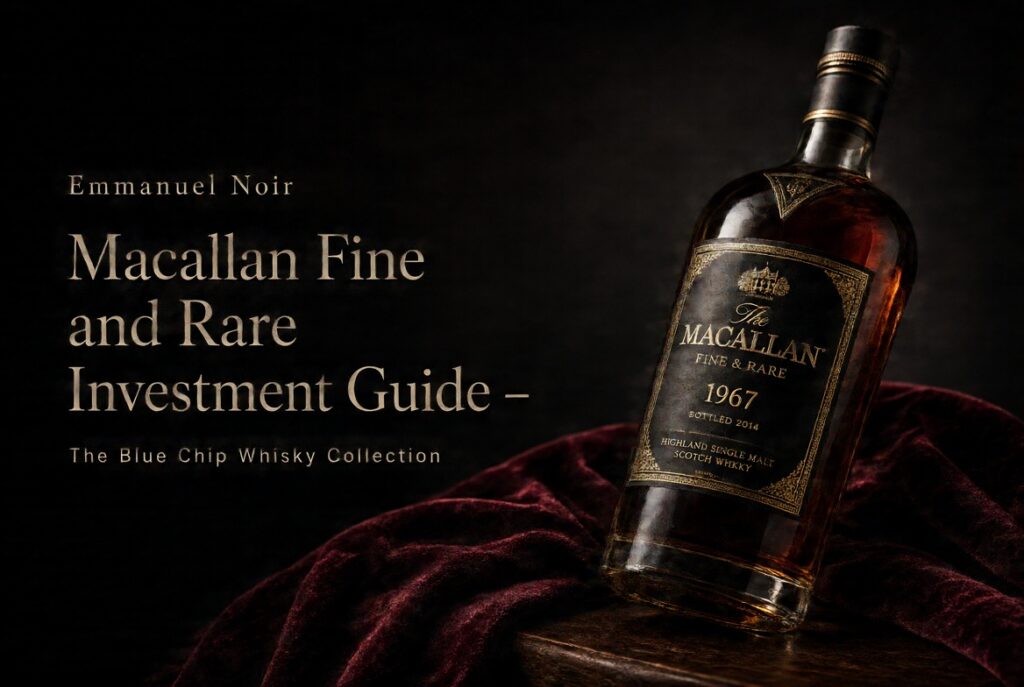
Introduction: When Whisky Becomes a Collectible Asset
Macallan Fine and Rare investment occupies a distinctive place in the world of collectible Scotch whisky, where exceptional age, documented provenance, historical significance and auction demand can shape a bottle’s appeal. Yet rarity alone does not guarantee financial performance. For collectors considering these celebrated releases, understanding the evidence behind their reputation—and the risks that accompany ownership—is essential.
The phrase blue chip is often applied to this collection, and the comparison is understandable. Certain Macallan bottles have achieved extraordinary auction results, attracting international bidders and setting records that have helped establish rare Scotch whisky as a serious subject of alternative-asset analysis. Yet the distinction between a celebrated collectible and a sound investment deserves careful examination. A remarkable auction price demonstrates demand at a particular moment; it does not guarantee that another bottle will appreciate, or that its owner will realise a profit after costs.
For collectors exploring Collectors Corner, the Macallan Fine and Rare investment story offers a compelling case study in how heritage, scarcity, brand recognition and verifiable ownership history interact in the market for rare spirits.
The central question is not simply whether Macallan Fine & Rare bottles are expensive. It is whether particular vintages, acquired at defensible prices and supported by impeccable documentation, can justify a place in a carefully managed collection. Answering that question requires more than brand prestige. It requires an understanding of the collection’s history, the differences between individual releases, the mechanics of whisky auctions and the risks that accompany an illiquid, condition-sensitive asset.
Quick Reference: The Macallan Fine & Rare Investment Case
Distillery and origin
The Macallan · Speyside, Scotland · Single malt Scotch whisky
Collection profile
Vintage-dated bottlings spanning multiple decades, with individual releases distinguished by vintage, age, cask history and presentation.
Principal value drivers
Rarity, provenance, condition, authenticity, collector demand, historical significance and comparable auction evidence.
Investment classification
A speculative, illiquid collectible—not a conventional income-producing asset or a guaranteed store of value.
Non-negotiable acquisition standard
Independent authentication where available, documented provenance, sound packaging, appropriate storage and a realistic exit-cost calculation.
The investment thesis is strongest when applied to a specific bottle rather than to the Macallan name in the abstract. A historically significant vintage with exceptional documentation may occupy a very different market position from a more recent release carrying the same Fine & Rare designation.
Key Specifications: What Defines Fine & Rare?
The Macallan Fine & Rare is a collection of vintage-dated single malts selected from the distillery’s maturing stocks. The collection draws on whisky produced across different periods, preserving distinct expressions of the distillery’s history rather than presenting a single uniform product. The official collection material describes its vintage range as extending across eight decades.
The distinctions between bottles matter. Vintage identifies the year associated with the whisky, while age indicates the maturation period before bottling. Cask characteristics, alcohol strength, bottle size, packaging and release history can further separate one expression from another. Collectors should never assume that two bottles of similar age or appearance have equivalent rarity or market value.
The 1926 vintage illustrates this point with unusual clarity. The distillery identifies the Fine & Rare 1926 as a 60-year-old whisky bottled in 1986 from cask 263, with a total outturn of 40 bottle equivalents. These details give the bottle a precisely documented historical identity, rather than relying on the vague appeal of an old and expensive spirit.
For the investor, these specifications are more than catalogue details. They form the foundation of due diligence. A credible valuation begins by identifying the exact expression, confirming that the bottle matches its documented characteristics and comparing it with genuinely comparable examples—not simply with the highest price ever achieved by the brand.
Historical Background: The Heritage Behind the Bottle
From Speyside Distilling to an International Collecting Icon
The Macallan’s history stretches back to the nineteenth century. The distillery’s official account traces an important turning point to 1892, when Roderick Kemp acquired the property. The later development of the brand’s reputation created the foundations for the international recognition that its rarest bottlings enjoy today.
Fine & Rare translates that broader heritage into a collection of individual historical artefacts. Each vintage carries the imprint of a particular period of distillation and maturation. For serious collectors, this creates a narrative that differs from purchasing a contemporary bottle purely for its taste profile. The acquisition becomes an act of preservation: a small, tangible connection to the distillery’s past.
That narrative is commercially relevant, but it must be handled with discipline. Heritage supports desirability only when collectors continue to value it. It cannot independently establish a fair purchase price, and it does not protect a buyer from overpaying during a competitive auction.
The 1926 Vintage: A Landmark in Whisky Auction History
Few bottles demonstrate the relationship between scarcity and collector demand more vividly than the Macallan 1926. The distillery reports that only 40 bottles were produced from the cask in question, with different artistic treatments and label variations contributing to the identity of surviving examples. The Valerio Adami-labelled bottle sold at Sotheby’s in London for £2,187,500 in November 2023, setting a landmark auction result for a bottle of wine or spirits.
This achievement helped reinforce the Macallan’s position at the summit of the collectible whisky market. It also illustrates why headline prices require careful interpretation. The 1926 is an extreme example of scarcity, historical importance and global recognition converging in one object. Its result should not be treated as a representative valuation for every Fine & Rare vintage, much less as evidence that the collection as a whole will deliver comparable returns.
For a more rigorous view of the wider category, readers can explore rare whiskies that have outperformed stocks, where the broader investment narrative should be assessed alongside the limits of historical performance comparisons.
The 1926 story also exposes an important tension in collectible whisky. The rarer a bottle becomes, the more its price may depend on the preferences and resources of a relatively small group of buyers. That scarcity can intensify competition when an exceptional example comes to market. It can also make resale timing unpredictable.
Provenance, Surviving Bottles and the Value of Documentation
In the upper reaches of the market, provenance is part of the asset itself. Collectors want to understand where a bottle has been, how it has been stored, whether its ownership history is credible and whether its physical details correspond with the claimed release. Original packaging and supporting records can strengthen confidence, although neither should replace a careful examination of the bottle.
Condition deserves equal attention. Fill level, closure integrity, label wear, capsule condition, evidence of leakage and the state of the packaging may all affect a buyer’s assessment. A bottle with an extraordinary story but uncertain authenticity can carry more risk than its headline valuation suggests.
This is why Fine & Rare should be approached as a series of distinct collectible assets rather than a single investment category with a uniform return profile. The name opens the door to the market; the individual bottle, its documentation and the price paid determine whether the acquisition makes sense.
Design & Craftsmanship: The Details That Distinguish a Collectible
The Macallan Fine & Rare collection derives its appeal from more than age alone. Its strongest expressions bring together the distillery’s heritage, the character of individual vintages, the scarcity of surviving bottles and the visual language of serious whisky collecting. These elements create a distinctive identity, but they do not contribute equally to every release’s market value.
Vintage, Cask Character and the Importance of Distinction
A vintage-dated single malt carries a specific historical identity. Its production belongs to a particular year, and its maturation reflects the conditions and cask influences that shaped the spirit before bottling. Even within one distillery, those differences can produce markedly different expressions.
For a collector, the vintage is therefore a starting point rather than a complete valuation. The age statement, bottling date, cask information, stated alcohol strength and release documentation help establish what the bottle actually represents. Where the distillery publishes details about an individual expression, those records should take precedence over vague seller descriptions.
This distinction matters especially when comparing bottles separated by several decades. An older vintage may have considerable historical appeal, but age alone does not establish superior quality, greater rarity or stronger investment prospects. The market ultimately reflects the relationship between a bottle’s particular attributes and the willingness of informed buyers to pay for them.
Presentation, Labels and the Physical Object
At the upper end of whisky collecting, presentation can become part of the object’s identity. Labels, capsules, closures, packaging and accompanying documentation help distinguish one release from another. Certain historically significant bottles also carry recognisable artistic or design variations that collectors associate with specific releases.
However, visual appeal must not be confused with authenticity. A convincing label cannot establish that the liquid is genuine, while attractive original packaging cannot independently verify the bottle’s ownership history. Collectors should examine the whole object, comparing its physical characteristics with reliable records and seeking specialist advice when the value warrants it.
Condition also affects the ownership experience. A bottle with a damaged label, compromised closure or signs of leakage may attract less interest than an otherwise comparable example in stronger condition. The significance of each defect depends on the particular release and the expectations of prospective buyers.
For an exceptional Macallan, preservation is not an afterthought. It is an essential part of protecting the collectible’s identity and maintaining confidence in its future sale.
Rarity Is More Than a Low Bottle Count
Scarcity is one of the most persuasive elements in the Macallan Fine and Rare investment narrative, but scarcity has several dimensions. A small original outturn can limit the number of bottles available. Over time, consumption, damage, disputed authenticity and the dispersal of private collections may further influence the number of credible examples circulating in the market.
Nevertheless, a low surviving supply creates investment potential only when demand exists at a price that supports a rational acquisition. Some rare objects remain difficult to sell because their appeal is narrow, their valuation is uncertain or the pool of buyers is small.
The most compelling collectible whisky combines identifiable scarcity with a convincing historical narrative, strong brand recognition, verifiable authenticity and an established audience of serious buyers. Fine & Rare can bring these attributes together, but the balance differs by vintage and individual bottle.
Performance & Ownership: Preserving Value Beyond the Purchase
A bottle of Macallan Fine & Rare does not produce dividends, pay interest or generate rental income. Its financial outcome depends on the price paid, the condition maintained, the costs of ownership and the price a future buyer will accept. That makes it fundamentally different from a conventional income-producing investment.
For collectors, ownership has two distinct dimensions. The first is the pleasure of possessing a historically significant whisky. The second is the financial discipline required to preserve its condition and retain the option of selling it. A successful strategy recognises both without confusing personal satisfaction with financial performance.
Storage, Stability and Long-Term Preservation
Whisky in a sealed bottle does not mature in the same way as whisky in a cask. Once bottled, it generally retains its established character rather than continuing to develop through the controlled maturation process associated with warehouse storage.
The liquid can still deteriorate if the bottle is poorly stored or its closure fails. Heat, direct sunlight, substantial temperature fluctuations, leakage and prolonged exposure to unsuitable conditions can compromise the contents or the packaging. Storage decisions therefore matter even when the bottle remains unopened.
A prudent collector should:
- Keep bottles away from direct sunlight and excessive heat.
- Maintain a stable, moderate environment and avoid abrupt temperature changes.
- Store bottles upright to limit prolonged contact between high-strength spirit and the closure.
- Monitor fill levels, seals and packaging for changes that could indicate leakage or deterioration.
- Retain original boxes, certificates, purchase invoices and relevant correspondence.
- Document the collection with clear photographs and secure records of ownership.
These measures help preserve the bottle and its documentation, although they cannot guarantee a particular resale value. Collectors should also seek specialist guidance for unusually old or fragile bottles rather than treating every expression as interchangeable.
Authentication and Provenance: The Foundation of Confidence
Authentication deserves particular attention when the purchase price rises into five- or six-figure territory. Counterfeit spirits, altered labels, substituted contents and incomplete ownership records can expose buyers to significant financial losses. A prestigious name does not eliminate these risks.
The first step is to identify the exact release and compare the bottle against credible reference material. Collectors should examine the label, closure, capsule, bottle construction, stated volume, alcohol strength and packaging, while checking whether the seller can substantiate the ownership history.
Where possible, purchase documentation should establish the seller’s identity, the date and terms of the transaction, and the precise bottle being transferred. Specialist examination and reputable auction-house procedures can add confidence, although no single document or inspection method necessarily proves every aspect of a bottle’s history.
Readers developing a broader collecting discipline can also consult a guide to authenticating and valuing collectible assets for a wider perspective on rarity, documentation and the relationship between an object’s story and its marketability.
For an important acquisition, the objective is not to eliminate every conceivable risk. It is to identify material uncertainties before committing capital and to avoid paying a premium for a story that the evidence cannot support.
Liquidity, Transaction Costs and the Real Return
Auction headlines rarely tell the whole investment story. The price reported publicly may represent the buyer’s total expenditure, while a seller’s proceeds depend on the sale terms, applicable commission, taxes and other costs. The distinction can materially change the economics of an acquisition.
Consider a hypothetical example. A collector purchases a bottle for £50,000 and later sells it for £60,000. The gross price increase is £10,000, or 20%. Yet if the seller incurs £6,000 in selling expenses, the proceeds fall to £54,000 before any additional applicable costs or taxes. The net gain becomes £4,000, or 8% of the original purchase price, before accounting for storage, insurance, inflation or the time the capital remained tied up.
The example is illustrative, not a forecast of Macallan returns. Actual commissions and expenses vary by transaction and jurisdiction.
Liquidity presents another challenge. A bottle may carry a substantial estimated valuation without attracting a buyer at that price when the owner wishes to sell. An investor who needs immediate access to capital may be forced to accept a discount or wait for a suitable auction.
A disciplined acquisition therefore starts with the potential exit, not merely the excitement of the purchase. Before bidding, establish a conservative resale scenario, identify the likely selling channel and calculate the amount that would remain after expenses.
Market Position & Competition: Where Macallan Fine & Rare Sits
Macallan Fine & Rare occupies an influential position in the market for collectible Scotch whisky. Its name recognition, vintage-based identity and association with historically significant bottles help attract attention from established collectors and new entrants alike.
Yet the market is not uniform. Collectors evaluate individual expressions, and the price of one celebrated bottle cannot be transferred mechanically to another. The strongest analysis compares genuinely similar releases and distinguishes exceptional auction records from the wider range of prices at which collectible whisky changes hands.
What Drives Demand for Macallan Fine & Rare?
Four forces help explain the collection’s appeal.
Brand recognition. The Macallan is widely recognised in the international single-malt market. That recognition can broaden the audience for certain releases, although it does not guarantee that every bottle will sell quickly or at a premium.
Historical significance. A vintage associated with an important period in the distillery’s history may attract collectors who value provenance and continuity. Bottles with unusually well-documented histories can stand apart from otherwise similar releases.
Scarcity and condition. Limited original outturns, the number of credible surviving examples and the condition of individual bottles influence the available supply. These factors become more persuasive when reliable documentation supports the claims.
Auction visibility. Publicly reported sales can establish reference points and reinforce collector awareness. However, a record-setting result may reflect a rare combination of bottle-specific characteristics and competitive bidding rather than a general upward movement across the category.
These forces can reinforce one another, but they do not operate independently of broader economic conditions. Discretionary spending, changes in collector preferences, auction participation and the availability of alternative assets can all affect demand.
Fine & Rare Versus Other Collectible Whisky
The Macallan is not the only distillery associated with collectible single malt. Springbank, Bowmore, Dalmore and other established names have their own histories, sought-after releases and collector constituencies. Each offers a different combination of distillery identity, vintage availability, production history and market recognition.
A useful comparison considers the precise release rather than ranking brands in the abstract.
| Evaluation factor | Macallan Fine & Rare | Other collectible single malts |
|---|---|---|
| Brand recognition | Strong international recognition | Varies by distillery and release |
| Vintage identity | Central to the collection’s structure | Depends on the bottling |
| Scarcity | Varies significantly by vintage and bottle | Varies by release and surviving supply |
| Auction visibility | Certain expressions have achieved exceptional results | Selected releases also attract strong bidding |
| Authentication | Requires bottle-specific verification | Requires bottle-specific verification |
| Liquidity | Depends on release, price and buyer demand | Depends on release, price and buyer demand |
| Investment risk | Significant; no guaranteed appreciation | Significant; no guaranteed appreciation |
The table is a qualitative framework, not a measured ranking of returns. A proper financial comparison would require comparable transaction data, consistent periods, net-of-cost calculations and an assessment of how frequently each category trades.
For readers who want to examine how collecting fits into a wider allocation of tangible assets, investing in fine art offers a useful comparison with another market in which provenance, condition, scarcity and the preferences of individual buyers can strongly influence valuation.
The comparison is instructive because both fine art and rare whisky can derive value from cultural significance and collector demand. Neither market, however, should be assessed solely through its most celebrated sales. The relevant question is whether a specific acquisition offers a defensible entry price and a plausible route to resale.
Are Macallan Fine & Rare Bottles Really Blue Chip?
The term blue chip communicates reputation, established demand and perceived quality. In the context of rare whisky, it is best understood as a description of market standing rather than a formal investment classification.
Certain Fine & Rare releases possess characteristics commonly associated with blue-chip collectibles: international recognition, historical significance, limited availability and a record of interest from specialist buyers. Those qualities may support long-term desirability, especially for bottles whose authenticity and provenance are well established.
However, blue-chip status does not remove the possibility of falling prices. A collector can still overpay, misjudge future demand or discover that the cost of selling substantially reduces the expected return. Nor does a record auction establish a dependable annual rate of appreciation.
The more defensible conclusion is that Macallan Fine & Rare may merit consideration within a diversified collection of tangible assets, provided the buyer understands the risks and can afford to hold the bottle without relying on an immediate resale. Its strongest investment cases begin with bottle-specific evidence, not an assumption that every rare Macallan will rise in value.
Buying Considerations: How to Acquire Macallan Fine & Rare Intelligently
The difference between a distinguished collectible and a successful investment often emerges before the bottle changes hands. In the market for Macallan Fine & Rare, reputation may attract attention, but disciplined purchasing determines whether the acquisition stands on credible financial and historical foundations.
Collectors should begin with a specific vintage, a clearly defined budget and a reason for wanting that particular expression. Buying because a bottle has appeared in a headline-making auction is rarely sufficient. The more useful questions concern authenticity, comparable sales, ownership costs, the depth of demand and the conditions under which the bottle might eventually be sold.
1. Establish the Bottle’s Identity Before Considering Its Price
Start with the exact vintage, stated age, bottling details, alcohol strength, bottle size and presentation. Where available, compare these details with official distillery documentation and reliable specialist references.
Do not assume that bottles described simply as “old Macallan,” “rare Macallan” or “Fine & Rare” are interchangeable. Even within the same collection, differences in vintage, condition, packaging and historical significance can produce substantial valuation differences.
The 1926 vintage, for example, occupies a very different position from a more recent Fine & Rare release. Its exceptional scarcity and historical auction record make it an important reference point, but not a suitable pricing benchmark for the entire collection.
2. Compare Real Transactions, Not Asking Prices
An advertised price indicates what a seller hopes to receive. It does not prove what a buyer will pay.
Before making an offer, seek completed sales for the same vintage and, where possible, comparable bottle condition, packaging and provenance. Record the date of each sale and establish whether the published figure represents the hammer price or the buyer’s total expenditure.
A meaningful comparison should also consider market conditions at the time of sale. A bottle sold during a period of intense bidding may not command the same price in a quieter market. Equally, an isolated transaction involving an exceptional example may distort the apparent value of ordinary examples from the same release.
The objective is to establish a defensible acquisition range rather than to identify the highest number available.
3. Choose the Right Acquisition Channel
Collectors generally encounter rare whisky through specialist auction houses, established spirits merchants, private transactions and curated collectible marketplaces. Each route presents a different balance of selection, verification, transparency and cost.
For buyers entering this market, Whisky Auctioneer provides a specialist auction venue through which to investigate collectible bottles and historical sale listings. Its catalogue can help establish the range of releases offered, although each prospective purchase still requires independent assessment of the bottle, seller terms and available documentation.
An auction house’s reputation should inform due diligence, not replace it. Buyers must understand the applicable buyer’s premium, payment deadlines, shipping arrangements, insurance, import restrictions and any relevant duties or taxes. A low hammer price can become an expensive acquisition once those additional costs are included.
Private transactions require particular caution. Before transferring funds, establish the seller’s identity, confirm the precise bottle being offered and obtain adequate evidence of ownership and authenticity. For a significant purchase, professional advice may be proportionate to the financial exposure.
4. Calculate the Total Cost of Ownership
A serious investment decision begins with the full cost of acquiring and eventually selling the bottle.
That calculation may include:
- The purchase price or auction hammer price.
- Buyer’s premium and applicable taxes.
- Authentication or specialist inspection fees.
- Secure shipping and transit insurance.
- Appropriate storage and collection insurance.
- Seller’s commission and other exit expenses.
- Currency-conversion costs for international transactions.
- Any applicable import duties or regulatory charges.
The relevance of each expense depends on the transaction and jurisdiction. Collectors should obtain actual fee schedules rather than relying on generic estimates.
Suppose a buyer’s maximum budget is £40,000. If the buyer’s premium, taxes and transport are additional, £40,000 should not automatically become the maximum bid. The hammer price must leave enough room for the associated costs while keeping the acquisition within the buyer’s total budget.
This distinction is especially important when bidders become emotionally invested in winning a bottle. Scarcity can encourage competitive bidding, but no collectible becomes a sound purchase merely because someone else also wants it.
5. Verify Provenance, Condition and Authenticity
At the upper end of the market, provenance can materially influence confidence in a bottle’s value. A credible ownership history, original purchase documentation and consistent physical details may support an acquisition, while unexplained gaps deserve investigation.
Before committing significant capital, request clear photographs of the front and back labels, capsule, closure, fill level, bottle base and original packaging. Compare those details with dependable references for the precise release. Where the bottle’s value justifies the expense, seek an independent specialist assessment and clarify what that assessment can—and cannot—establish.
No photograph alone can conclusively authenticate every bottle. Nor does an impressive box or certificate necessarily establish the authenticity of the liquid inside. A buyer should treat the seller’s claims as information to verify rather than proof to accept.
6. Assess the Exit Before You Enter
A collectible’s investment potential depends partly on the existence of a credible future buyer. Before purchasing, identify likely resale channels, investigate comparable completed sales and estimate the costs of bringing the bottle back to market.
Consider three questions:
- Who is the likely buyer for this exact vintage?
- How frequently do comparable bottles appear in completed sales?
- What net proceeds might remain after selling expenses?
If those questions cannot be answered with reasonable confidence, the purchase should be treated primarily as a collecting decision rather than a measurable investment opportunity.
Collectors interested in the wider mechanics of tangible-asset ownership can also explore a guide to investing in gold bullion. Although whisky and bullion have very different markets, the comparison highlights an important distinction: an asset’s reputation is not the same as its liquidity, and a quoted valuation is not the same as cash available after a sale.
A Practical Comparison: Which Macallan Fine & Rare Acquisition Makes Sense?
There is no universally superior Fine & Rare vintage. The appropriate choice depends on the collector’s budget, objectives, tolerance for risk and ability to assess individual bottles.
The following framework compares broad acquisition profiles rather than assigning unsupported prices or predicting returns.
| Acquisition profile | Potential attraction | Principal concern | Most suitable approach |
|---|---|---|---|
| Historically exceptional vintage | Strong historical narrative and potentially intense collector interest | Very high capital exposure and a narrow pool of qualified buyers | Specialist-led due diligence and conservative valuation |
| Established vintage with documented sales | More evidence for assessing comparable market prices | Past sales may not predict future demand | Compare completed transactions and calculate net exit proceeds |
| Less-established Fine & Rare release | Potentially lower entry cost and scope for deeper research | Thinner sales evidence and less predictable resale | Buy only when the bottle’s merits and price are independently defensible |
| Bottle with incomplete provenance | May appear attractive if offered below comparable examples | Authenticity, condition and resale uncertainty | Avoid unless material uncertainties can be resolved |
| Bottle acquired primarily for enjoyment | Personal satisfaction independent of resale | Financial return may be secondary or negative | Set a discretionary budget and value the ownership experience honestly |
A particularly important distinction emerges from this comparison: the bottle with the most celebrated history is not necessarily the best purchase for every collector. A more modest release acquired at a defensible price, with sound documentation and a clear exit strategy, may suit a disciplined collection better than a trophy bottle bought at the peak of competitive bidding.
Where to Research and Source Rare Whisky
The right research process uses more than one source. Official distillery material helps establish a release’s identity; auction records provide transaction evidence; specialist merchants offer insight into current availability; and independent expertise can help resolve uncertainties about authenticity or condition.
For broader market discovery, The Whisky Exchange is a useful specialist retail reference. Its listings can help collectors understand how particular expressions are presented in the marketplace, but listed prices should not be mistaken for confirmed completed-sale values.
For a second retail reference, Master of Malt offers a catalogue through which collectors can investigate whisky releases and availability. As with any merchant, confirm the exact expression, bottle condition, shipping terms and total transaction cost before proceeding.
These resources serve different purposes from an auction archive. A retail listing shows what a seller currently offers; a completed auction provides evidence of a transaction at a particular time. Neither alone establishes the price at which a collector can reliably sell a bottle in the future.
Pros & Cons: The Investment Case in Perspective
The appeal of Macallan Fine & Rare rests on a combination of heritage, scarcity and international collector recognition. A responsible assessment must give equal attention to the limitations of the asset.
The advantages
Established collector recognition
The Macallan’s international profile can help certain releases attract attention across multiple collecting markets.
Bottle-specific historical significance
Vintage, cask information and release history can give individual bottles a distinctive identity.
Potential for portfolio diversification
Collectible whisky may offer exposure to a market that behaves differently from conventional financial assets, although diversification benefits are not guaranteed.
Dual collecting and ownership appeal
The bottle may deliver personal enjoyment and historical interest even when financial appreciation remains uncertain.
The disadvantages
No guaranteed return
Past auction records cannot establish future prices or protect against a decline in demand.
Limited liquidity
A suitable buyer may not appear when the owner needs to sell.
Authentication and condition risks
Counterfeiting, uncertain provenance, leakage and deterioration can affect both value and marketability.
Costs and concentration risk
Fees, insurance, storage, taxes and excessive exposure to one collectible category can undermine the investment case.
The balance is clear. Macallan Fine & Rare may reward knowledgeable, patient collectors under favourable conditions, but it demands specialist research, capital discipline and a willingness to tolerate uncertainty. Prestige can justify attention; it cannot replace valuation.
Who Should Buy Macallan Fine & Rare?
The Experienced Collector With a Long Horizon
An established collector may find Fine & Rare compelling when a particular vintage complements an existing collection or fills a meaningful historical gap. Such a buyer is more likely to understand the distinction between a desirable bottle and an attractively priced one, and may already have relationships with reputable auction houses, merchants and specialists.
A long holding period can provide flexibility, but it does not guarantee appreciation. The buyer should still establish a maximum acquisition price, retain documentation and consider how changing demand could affect a future sale.
The Whisky Enthusiast Who Values Heritage
Some buyers place greater importance on provenance, distilling history and the experience of ownership than on short-term returns. For this audience, Fine & Rare may offer a distinctive way to engage with the Macallan’s history.
The financial discipline remains the same: the purchase should fit within a discretionary budget, and the buyer should be comfortable owning the bottle even if its resale value stagnates or declines.
The Diversified Collector of Tangible Assets
A collector with experience in art, watches, classic cars or other tangible assets may appreciate the analytical similarities between these markets. Scarcity, condition, authenticity and buyer demand influence value across many collectible categories, although the risks and trading mechanics differ.
Whisky should remain proportionate to the collector’s overall financial position. A concentrated holding in rare spirits can create significant exposure to changing tastes, market sentiment and the availability of specialist buyers.
Who Should Skip It?
Buyers Seeking Predictable Income
Fine & Rare does not provide a regular income stream. Anyone who needs predictable cash flow, readily available capital or contractual returns should not treat rare whisky as a substitute for assets designed to meet those objectives.
First-Time Buyers Without Authentication Support
A newcomer may be tempted by a dramatic auction headline or an apparently attractive private offer. Without the ability to evaluate documentation, compare completed sales and identify potential warning signs, that buyer faces a difficult information disadvantage.
Starting with education and lower-risk collecting experiences is more sensible than committing substantial capital to an exceptional bottle before developing the necessary expertise.
Investors Who May Need Immediate Access to Their Money
Rare whisky can take time to sell, and a quick sale may require accepting a lower price. Anyone whose financial security depends on accessing the invested capital at short notice should avoid relying on a collectible bottle as a liquid reserve.
Buyers Who Expect Every Rare Bottle to Appreciate
Scarcity is not synonymous with rising value. Demand can weaken, tastes can change, and the price paid can exceed what future buyers consider reasonable. The Macallan name does not immunise a purchase against these risks.
The most appropriate buyer is therefore not simply the person who can afford the bottle. It is the person who understands what is being acquired, can verify the evidence and can tolerate an uncertain financial outcome without compromising broader financial priorities.
Editorially Selected Buying Resources
When a collector is ready to investigate a specific bottle, established specialist merchants can provide useful starting points for checking availability and comparing descriptions. Any commercial relationship should remain secondary to authenticity, transparent pricing and the suitability of the individual release.
For collectors comparing available expressions, explore rare whisky at The Whisky Exchange as a potential sourcing route. Confirm that the exact Fine & Rare vintage is available, verify the seller’s terms and compare the complete purchase cost against independent market evidence.
Collectors seeking another retail reference can investigate whisky selections at Master of Malt. Availability and pricing vary by release, so treat the listing as a point of research rather than an independent valuation or assurance of investment quality.
Commercial transparency: These are designated affiliate destinations supplied for the Emmanuel Noir publishing workflow. Confirm that each redirect is configured, resolves to the intended partner and is covered by the applicable affiliate agreement before publication. The links do not imply that either merchant has verified a particular bottle or endorsed its investment merits.
Frequently Asked Questions About Macallan Fine & Rare Investment
Is Macallan Fine & Rare a good investment?
Macallan Fine & Rare may appeal to collectors seeking exposure to rare whisky, particularly when a bottle combines historical significance, verifiable provenance, sound condition and credible evidence of market demand. However, its suitability depends on the individual release and the price paid. Rare whisky is illiquid, incurs transaction and ownership costs, and can decline in value. No vintage guarantees a positive return.
Why is Macallan Fine & Rare so expensive?
Several factors can contribute to its pricing: the Macallan’s international reputation, the historical significance of individual vintages, limited original outturns, surviving-bottle scarcity, condition and collector demand. Exceptional auction results can also reinforce awareness of particular releases. Nevertheless, not every Fine & Rare bottle commands the same premium, and a high asking price does not establish fair market value.
Which Macallan Fine & Rare vintage is the most valuable?
The answer depends on the bottle, its condition, its presentation and the transaction being considered. The Macallan Fine & Rare 1926 has achieved exceptional public auction recognition, including the £2,187,500 sale of the Valerio Adami-labelled bottle at Sotheby’s in November 2023. That record is a historical reference point, not a guarantee that every 1926 bottle—or another vintage—will achieve a comparable result.
How can I authenticate a Macallan Fine & Rare bottle?
Begin by identifying the exact release and comparing its physical characteristics with reliable documentation. Examine the labels, capsule, closure, fill level, bottle details and packaging. Request purchase records and a credible ownership history, and consider independent specialist advice for significant acquisitions. Photographs and certificates can assist due diligence, but neither necessarily proves the authenticity of the liquid or the complete provenance.
Where can I buy Macallan Fine & Rare whisky?
Potential acquisition channels include specialist whisky auction houses, established spirits merchants and private collectors. Buyers should compare completed sales, examine the exact bottle offered, review all transaction fees and verify the seller’s terms before committing funds. Availability varies by vintage, and a reputable marketplace does not remove the need for bottle-specific checks.
Does Macallan whisky appreciate in value over time?
Some rare Macallan bottles have achieved substantial prices, but appreciation is neither automatic nor universal. Results vary by vintage, acquisition price, market conditions, provenance and sale costs. A meaningful performance assessment should use comparable completed transactions over a defined period and account for expenses, rather than relying on isolated record prices.
How should I store a collectible Macallan bottle?
Keep the bottle away from direct sunlight, excessive heat and major temperature fluctuations. Store it upright, monitor the closure and fill level, and preserve original packaging and documentation. Appropriate insurance and secure storage may also be worthwhile for significant holdings. These precautions help protect the bottle’s condition, although they cannot guarantee its future market value.
Is Macallan Fine & Rare better than other collectible Scotch whiskies?
Not universally. Macallan benefits from strong brand recognition and certain historically significant releases, but other distilleries have their own sought-after bottlings and collector communities. The better acquisition depends on the exact bottle, price, condition, provenance, demand and intended holding period. A disciplined buyer compares specific releases rather than assuming one distillery will always outperform another.
How long should I hold a Macallan Fine & Rare bottle?
There is no universally appropriate holding period. A collector should avoid purchasing with a fixed expectation that a bottle will appreciate by a particular date. Instead, consider the capital tied up, storage and insurance costs, potential changes in demand, and the circumstances under which a sale might become necessary. Only commit funds that can remain invested—or tied up in a collectible—for an uncertain period.
Conclusion: The Discipline Behind a Rare Whisky Investment
The Macallan Fine & Rare collection occupies a distinctive place in the world of collectible Scotch whisky. Its most celebrated bottles bring together distilling heritage, historical scarcity, recognisable design and the attention of an international collecting audience. The 1926 vintage demonstrates how these attributes can converge to create an extraordinary auction result.
Yet the lasting lesson is not that every rare Macallan will become more valuable. It is that exceptional collectibles reward careful selection, credible evidence and an understanding of the market in which they trade.
For the prospective buyer, the process begins with the bottle itself. Establish its identity, verify its provenance, examine its condition and compare genuine transactions. Calculate the full cost of acquisition, account for the expense of eventual resale and consider whether sufficient demand exists beyond the current moment of enthusiasm.
Above all, separate the pleasure of ownership from the promise of financial gain. A bottle can be historically fascinating and personally meaningful without delivering an attractive investment return. Conversely, a potentially desirable acquisition can become financially disappointing when its purchase price leaves insufficient room for transaction costs or weaker future demand.
Macallan Fine & Rare deserves serious consideration from collectors who understand these distinctions and approach the market with patience. Its heritage gives the collection its character; disciplined judgement determines whether an individual acquisition makes sense.
The Emmanuel Noir Verdict
A distinguished collectible. A selective investment.
The Macallan Fine & Rare merits its position among the most closely watched names in rare whisky collecting. Its strongest investment cases rest on a combination of historical significance, credible scarcity, excellent condition, documented provenance and a defensible acquisition price.
Our assessment: Approach the collection selectively rather than treating the name as a guarantee of appreciation. Prioritise bottle-specific evidence, maintain a conservative exit strategy and never confuse a record auction with a dependable forecast.
Best suited to
Experienced collectors and financially secure buyers who appreciate rare whisky, understand illiquidity and can tolerate uncertain resale outcomes.
Principal reservation
High acquisition costs, authentication risk, uncertain liquidity and the possibility that future sale proceeds will fall short of expectations.
Final judgement
Collect with conviction, acquire with evidence and value every bottle on its own merits.
“The rarest bottle is not necessarily the wisest acquisition. True collecting begins where rarity meets discernment.”
— Emmanuel Noir
Affiliate Disclosure
EmmanuelNoir.com may earn a commission when readers purchase products or services through designated affiliate links in this article. This does not increase the price paid by the reader unless otherwise stated by the relevant provider. Affiliate relationships do not determine our editorial assessments, and no retailer’s inclusion constitutes a guarantee of authenticity, investment performance or future resale value.
Collectible whisky carries financial risk. Prices can fluctuate, transaction costs can be substantial, and a sale at a profit is never guaranteed. Readers should conduct independent due diligence before making significant acquisitions.