
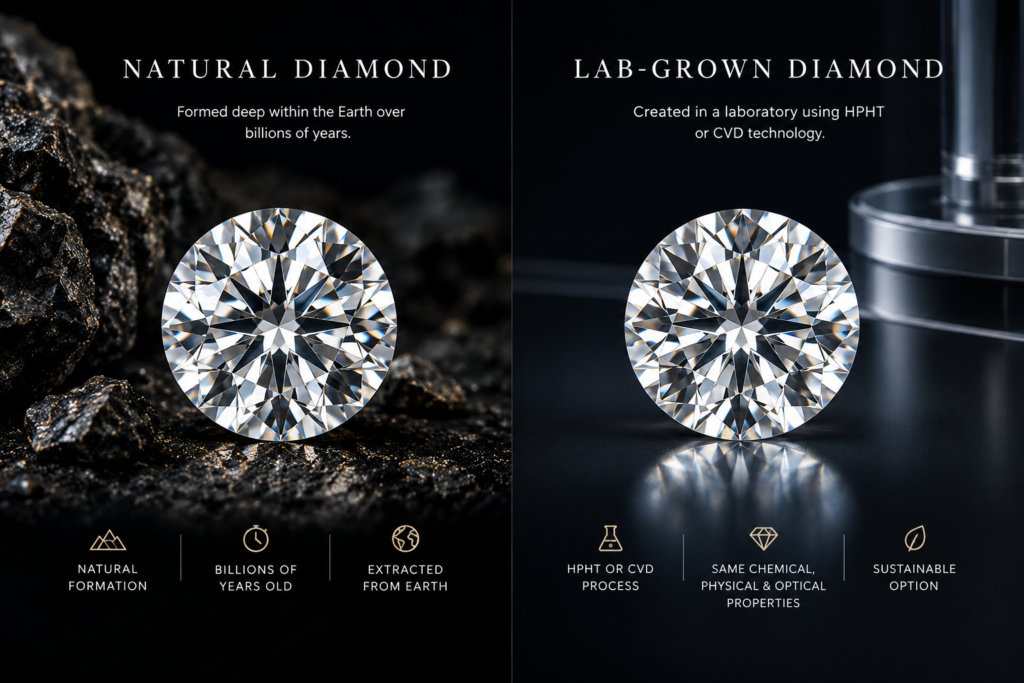
A diamond can be chemically identical to another and still carry a profoundly different story. That distinction sits at the heart of the natural vs lab grown diamonds debate, a subject that has moved well beyond price and into questions of rarity, provenance, craftsmanship, symbolism and long-term desirability.
For affluent buyers and collectors, the decision is not simply whether one stone looks more impressive under a jeweller’s loupe. It is about understanding what is actually being acquired: a geological object formed deep within the Earth over extraordinary spans of time, or a diamond created through advanced technology in a controlled laboratory environment. Both can possess the essential optical, physical and chemical characteristics associated with diamond, yet their origins, market dynamics and collector narratives are fundamentally different.
That makes the distinction particularly important within Luxury Fine Jewelry, where the significance of an acquisition often extends beyond immediate visual appeal. A serious buyer should consider the stone itself, the quality of its cutting, the credibility of its grading documentation, the provenance represented by the purchase and the role the diamond is expected to play in a personal collection.
The modern market has made the choice more nuanced. Laboratory-grown diamonds are not diamond simulants such as cubic zirconia or synthetic moissanite; they are diamonds produced through technological processes rather than geological formation. The Federal Trade Commission specifically distinguishes laboratory-created diamonds from mined diamonds and requires sellers to make that difference clear to consumers.
For the buyer, therefore, the most useful question is not simply, “Which is better?” It is more precise: Which type of diamond better matches the purpose, philosophy and expectations of this particular acquisition?
Natural vs Lab Grown Diamonds: Quick Reference
| Consideration | Natural Diamond | Laboratory-Grown Diamond |
|---|---|---|
| Origin | Formed naturally within the Earth | Created through controlled laboratory processes |
| Core material | Diamond | Diamond |
| Optical properties | Diamond characteristics | Diamond characteristics |
| Chemical composition | Carbon crystallised as diamond | Carbon crystallised as diamond |
| Primary growth methods | Natural geological formation | HPHT or CVD technology |
| Rarity | Naturally scarce geological material | Manufactured and potentially scalable |
| Provenance | Geological and, where documented, geographic | Laboratory/manufacturer provenance |
| Typical appeal | Rarity, heritage, geological history and traditional symbolism | Size, specification, design flexibility and technological provenance |
| Collector consideration | Scarcity and provenance can be central | Acquisition economics and individual stone quality are often more important |
| Grading | Independent grading/reporting is essential | Independent assessment is equally important |
| Investment potential | Highly dependent on rarity, quality, provenance and market demand | Should not be assumed simply because the stone is a diamond |
| Best suited to | Buyers who value geological rarity and traditional diamond heritage | Buyers prioritising specification, design and contemporary value |
The table reveals an important point that is frequently lost in online discussions: diamond identity and diamond market value are not the same thing. A laboratory-grown stone can be a genuine diamond while occupying a very different position in the luxury market from a naturally formed stone.
What Is a Natural Diamond?
A natural diamond is a geological material formed through natural processes within the Earth. Its journey begins long before it reaches a cutting house, jeweller or auction room. Carbon atoms crystallise under extreme conditions, and geological forces can eventually bring diamond-bearing material closer to the surface, where it may be recovered, cut and polished.
That geological history is part of the attraction.
For a collector, a natural diamond represents more than a finished gemstone. It can embody an almost unfathomable span of geological time, followed by a comparatively brief human chapter involving discovery, cutting, polishing, setting and ownership. In exceptional stones, provenance can become an additional layer of significance.
This is one reason serious buyers should resist reducing natural diamonds to carat weight alone. Two diamonds of identical weight can have dramatically different desirability depending on colour, clarity, cut, proportions, fluorescence, shape, provenance and rarity.
For readers considering diamonds as part of a broader luxury-asset strategy, Emmanuel Noir’s diamond investment guide examines the factors that should be considered before treating a diamond as an investment rather than simply a piece of jewellery.
What Is a Lab Grown Diamond?
A laboratory-grown diamond is produced by technology that recreates conditions under which diamond can form. The two principal methods are HPHT — high-pressure, high-temperature — and CVD — chemical vapour deposition.
HPHT technology uses high pressure and high temperature to encourage carbon to crystallise into diamond. CVD takes a different technological route, using a controlled chamber in which carbon-containing gases are introduced and diamond material grows layer by layer.
The resulting stone is not merely diamond-like. It is diamond material produced through a different origin pathway. The distinction matters because the origin of the stone is itself a material fact in a jewellery transaction.
The GIA currently provides dedicated laboratory-grown diamond services and uses distinct documentation and identification procedures for laboratory-grown stones. Its laboratory-grown diamond services include quality assessments and, for applicable reports, laser inscription identifying the stone as laboratory-grown.
This is precisely why sophisticated buyers should never rely solely on appearance. A well-cut laboratory-grown diamond can display exceptional brilliance, fire and scintillation. A natural diamond can do the same. The eye may appreciate the result, while the documentation establishes the origin.
Natural vs Lab Grown Diamonds: The First Principle — Origin Changes the Story
The most important conceptual distinction is simple: natural diamonds and laboratory-grown diamonds are different in origin, even when they share the fundamental properties of diamond.
That distinction should not be confused with the difference between a diamond and a simulant. A simulant attempts to resemble diamond while being a different material. A laboratory-grown diamond belongs to the diamond category itself, but it is produced rather than naturally formed.
The terminology matters in the marketplace. The FTC’s Jewelry Guides state that laboratory-created diamonds should be clearly described as laboratory-grown, laboratory-created or equivalent wording so that consumers understand they are not mined diamonds.
For a serious buyer, this means the phrase “lab grown” is not a minor marketing footnote. It is part of the identity and provenance of the stone.
The 4Cs Still Matter — But They Do Not Tell the Whole Story
Whether a buyer chooses a natural or laboratory-grown diamond, the traditional 4Cs — cut, colour, clarity and carat weight — remain central to evaluating the stone’s quality.
Yet the 4Cs should never become a substitute for proper documentation.
The GIA’s natural diamond grading reports assess the 4Cs and, for relevant round brilliant diamonds, provide a cut grade alongside additional information such as clarity characteristics and proportions.
Laboratory-grown diamonds are also subject to professional assessment, but the reporting framework distinguishes them from natural diamonds. GIA’s current laboratory-grown services use dedicated documentation, with applicable stones laser-inscribed as “Laboratory-Grown” alongside the report identification.
The implication is important: a buyer comparing two stones should compare like with like. Carat weight alone is insufficient. Colour grade alone is insufficient. Even a seemingly exceptional clarity grade cannot compensate for poor cutting, questionable documentation or an acquisition price that bears little relationship to the stone’s actual market position.
A Brief History of the Diamond Divide
The modern natural-versus-laboratory-grown conversation is the latest chapter in a much longer history of diamond technology.
Natural diamonds have occupied a privileged position in jewellery for centuries, but the modern diamond industry accelerated dramatically during the nineteenth and twentieth centuries as major discoveries, industrial cutting techniques and increasingly sophisticated retail networks transformed diamonds into globally recognised symbols of wealth, romance and status.
Laboratory diamond research developed alongside advances in high-pressure physics and materials science. HPHT synthesis eventually demonstrated that humans could reproduce the extreme conditions required to grow diamond, initially with strong industrial applications. Later advances in CVD technology opened another pathway for producing diamond material with increasing control and scalability.
The result is today’s two-track market: one built around naturally occurring geological rarity, and another built around technological production.
That evolution has changed the luxury buyer’s decision. The question is no longer whether laboratory technology can produce a diamond. It can. The more sophisticated question is what the buyer believes gives a diamond enduring significance — geological rarity, personal symbolism, visual performance, provenance, price efficiency, collectability or some combination of these attributes.
And that is where the natural vs lab grown diamonds conversation becomes considerably more interesting than a simple price comparison.
Why Serious Buyers Should Look Beyond the Initial Price
Laboratory-grown diamonds have made larger or higher-specification stones accessible at price points that can differ substantially from comparable natural diamonds. That can be compelling for a buyer whose priority is visual scale or a particular combination of cut, colour and clarity.
But price efficiency should not automatically be interpreted as investment value.
The market for a luxury object depends on more than what it costs to manufacture. Scarcity, desirability, provenance, cultural significance, brand positioning and secondary-market demand can all influence how an asset behaves after purchase. Those variables deserve particular attention when the buyer is considering a significant natural diamond or an exceptional piece of diamond jewellery.
Natural diamonds themselves are not automatically investments either. A diamond’s ability to retain or appreciate value depends heavily on its individual characteristics and the market in which it is bought and sold. The prudent collector therefore separates wearable luxury from financial investment, even when both occupy the same piece of jewellery.
That distinction will become crucial when we examine pricing, resale expectations, rarity and the question of whether natural or laboratory-grown diamonds make more sense for different types of buyers.
Design & Craftsmanship: Where the Stone Becomes Jewellery
A diamond does not become a luxury object simply because it possesses a high carat weight. Its character emerges through proportion, cutting precision, symmetry, polish and the way those elements interact with the setting. This is true whether the stone was mined from the Earth or grown in a laboratory.
In exceptional jewellery, craftsmanship creates the bridge between gemstone and object. A beautifully proportioned natural diamond can lose much of its visual authority if poorly cut. Conversely, a laboratory-grown diamond with excellent optical performance can look remarkably compelling when cut with precision and placed in a thoughtfully engineered setting.
That is why the natural vs lab grown diamonds comparison should never be reduced to a question of whether one “looks better.” Once a diamond has been cut and mounted, the quality of the finished jewellery depends on a chain of decisions: rough selection, planning, faceting, polishing, setting, metal choice and final finishing.
Cut Quality Is Still the Quiet Luxury Factor
Among the traditional 4Cs, cut deserves particular attention because it determines how effectively a diamond handles light. Two stones can share the same carat weight, colour and clarity yet produce very different visual impressions because their proportions and facet relationships differ. The same principle applies across coloured stones, where the most valuable precious gemstones often derive their distinction from the interaction between colour, cut, clarity, provenance and the cutter’s ability to reveal the character of the natural material.
For the luxury buyer, this creates an important opportunity. Instead of allowing carat weight to dominate the purchase, examine how the diamond actually performs. A slightly smaller stone with excellent proportions can possess greater presence than a larger stone whose cut compromises brilliance or scintillation.
The principle applies equally to natural and laboratory-grown diamonds. Technology may determine how the rough material came into existence, but it does not eliminate the need for skilled cutting.
For readers interested in how rarity extends beyond conventional white diamonds, Emmanuel Noir’s guide to most valuable coloured diamonds explore why exceptional colour can transform a diamond from a beautiful gemstone into an entirely different class of collector object.
HPHT vs CVD: Two Very Different Routes to a Laboratory-Grown Diamond
The phrase “lab grown” describes origin, but it does not describe a single manufacturing process.
HPHT uses extremely high pressure and temperature to encourage carbon to crystallise around a diamond seed. CVD, or chemical vapour deposition, uses a controlled chamber in which carbon-containing gases are broken down and carbon is deposited onto diamond seed material.
The resulting growth patterns differ. GIA research identifies distinctive characteristics associated with HPHT and CVD stones, including differences in growth morphology, fluorescence, strain patterns and inclusions. Identification can require advanced instrumentation rather than ordinary visual inspection.
This distinction matters less to a buyer because one method is inherently “better” and more because it demonstrates how sophisticated the laboratory-grown market has become. A modern laboratory-grown diamond is the product of substantial materials science, engineering and quality control.
That technological provenance may itself appeal to some buyers.
For others, however, the attraction of a natural diamond lies precisely in the absence of human manufacture at the origin of the stone. The geological formation is not a manufacturing specification that can be replicated simply by reproducing pressure and temperature. It is part of the object’s story.
Performance & Ownership: What You Actually See on the Hand
When a finished diamond is viewed in jewellery, the first experience is optical rather than geological.
Brilliance, fire and scintillation are what the wearer sees when the stone moves through light. A well-cut laboratory-grown diamond can therefore produce an exceptionally impressive visual result. Its laboratory origin does not prevent it from functioning as a diamond in the physical and optical sense.
GIA notes that laboratory-grown diamonds possess essentially the same chemical, physical and optical properties as natural diamonds, while their growth characteristics allow trained laboratories to distinguish their origin.
This is an important corrective to two opposite misconceptions.
The first is that laboratory-grown diamonds are merely imitations. They are not. A laboratory-grown diamond is diamond material.
The second is that chemical and optical similarity means the two categories are interchangeable in every respect. They are not. Origin, rarity, supply dynamics, disclosure and market positioning remain materially different.
Durability Does Not Decide the Debate
Diamond’s reputation for exceptional hardness makes it naturally suited to jewellery intended for regular wear. But hardness is only one part of ownership.
The setting remains vulnerable to wear, impacts and deformation. Prongs can loosen. Pavé sections can require inspection. Fine settings can accumulate dirt and oils. White metals may require maintenance, and delicate jewellery can need professional attention regardless of the stone’s origin.
The appropriate care routine therefore depends more on the design of the jewellery than on whether the diamond is natural or laboratory-grown.
For a significant acquisition, documentation should be preserved alongside the piece. Keep the grading report, purchase documentation, photographs and any available provenance records. These materials form part of the object’s ownership history and can become particularly useful when jewellery changes hands.
Identification Is Not a Matter of Guesswork
One of the most important lessons for serious buyers is that visual confidence is not the same as authentication.
A laboratory-grown diamond may appear indistinguishable from a natural diamond to the unaided eye. GIA explains that advanced laboratory testing may be necessary to establish origin conclusively, particularly as laboratory-grown material becomes increasingly sophisticated.
That makes independent documentation indispensable when the distinction affects the purchase decision.
A seller’s description should never be treated as the sole evidence of origin. Examine the report, verify the report number through the issuing laboratory where available, confirm that the inscription corresponds with the documentation when applicable, and make sure the description on the invoice reflects what has actually been purchased.
This is particularly important in jewellery containing multiple small stones. Melee diamonds can be difficult to screen individually, and professional laboratories have developed specialised methods to identify laboratory-grown stones in small sizes. GIA research specifically highlights the identification challenges presented by melee parcels.
Market Position: Two Diamonds, Two Economic Narratives
The most consequential difference between natural and laboratory-grown diamonds emerges when the conversation moves from the jewellery box to the marketplace.
Natural diamonds derive part of their appeal from geological scarcity. Their supply is constrained by the existence, discovery, extraction and economics of natural diamond deposits. Exceptional natural diamonds add further scarcity through unusual colour, size, clarity, provenance or combinations of these characteristics.
Laboratory-grown diamonds operate under a fundamentally different supply model. Production depends on technology, manufacturing capacity, energy, capital investment and demand. Improvements in production can increase the availability of stones at particular specifications.
That distinction has major implications for price.
A laboratory-grown diamond can offer a buyer substantially more apparent specification for a given budget. A larger laboratory-grown stone may therefore be an attractive choice for someone whose priority is visual scale, a particular setting or the ability to allocate more of the budget toward craftsmanship.
But the same characteristic that makes laboratory-grown diamonds attractive to consumers can complicate their positioning as scarce collectible assets: manufacturing capacity can expand supply.
Rarity Is Not the Same as Quality
This distinction deserves emphasis.
A 3-carat laboratory-grown diamond can be an extraordinary piece of craftsmanship and still not possess the same scarcity profile as an unusual 3-carat natural diamond. Conversely, a mediocre natural diamond is not automatically collectible simply because it was formed naturally.
Quality and rarity must be evaluated separately.
For collectors, the most compelling natural diamonds tend to combine multiple desirable attributes: exceptional colour, clarity, size, cut, provenance or a combination that is genuinely unusual within the market.
For the laboratory-grown buyer, the calculation can be different. The attraction may lie in securing a particular visual specification, maximising size within a defined budget or commissioning a contemporary piece without paying the premium associated with geological rarity.
Neither objective is inherently superior. They simply describe different definitions of value.
Natural vs Lab Grown Diamonds in the Luxury Jewellery Market
Luxury jewellery has always contained objects whose value comes from several layers at once.
The gemstone matters. The maker matters. The design matters. The materials matter. Provenance can matter. Cultural significance can matter. Scarcity can matter. And the emotional reason for the acquisition can matter more than all of them.
Natural diamonds occupy a particularly established position within this hierarchy because their geological origin reinforces the traditional luxury narrative of rarity and permanence.
Laboratory-grown diamonds introduce a newer narrative: precision manufacturing, technological progress, accessibility of specification and the ability to produce diamond material without geological extraction.
That does not necessarily make laboratory-grown jewellery less sophisticated. It changes the story the object tells.
For a buyer commissioning a contemporary engagement ring, for example, a laboratory-grown diamond may make it possible to prioritise a larger centre stone or a more elaborate setting. For another buyer, the significance of a naturally formed stone may be inseparable from the meaning of the gift.
The correct decision therefore depends on what the jewellery is intended to represent.
Competition: Natural Diamond, Lab Grown Diamond and the Meaning of Luxury
The strongest comparison is not between two stones sitting beneath a loupe. It is between two philosophies of acquisition.
The natural-diamond philosophy places greater emphasis on geological origin, scarcity, tradition and the historical role diamonds have played in luxury culture.
The laboratory-grown philosophy places greater emphasis on technological creation, specification, contemporary economics and the ability to obtain diamond material without relying on geological rarity as the central value proposition.
There is room for both within modern luxury.
The sophisticated buyer should simply refuse to let marketing language make the decision on their behalf.
Terms such as “ethical,” “sustainable,” “investment,” “rare,” “exclusive” or “better value” should each trigger a second question: Better according to which measure?
Environmental claims deserve the same discipline. The impact of a diamond depends on factors that can include extraction or manufacturing methods, energy sources, transportation and supply-chain practices. A categorical claim that one origin is automatically environmentally superior oversimplifies a complicated lifecycle question.
The Federal Trade Commission’s jewellery guidance also makes clear why origin and environmental representations need careful substantiation rather than vague marketing language.
For the serious buyer, this leads to a more useful conclusion: luxury is not defined by the adjective attached to a diamond. It is defined by the integrity of the object, the quality of its execution, the transparency of its provenance and the reasons the buyer believes the object deserves a place in their life or collection.
The Collector’s Perspective
Collectors often think differently from conventional consumers.
The consumer asks whether the diamond looks beautiful for the price.
The collector asks why this particular diamond deserves to exist within a collection.
That second question changes everything.
A natural diamond with exceptional characteristics can possess a compelling collecting narrative because its supply cannot simply be increased by commissioning another production run. An unusual natural coloured diamond, a stone with important provenance or a genuinely scarce combination of size and quality can become interesting precisely because the number of comparable examples is limited. For collectors deciding how such a stone might fit into a broader jewellery strategy, our how to build a fine jewelry collection guide examines how gemstone rarity, craftsmanship, provenance and the intended role of each acquisition can shape the collection as a whole.
Laboratory-grown diamonds are more difficult to approach through the same scarcity framework. Their strongest proposition is usually not geological rarity but control: control over specification, production and, in many cases, budget.
This does not make laboratory-grown jewellery irrelevant to collectors. It simply suggests that the collector should evaluate it primarily as a design object, a personal acquisition or a technologically distinctive expression of modern jewellery rather than automatically assigning it the scarcity premium associated with exceptional natural stones.
That distinction will become decisive when we turn to the actual buying decision: what should a serious buyer pay for, what should they verify, and when does the premium for natural origin make sense?
Buying Considerations: What Serious Buyers Should Examine
The most intelligent way to approach natural vs lab grown diamonds is to decide what you are actually buying before deciding which stone you want.
If the objective is maximum visual scale for a defined budget, a laboratory-grown diamond can be compelling. If the objective is geological rarity, traditional provenance and the possibility of owning an unusually scarce natural stone, the calculation changes.
Neither decision should begin with carat weight.
It should begin with purpose.
1. Decide Whether Rarity Matters to You
Rarity is one of the most important distinctions between natural and laboratory-grown diamonds.
A natural diamond is the product of geological processes that cannot simply be repeated on demand. Exceptional natural stones can become especially scarce when several desirable characteristics occur together: substantial size, high clarity, exceptional colour, unusual shape, strong cut quality and documented provenance.
Laboratory-grown diamonds follow a production model. Their availability can respond to technological capability and market demand. That makes them particularly attractive to buyers who want specification rather than scarcity.
For a collector, this distinction is fundamental.
If the emotional centre of the purchase is “I want something exceptionally rare,” natural diamonds generally deserve greater attention.
If it is “I want the finest stone I can obtain within this budget,” laboratory-grown diamonds may deserve serious consideration.
2. Compare Like With Like
One of the easiest mistakes in a diamond purchase is comparing stones solely by carat weight.
A 2-carat natural diamond and a 2-carat laboratory-grown diamond may differ considerably in colour, clarity, cut quality, proportions and fluorescence. Even two stones from the same origin category can perform very differently.
The disciplined approach is to establish a hierarchy:
- Origin
- Cut quality
- Colour
- Clarity
- Carat weight
- Shape and proportions
- Fluorescence
- Treatments or post-growth processes
- Grading documentation
- Seller reputation and return terms
This approach prevents the largest number on the specification sheet from becoming the entire purchasing argument.
3. Insist on Independent Documentation
For a serious acquisition, documentation is not decorative paperwork. It is part of the transaction.
A reputable grading laboratory can document characteristics and help establish whether the stone is natural or laboratory-grown. Buyers should verify the report number, examine the report details and, where applicable, check the laser inscription on the stone.
The distinction is particularly important because the two categories can look extraordinarily similar to the naked eye.
A seller who is vague about origin, reluctant to provide documentation or unwilling to explain the grading laboratory should be treated cautiously.
4. Examine the Seller as Carefully as the Stone
Luxury jewellery is an experience of trust as much as an experience of materials.
Before purchasing, examine the seller’s reputation, return policy, warranty, resizing terms, after-sales service and documentation standards. Online purchasing can offer remarkable choice, but the burden of due diligence increases when the buyer cannot inspect the stone physically before committing.
The Federal Trade Commission advises diamond buyers to compare quality, price and service among sellers and to investigate businesses before purchasing. It also recommends understanding terms such as natural, laboratory-created and imitation because they describe materially different categories.
5. Treat Environmental Claims With Discipline
Environmental messaging has become an increasingly influential part of the diamond conversation, but sophisticated buyers should resist absolute claims.
The environmental profile of a diamond can depend on extraction or manufacturing methods, energy sources, transportation, processing and supply-chain practices. “Mined” and “laboratory-grown” describe origin; they do not, by themselves, provide a complete lifecycle assessment.
That distinction matters because luxury buyers increasingly expect provenance to include more than the stone’s physical origin. They also want to understand how claims about responsible production are substantiated.
The prudent approach is simple: ask for evidence rather than accepting broad sustainability language at face value.
6. Understand What You Are Paying For
A natural diamond can command a premium partly because the market places value on geological rarity and traditional diamond provenance.
A laboratory-grown diamond can offer a different proposition: a buyer may be able to obtain greater size or a higher specification within the same budget.
The mistake is to assume that the cheaper stone is automatically the better purchase.
Price efficiency and value retention are different concepts.
If a buyer spends $15,000 on a laboratory-grown diamond rather than $15,000 on a natural diamond, the two purchases should not be evaluated simply by asking which one contains more carats. The more meaningful question is which object better fulfils the buyer’s intended purpose.
7. Separate Jewellery Value From Investment Value
This distinction is essential.
A diamond can be a superb luxury purchase without being a superior financial investment.
Jewellery carries emotional, aesthetic and cultural value that cannot be captured by resale calculations alone. A ring chosen to mark a marriage, anniversary or personal milestone may deliver extraordinary value to its owner regardless of what the secondary market eventually offers.
Natural diamonds can possess characteristics that make particular stones more interesting to collectors, but buyers should not assume that ordinary natural diamonds automatically appreciate.
Laboratory-grown diamonds should be approached with even greater caution when an investment thesis is the primary reason for purchase. Production scalability and changing market economics mean that today’s retail price should not be treated as a guaranteed floor beneath tomorrow’s resale value.
The strongest investment case, when one exists, usually belongs to exceptional individual stones rather than to the generic category.
8. Consider the Setting Before Finalising the Stone
A diamond and its setting should be considered as one composition.
A larger centre stone may require a different setting architecture. A delicate halo can create visual scale without requiring an enormous centre diamond. An emerald cut can communicate a different aesthetic from a round brilliant. An oval can produce substantial finger coverage while maintaining an elegant silhouette.
This is where a sophisticated buyer can make a laboratory-grown diamond particularly interesting: savings on the stone may allow more of the budget to move toward bespoke design, rare metalwork or a more ambitious setting.
For natural-diamond buyers, the opposite strategy can make sense: allocate more of the budget toward the stone itself and keep the setting restrained enough to allow the diamond’s rarity to dominate.
Natural vs Lab Grown Diamonds: Side-by-Side Comparison
| Factor | Natural Diamond | Laboratory-Grown Diamond |
|---|---|---|
| Fundamental material | Diamond | Diamond |
| Origin | Geological formation | Controlled laboratory production |
| Main production routes | Natural geological processes | HPHT or CVD |
| Visual potential | Exceptional when well cut | Exceptional when well cut |
| Rarity | Naturally scarce | Production can be scaled |
| Typical price position | Usually higher for comparable specifications | Usually lower for comparable specifications |
| Geological provenance | Yes | No |
| Technological provenance | Not applicable | Yes |
| Collector appeal | Strongest when rarity and provenance are exceptional | More commonly centred on design, specification and personal appeal |
| Resale expectations | Highly individual; not guaranteed | Highly individual; should not be assumed to track original retail price |
| Best advantage | Rarity, heritage and geological story | Specification and budget efficiency |
| Principal risk | Paying a premium for an ordinary stone simply because it is natural | Mistaking lower purchase price for investment value |
| Ideal buyer | Collector or buyer who values natural origin | Buyer prioritising specification, design or budget efficiency |
The table should not be interpreted as a verdict in favour of either category. It is a framework for understanding what each purchase is designed to accomplish.
The Case for Natural Diamonds
Pros
Geological rarity. Natural formation gives exceptional stones a scarcity narrative that laboratory production cannot replicate.
Traditional luxury heritage. Natural diamonds have an established place in fine jewellery, ceremonial culture and collecting.
Provenance potential. Particularly important stones can acquire additional significance through documented ownership history, exceptional origin stories or auction history.
Collector compatibility. Exceptional natural diamonds can fit naturally into collections built around rarity, provenance and connoisseurship.
Emotional symbolism. For many buyers, the idea that the stone formed naturally over geological time adds meaning to an important personal acquisition.
Cons
Higher acquisition cost. Comparable natural stones can command substantial premiums over laboratory-grown alternatives.
Potentially weaker value than expected. Being natural does not automatically make a diamond a strong investment.
Greater complexity. Finding a genuinely exceptional stone requires more research than simply selecting a natural diamond with attractive specifications.
Marketing premiums. Buyers can pay heavily for branding, retail positioning or emotional narratives that are not necessarily reflected in secondary-market demand.
The Case for Laboratory-Grown Diamonds
Pros
Specification efficiency. Buyers can often pursue larger or higher-specification stones for a given budget.
Design flexibility. A lower stone acquisition cost can leave more capital for bespoke settings, craftsmanship or other jewellery elements.
Technological provenance. For some buyers, advanced diamond-growing technology is itself part of the attraction.
Clear category distinction. When properly documented and disclosed, laboratory-grown diamonds can be evaluated on their own merits rather than being treated as imitation stones.
Strong visual potential. A well-cut laboratory-grown diamond can deliver exceptional brilliance, fire and scintillation.
Cons
Production scalability. Greater manufacturing capacity can challenge scarcity-based collecting narratives.
Resale uncertainty. Buyers should not assume that a laboratory-grown diamond will retain its original retail price.
Limited traditional provenance. It does not possess the geological history that forms part of the appeal of natural diamonds.
Rapid market evolution. Technology, production economics and consumer preferences can change quickly.
Potential buyer mismatch. Someone seeking a rare geological object may ultimately feel that a laboratory-grown diamond does not satisfy the emotional purpose of the acquisition.
When the Price Difference Is Worth Paying
This is the question at the centre of the entire natural vs lab grown diamonds debate.
The natural premium is more defensible when the stone possesses something genuinely scarce.
That might be an exceptional natural colour, unusual size, outstanding clarity, distinctive shape, important provenance or a combination of characteristics that significantly narrows the comparable market.
The premium is less compelling when the only argument is simply that the stone is natural.
A natural diamond of ordinary characteristics is still natural, but natural origin alone does not transform an otherwise unremarkable stone into a collector-grade asset.
For the buyer considering an important acquisition, the question should therefore become:
What exactly is the premium buying me?
If the answer is rarity, provenance, exceptional colour or an unusually strong combination of characteristics, the premium may be meaningful.
If the answer is merely “because it is natural,” more scrutiny is warranted.
Where Laboratory-Grown Diamonds Make the Most Sense
A laboratory-grown diamond can be particularly attractive when the buyer has a clear design objective.
Perhaps the goal is a substantial engagement ring with a large centre stone. Perhaps the buyer wants an elaborate custom setting. Perhaps the budget is fixed but the desired visual scale is not negotiable.
In those circumstances, the laboratory-grown route can free capital for craftsmanship elsewhere in the piece.
For buyers who want to explore diamond jewellery from established online specialists, James Allen’s diamond collection provides a useful reference point for comparing stone specifications and jewellery designs.
This recommendation is included for comparison and purchasing research, not as an assertion that James Allen is universally superior or that every listed diamond represents exceptional value.
When Natural Diamonds Make the Stronger Argument
Natural diamonds become particularly compelling when the buyer is not simply shopping for a diamond but searching for a specific stone.
That distinction separates consumption from collecting.
A collector may reject a larger laboratory-grown diamond in favour of a smaller natural stone because the natural stone possesses an unusual colour, exceptional proportions, important provenance or an especially compelling combination of characteristics.
The collector’s satisfaction comes from owning that particular object.
For this audience, the premium is not necessarily paying for greater sparkle. It is paying for scarcity, history and the possibility that another comparable stone may be difficult to find.
A Second Buying Resource: Compare Before You Commit
A serious diamond purchase benefits from independent comparison. Buyers should examine multiple stones, compare grading reports and resist the pressure to make a decision simply because a seller describes a particular stone as “rare,” “investment grade” or “exceptional.”
For buyers evaluating diamonds as potential luxury assets rather than simply jewellery purchases, Emmanuel Noir’s rough diamond investment guide provides another perspective on the relationship between diamond rarity, market structure and investment thinking.
The important caveat is that a finished jewellery diamond and rough diamond are fundamentally different acquisition propositions. The comparison is useful for understanding scarcity and market mechanics, not for suggesting that the two should be evaluated identically.
Who Should Buy a Natural Diamond?
A natural diamond is the stronger choice for the buyer who:
- values geological rarity;
- attaches importance to traditional diamond heritage;
- wants provenance to form part of the object’s story;
- is willing to pay a premium for scarcity;
- appreciates exceptional stones as collectible objects;
- intends to keep the jewellery for many years or potentially across generations;
- understands that natural origin does not guarantee investment performance.
For this buyer, the emotional and intellectual appeal of the stone is inseparable from where it came from.
Who Should Buy a Laboratory-Grown Diamond?
A laboratory-grown diamond is the stronger choice for the buyer who:
- prioritises size or specification within a defined budget;
- wants to allocate more capital toward jewellery design and craftsmanship;
- appreciates technological innovation;
- cares more about the finished visual result than geological provenance;
- wants a genuine diamond rather than a simulant;
- understands that laboratory-grown origin is materially different from mined origin;
- is purchasing primarily for personal enjoyment rather than speculative resale.
This can be an entirely sophisticated luxury decision.
There is nothing inherently contradictory about commissioning an exceptional piece of jewellery around a laboratory-grown diamond. The luxury can reside in the design, craftsmanship, metalwork, setting and overall composition rather than in geological scarcity.
Who Should Skip the Purchase — At Least for Now?
The buyer who should pause is the one who cannot clearly answer why the diamond matters.
If the decision is being driven entirely by social pressure, an arbitrary carat target or a belief that diamonds automatically appreciate, stepping back is sensible.
The same applies to anyone who has not compared grading documentation, seller policies and total purchase cost.
And for collectors, there is one additional warning: do not buy a natural diamond merely because the word “natural” appears to justify a premium.
A serious collection is built selectively.
The strongest acquisition may be a smaller natural diamond with extraordinary characteristics. It may be a laboratory-grown diamond in a beautifully engineered bespoke setting. Or it may be no diamond at all until the right stone appears.
Patience remains one of the most valuable luxuries available to the collector.
The Emmanuel Noir Buying Framework
Before committing to a significant diamond purchase, ask seven questions:
What is the origin?
What independent documentation supports that origin?
How strong is the cut?
What makes this individual stone distinctive?
Am I paying for rarity, specification, design or branding?
What do I realistically expect if I ever need to resell it?
Would I still want this exact stone if resale value were irrelevant?
That final question may be the most revealing.
If the answer is yes, the purchase is probably being made for the right reason.
If the answer is no, the buyer may be evaluating a luxury object as though it were a financial instrument — a category error that can become expensive.
Frequently Asked Questions About Natural vs Lab Grown Diamonds
Are lab grown diamonds real diamonds?
Yes. Laboratory-grown diamonds are genuine diamond material, not diamond simulants. They share the fundamental chemical, physical and optical characteristics of natural diamonds, although their origin and growth characteristics differ.
The critical distinction is provenance. A natural diamond formed through geological processes, while a laboratory-grown diamond was produced through a technological process such as HPHT or CVD. A serious buyer should therefore regard “lab grown” as an origin designation rather than a synonym for imitation.
Are natural diamonds better than lab grown diamonds?
Not universally.
Natural diamonds offer something laboratory-grown diamonds cannot reproduce: geological origin and natural scarcity. Laboratory-grown diamonds offer a different advantage, often allowing buyers to pursue larger or higher specifications within a given budget.
The better choice depends on the buyer’s priorities.
If rarity, geological history and traditional provenance matter most, a natural diamond may be the more compelling acquisition. If specification, design freedom and budget efficiency matter more, laboratory-grown diamonds can make considerable sense.
Do lab grown diamonds hold their value?
Buyers should be cautious about expecting strong resale performance from laboratory-grown diamonds.
The market is shaped by production capacity, technological development, consumer demand and changing retail economics. Because laboratory-grown production can be scaled, scarcity does not operate in the same way as it does for naturally occurring diamonds.
This does not mean a laboratory-grown diamond has no value. It means that buyers should distinguish purchase value from resale value and should never assume that the original retail price establishes a guaranteed future floor.
Do natural diamonds appreciate in value?
Some exceptional natural diamonds can become highly desirable collector objects, but natural origin alone does not guarantee appreciation.
Investment potential depends on the individual stone and its market position. Exceptional colour, rarity, size, clarity, cut, provenance and auction history can all contribute to desirability.
For that reason, anyone approaching diamonds primarily as an asset should study the market before purchasing. Emmanuel Noir’s diamond investment guide provides a broader framework for evaluating diamonds as potential luxury assets.
Can you tell the difference between natural and lab grown diamonds by looking at them?
Usually not with confidence.
A laboratory-grown diamond can display the same fundamental optical characteristics as a natural diamond, and determining origin may require specialised laboratory equipment.
That is why grading documentation and professional verification matter. A sophisticated buyer should never rely on visual inspection alone when origin affects the value or meaning of the purchase.
Are lab grown diamonds more ethical?
There is no responsible universal answer based solely on origin.
Laboratory-grown diamonds avoid conventional mining because they are produced in controlled facilities, but their environmental profile can depend heavily on the energy used, manufacturing process and broader supply chain.
Natural diamonds likewise vary according to mining practices, location, processing and supply-chain standards.
The more rigorous question is not simply which category is “ethical,” but what evidence supports the specific environmental and social claims being made about the stone?
Do lab grown diamonds get cloudy or lose their sparkle?
A properly cut laboratory-grown diamond does not inherently become cloudy simply because it was grown in a laboratory.
Its optical performance depends heavily on cut quality, material characteristics and finishing. As with natural diamonds, poor cutting can diminish brilliance while excellent cutting can create impressive light performance.
The buyer should therefore evaluate the individual stone rather than assuming that origin determines sparkle.
Which is better for an engagement ring?
Both can be appropriate.
An engagement ring is ultimately a deeply personal object, and the right choice depends on what the couple wants the diamond to represent.
A natural diamond may appeal to someone who values geological history, traditional symbolism and natural rarity. A laboratory-grown diamond may appeal to someone who wants a larger centre stone, a particular specification or more budget available for bespoke craftsmanship.
The most important decision is not which category wins in the abstract. It is whether the chosen stone reflects the meaning the ring is intended to carry.
Should I buy a larger lab grown diamond or a smaller natural diamond?
This is one of the most revealing choices in the entire market.
Choose the larger laboratory-grown diamond if visual scale and specification are central to the experience you want.
Choose the smaller natural diamond if rarity, geological provenance and the story of owning a naturally formed object matter more.
For a collector, the smaller stone may ultimately prove more emotionally compelling if it possesses unusual characteristics. For a design-led buyer, the larger laboratory-grown stone may create greater freedom for the finished piece.
There is no universally correct answer — only a more appropriate answer for the person wearing it.
Is a lab grown diamond a good luxury purchase?
It can be.
Luxury is not synonymous with scarcity alone. Craftsmanship, design, material quality, precision and personal significance all contribute to the character of a luxury object.
A laboratory-grown diamond set into exceptional jewellery can therefore be a sophisticated purchase. The buyer simply should not confuse its luxury appeal with the scarcity characteristics traditionally associated with exceptional natural diamonds.
What should I check before buying a diamond online?
At minimum, verify:
- the diamond’s stated origin;
- the grading laboratory and report number;
- the 4Cs and detailed proportions;
- whether the stone carries a laser inscription where applicable;
- the seller’s return policy;
- warranty and after-sales service;
- resizing conditions;
- total purchase price;
- any treatments or disclosures;
- and the terms governing future returns or exchanges.
For a significant purchase, the seller deserves almost as much scrutiny as the diamond.
Conclusion: Choose the Story You Actually Want to Own
The debate surrounding natural vs lab grown diamonds becomes much clearer once the noise is removed.
These are not simply two versions of the same retail product competing on price. They represent two different origin stories and, increasingly, two different approaches to luxury consumption.
The natural diamond carries geological history. Its appeal can come from scarcity, provenance, tradition and the extraordinary fact that the material existed within the Earth long before it became part of a ring, necklace or private collection.
The laboratory-grown diamond carries a technological story. It demonstrates what modern materials science can accomplish and gives buyers the opportunity to prioritise specification, scale and design within a different economic framework.
Neither story needs to invalidate the other.
The mistake is to purchase one while secretly wanting the qualities of the other.
A buyer who wants natural rarity should not be persuaded that a larger laboratory-grown stone compensates for the absence of geological provenance. A buyer who primarily wants design, scale and visual impact should not feel compelled to pay a substantial natural premium simply because tradition says they should.
The intelligent acquisition begins with self-knowledge.
Emmanuel Noir Verdict
For collectors and connoisseurs, Emmanuel Noir gives the advantage to exceptional natural diamonds when the purchase is centred on rarity, provenance and long-term collecting interest.
That qualification matters.
We are not recommending “natural” as a blanket category. We are recommending selectivity. A naturally formed diamond becomes significantly more compelling when its characteristics create genuine distinction — exceptional colour, remarkable clarity, unusual size, extraordinary cut, important provenance or another combination that separates it from the ordinary.
For design-led buyers and sophisticated consumers, laboratory-grown diamonds deserve serious consideration. They can deliver extraordinary visual performance while allowing greater flexibility in size, specification and jewellery design.
For investment-minded buyers, caution is the correct position. Neither category should be purchased on the assumption that every diamond appreciates. The individual stone, acquisition price, market demand and provenance matter far more than a simplistic natural-versus-laboratory label.
And for anyone still asking which is “better,” the answer is deliberately uncomfortable:
The better diamond is the one whose qualities you actually value — and whose price you can justify without needing a marketing story to make the decision for you.
That is the standard a serious luxury purchase should meet.
The Final Collector’s Principle
A diamond should earn its place.
Not through carat weight alone. Not through advertising language. Not through a fashionable sustainability claim. And not because a salesperson tells you that today’s price represents tomorrow’s investment opportunity.
It should earn its place through beauty, quality, provenance, craftsmanship, rarity where rarity matters, and a compelling reason for you to own that particular stone.
For buyers building a broader jewellery collection, Emmanuel Noir’s Cartier vs Van Cleef and Arpels comparison offers a useful next step into the wider question of how maison heritage, design language, craftsmanship and collector appeal influence fine-jewellery decisions.
The philosophy is simple: buy fewer things, understand them more deeply, and choose objects that remain meaningful after the excitement of acquisition has faded.
“Luxury begins where the obvious choice ends. The true collector does not ask what everyone else values; he asks what is rare enough, beautiful enough and meaningful enough to deserve a place in his world.”
— Emmanuel Noir
Affiliate Disclosure
Some links in this article may be affiliate links. If you purchase through an affiliate link, Emmanuel Noir may receive a commission at no additional cost to you. Our editorial recommendations remain independent, and affiliate relationships do not determine our assessment of a product, service or brand.