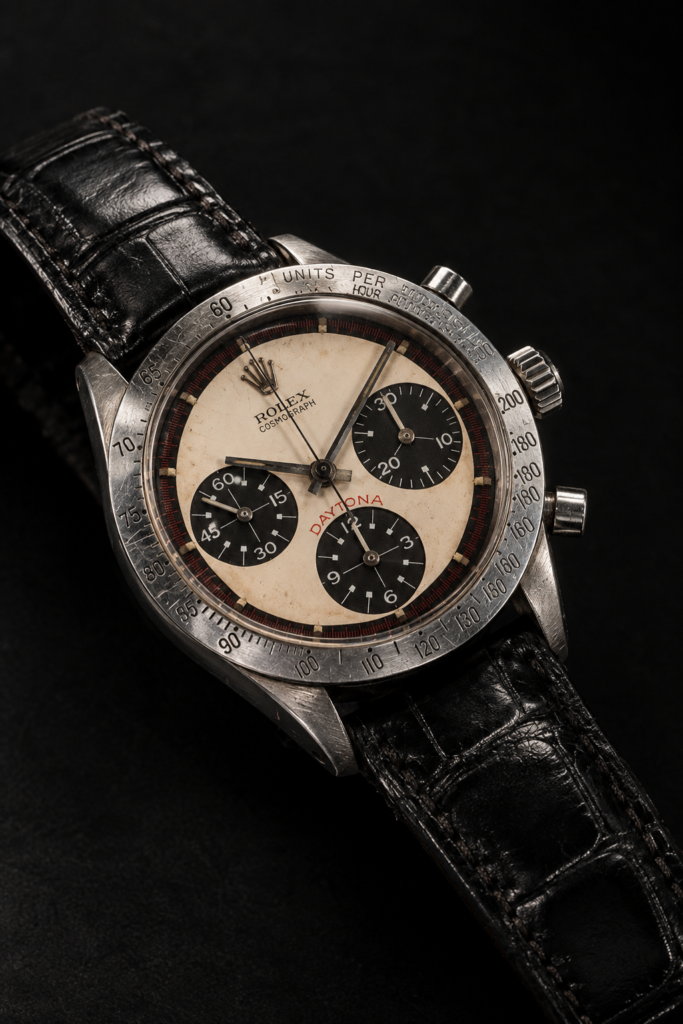
There are watches worth millions because they are rare. Then there is the Paul Newman Rolex Daytona untold story, in which a comparatively simple stainless-steel chronograph became a cultural artifact worth $17,752,500. On 26 October 2017, Phillips sold Paul Newman’s own Rolex Daytona Ref. 6239 in New York after a twelve-minute bidding battle, establishing a world auction record for a wristwatch at the time.
The number is extraordinary. The object itself is almost disarmingly restrained: steel case, manually wound chronograph, contrasting dial, acrylic crystal and a tachymeter bezel designed for speed rather than spectacle. Yet its significance cannot be separated from the man who wore it, the woman who gave it to him, the racing career it accompanied and the handwritten-looking intimacy of three words engraved into its caseback: “DRIVE CAREFULLY ME.” Rolex itself documents the engraving and its connection to Joanne Woodward and Newman’s racing life.
That is why the The Untold Story archive at Emmanuel Noir belongs at the beginning of this journey: luxury becomes most compelling when the object reveals the human history concealed behind its price.
Because the Paul Newman Rolex Daytona untold story begins with a price but ends with provenance, it asks a more difficult question than “What is the watch worth?” The real question is how an object designed to measure elapsed seconds became a permanent record of one man’s second life — the life he built away from Hollywood, behind a racing wheel.
And the answer begins before the auction room ever opened.
ACT 1: The Paul Newman Rolex Daytona Untold Story Begins Before the Record
The Watch Joanne Woodward Gave Paul Newman
The story reaches back to the late 1960s, when Rolex’s Cosmograph Daytona was still a specialised racing chronograph rather than the cultural phenomenon it would eventually become. Rolex had introduced the Cosmograph Daytona in 1963, developing the model around the demands of motorsport and adding the Daytona name to strengthen its association with the famous Florida racing destination.
Paul Newman entered that world from an unusual direction. He was already one of America’s most recognisable actors, but his fascination with motor racing was becoming increasingly serious. During the production of Winning, the 1969 racing film directed by James Goldstone, Newman played a professional driver. Just before filming, Joanne Woodward gave him a Cosmograph Daytona engraved “DRIVE CAREFULLY, ME.” Rolex’s own historical account places that gift immediately before filming began.
The inscription was affectionate rather than theatrical. It was also prophetic. Rolex’s own historical account records that Joanne Woodward gave Newman the Cosmograph Daytona just before Winning began filming, with the words “DRIVE CAREFULLY, ME” engraved on its caseback. The same account documents Newman’s subsequent professional racing career, including four SCCA championships and his second-place finish at the 1979 24 Hours of Le Mans.
That transformation changes how the Paul Newman Rolex Daytona should be understood. The watch did not become important because an actor happened to wear it. It became important because the life represented by the watch gradually became real.
For collectors, this distinction matters. The difference between celebrity association and authentic provenance can be enormous, which is why serious enthusiasts study the fundamentals of luxury watch collecting before attaching value to a famous name.
From Hollywood Star to Racing Driver
There is a beautiful contradiction at the centre of Newman’s story. Hollywood had made him famous, yet racing gave him a private identity that fame could not manufacture.
His first professional racing victory came in 1972, and his commitment deepened through the following decades. He raced at Lime Rock Park in Connecticut, competed at Daytona and Le Mans, and eventually became involved in team ownership. Motorsport records his four SCCA championships and his victories in major American racing competition.
The Daytona therefore acquired a meaning beyond its specification sheet.
It measured laps.
It travelled to circuits.
It sat on the wrist of a man who was no longer pretending to be a racing driver.
That is the first great secret of the watch. Its provenance was not created retrospectively by an auction house in 2017. The history accumulated naturally, year after year, while Newman lived it.
ACT 2: The Rise of the Paul Newman Rolex Daytona
The Dial Nobody Wanted Became the Dial Everyone Wanted
The most fascinating part of the Paul Newman Rolex Daytona untold story may be what happened to the dial itself.
Rolex originally described the distinctive configuration as an “exotic” dial. Its design differed from the standard Daytona through contrasting sub-registers, unusual markers, crosshairs and a distinctive seconds scale. The configuration appeared across several vintage Daytona references, including the Ref. 6239 and Ref. 6241. Phillips notes that these dials were initially poorly received and remained in production for only a relatively short period.
Collectors eventually attached Newman’s name to the configuration.
That name transformed the language of the market.
A dial that had once struggled for acceptance became one of the most recognisable signatures in vintage Rolex collecting. The Paul Newman designation was never simply a factory model name; it became a collector shorthand for a particular exotic-dial configuration whose cultural meaning had grown far beyond Rolex’s original intention.
The irony is almost perfect.
The market did not initially understand the dial.
Decades later, the market could not stop talking about it.
The Provenance That Changed Everything
Newman’s personal watch was not merely a Rolex Daytona with a famous dial. It was his Rolex Daytona — a distinction that transformed an already collectible reference into something singular.
Phillips identifies the watch as a Ref. 6239 with serial number 2,005,325, and describes it as the only exotic-dial Daytona owned by Newman. That distinction is fundamental. Thousands of vintage Daytonas can be studied, compared and traded; Newman’s personal watch carried a documented chain connecting the physical object to a specific human life.
There was another extraordinary chapter.
In 1984, while helping James Cox repair a treehouse at the Newman family home, Newman gave Cox the watch. Cox subsequently kept it for decades. The provenance survived because the physical watch remained connected to the people and documentation surrounding it, rather than disappearing into an anonymous chain of ownership. Hodinkee’s account describes Cox’s long stewardship and the eventual decision to consign the watch.
That is precisely why collectors should treat vintage watch authentication and provenance as inseparable disciplines.
By the time the watch appeared at Phillips in October 2017, its story had become unusually complete. The object had the reference, the exotic dial, the engraving, the serial number, the famous owner, the racing history and decades of personal provenance.
The auction room was about to discover what all of those facts were worth together.
Twelve Minutes That Changed Watch Collecting
The Phillips Winning Icons auction in New York opened with a deliberate phone bid of $10 million. More than 700 people watched as the bidding continued for twelve minutes. Eventually, the watch sold to an anonymous telephone bidder for $17,752,500, including buyer’s premium. Phillips recorded the result as a world auction record for a wristwatch at the time, with the sale becoming one of the defining moments in modern vintage-watch collecting
At that moment, a vintage Rolex became a global cultural event.
The result mattered beyond Rolex because it demonstrated the extraordinary premium that can emerge when rarity, condition, cultural significance and provenance converge in one object. Phillips described the sale as a world record for a wristwatch at auction, surpassing the previous record held by a stainless-steel Patek Philippe Ref. 1518.
The record did not last forever. In November 2019, the unique Patek Philippe Grandmaster Chime Ref. 6300A sold for approximately $31 million at the Only Watch charity auction, taking the overall wristwatch auction record.
But something more interesting survived.
Newman’s Daytona remained the most expensive Rolex ever sold at auction, while its mythology continued to influence the way collectors viewed vintage Daytonas. The $31 million figure therefore belongs to another watch; the $17.75 million result belongs to Newman’s Rolex, and that distinction is essential to telling its story accurately.
ACT 3: The Craft Behind the Paul Newman Rolex Daytona
Why the Ref. 6239 Became a Collector’s Language
Strip away the celebrity and the Paul Newman Rolex Daytona remains a fascinating piece of mid-century chronograph design.
The Ref. 6239 belongs to the early manual-wind Daytona generation. Its stainless-steel case is compact by contemporary standards, while the tachymeter scale sits directly on the bezel rather than being printed on a modern ceramic insert. Rolex’s historical technical material explains that the early Cosmograph used a manually wound mechanical movement, while its later “Paul Newman” dial became distinctive through its contrasting seconds track, differentiated sub-dial markers and enhanced chronograph legibility.
Then there is the dial.
The exotic configuration uses contrasting sub-registers, block-style markers and crosshairs that create a visual architecture distinctly different from the standard Daytona dial. The outer track and sub-dials create additional contrast, while the tachymeter reinforces the watch’s original connection to motorsport. Phillips has documented these characteristics across its vintage Daytona references and specifically identifies Newman’s Ref. 6239 as the reference point for the famous configuration.
Nothing about it is oversized.
Nothing needs to shout.
The visual tension comes from proportion, contrast and purpose.
That restraint is part of the reason vintage Daytona collecting remains so technically demanding. A collector is not merely buying an old Rolex. The collector is evaluating the relationship between case, dial, bezel, movement, hands, bracelet or strap, serial number, originality and historical documentation.
The Dial Was Only Half the Story
A common mistake in discussing Paul Newman Daytonas is to treat the phrase “Paul Newman” as though it automatically establishes extraordinary value.
It does not.
The term describes a collector-recognised dial configuration, but Newman’s personal watch is extraordinary because it combines that configuration with authenticated personal provenance. Phillips explicitly identifies the auction watch as Newman’s own Ref. 6239 and gives its serial number as 2,005,325.
This distinction is crucial for anyone studying investment-worthy luxury watches.
For the serious collector, provenance can function almost like another component of the watch. It cannot replace originality or condition, but when those elements already exist, provenance can radically change the cultural meaning of the object.
Newman’s watch demonstrates that principle in its purest form.
A Caseback That Became Part of Horological History
Three words transformed the back of the watch into part of its identity.
DRIVE CAREFULLY ME.
The inscription came from Joanne Woodward, who gave Newman the Daytona before his racing career fully developed. Rolex itself now preserves the story as part of the Daytona’s historical narrative and notes that the watch is displayed at the Academy Museum of Motion Pictures.
That engraving is not a factory specification.
It is not a complication.
It does not make the chronograph run more accurately.
Yet it may be the most important detail on the entire watch.
Because it establishes intimacy.
It tells us that before auction specialists, collectors and historians began assigning enormous financial value to the object, one person simply wanted another person to come home safely.
That is where the Paul Newman Rolex Daytona untold story stops being a story about watches and becomes a story about memory.
ACT 4: The Paul Newman Rolex Daytona Today — Legacy, Value and Collector Significance
Why the $17.75 Million Sale Still Matters
The 2017 auction result should not be interpreted as a current valuation for every Paul Newman Daytona. Auction records represent singular transactions shaped by condition, provenance, timing, competition and the identity of the object itself.
Newman’s watch was an extreme example because its provenance was unusually direct. Phillips described it as the only exotic-dial Daytona Newman owned, while the watch retained the physical and documentary elements connecting it to his life.
That makes the watch more useful as a case study than as a simple price benchmark.
It demonstrates how collectors assess rarity in layers.
First comes the reference.
Then the dial.
Then originality.
Then condition.
Then documentation.
Then provenance.
Finally comes cultural meaning.
The extraordinary price emerged from the combination.
The Paul Newman Daytona and the Modern Collector
Today, collectors can encounter vintage Daytonas through auctions, dealers, private sales and specialist marketplaces. Yet the most important lesson from Newman’s watch is not that every vintage Daytona will appreciate dramatically. It is that the strongest collector objects tend to possess a coherent story that can survive scrutiny.
That is why provenance should be treated as evidence, not decoration.
A photograph alone is not enough. A famous association without documentation is not equivalent to a documented chain of ownership. Likewise, a dial resembling an original exotic configuration does not automatically establish originality.
The serious collector therefore studies the object from every direction — reference, serial, dial printing, movement, caseback, hands, bezel, bracelet, service history and paperwork — before allowing the story to influence the price.
For a broader understanding of how rarity behaves across the collector world, Emmanuel Noir’s most valuable collectibles exploration provides useful comparative context.
There is also a larger cultural reason the watch endures.
Newman crossed boundaries that luxury objects rarely cross so convincingly. He belonged to Hollywood without allowing Hollywood to define the whole of his identity. He became a serious racing competitor without abandoning his acting career. His watch therefore became a physical meeting point between cinema, motorsport, design and collecting.
That combination is difficult to manufacture.
It has to be lived.
ACT 5: Why the Paul Newman Rolex Daytona Untold Story Still Matters
When Provenance Becomes the Rarest Complication
The modern collector’s world often talks about rarity in numbers: production quantities, surviving examples, dial variations and reference ranges.
Newman’s Daytona reveals another kind of rarity.
Personal history.
There may be other Ref. 6239 Daytonas. There are certainly other exotic-dial Daytonas. But there is only one Paul Newman’s personal Ref. 6239 with serial number 2,005,325, the engraving from Joanne Woodward and the documented history that carried it from Newman’s wrist to James Cox and eventually to Phillips.
That is why the phrase “Paul Newman Daytona” can mean two very different things.
One describes a collector-recognised dial.
The other describes a singular historical object.
Confusing those two meanings is one of the easiest ways for an inexperienced collector to misunderstand the vintage market.
The Difference Between Rarity and Meaning
A watch can be rare without being culturally important.
Another can be culturally important without being mechanically exceptional.
Newman’s Daytona happened to sit at the intersection of both worlds. Its manual-wind architecture belongs to a defining period in Rolex chronograph history, while its owner transformed the watch into a cultural object whose story extends into cinema and motorsport. Phillips’ auction documentation confirms how strongly those elements shaped the 2017 result.
This is also why the Paul Newman Rolex Daytona untold story should not be reduced to the headline number.
The $17.75 million sale was spectacular.
The history that produced it was even more interesting.
What Collectors Should Actually Learn From Newman
The lesson is not to search for celebrity watches and assume celebrity creates value.
The deeper lesson is to learn how evidence accumulates.
A serious collector asks where the watch came from. Who owned it? What parts remain original? Has the dial been refinished? Has the case been heavily polished? Does the serial number align with the documented production period? Are the papers credible? Is the provenance supported by photographs, correspondence or independent records?
Only after those questions are answered should the emotional story enter the valuation discussion.
That discipline protects collectors from the seduction of a famous name.
Because in vintage horology, the most dangerous sentence can be:
“I heard this belonged to someone famous.”
What This Story Means for the Emmanuel Noir Reader
The Paul Newman Rolex Daytona untold story is ultimately a lesson in why collectors pursue objects that can carry memory. The watch’s financial value became extraordinary because several forms of significance converged: Rolex’s racing heritage, an unusually recognisable dial, a famous owner, a deeply personal engraving, decades of documented ownership and the theatre of a major international auction. That same philosophy informs The Finest Luxury Picks This Week, where Emmanuel Noir curates exceptional objects and experiences through craftsmanship, rarity, provenance and enduring collector relevance.
For the Emmanuel Noir reader, the important distinction is between owning an object and understanding an object. The latter requires patience, provenance research, technical knowledge and an appreciation for the cultural forces that make certain pieces endure.
The story also provides a useful warning. The 2017 record cannot simply be applied to every vintage Daytona, and the 2019 Patek Philippe sale demonstrates why auction records change. The market may move, but the underlying collector principles — originality, condition, rarity, provenance and historical significance — remain essential.
Most importantly, Newman’s watch reminds us that the greatest collecting stories are rarely manufactured in a marketing department. They emerge slowly, through lives lived around extraordinary objects.
And sometimes, decades later, the world finally understands what was sitting on someone’s wrist.
Frequently Asked Questions About the Paul Newman Rolex Daytona
How much did Paul Newman’s Rolex Daytona sell for?
Paul Newman’s personal Rolex Daytona Ref. 6239 sold for $17,752,500 at Phillips in New York on 26 October 2017. The result included buyer’s premium and established a world auction record for a wristwatch at the time.
What Rolex Daytona did Paul Newman own?
The watch that became the legendary Paul Newman Daytona was a Rolex Cosmograph Daytona Ref. 6239, serial number 2,005,325, fitted with the exotic dial configuration now commonly associated with his name.
Why is the Rolex Daytona called the Paul Newman?
The nickname developed among collectors around vintage Daytona watches fitted with Rolex’s distinctive “exotic” dial configuration. Paul Newman’s public association with the Daytona became so powerful that the configuration eventually became known as the “Paul Newman” dial, although Rolex originally called it an exotic dial.
What was engraved on Paul Newman’s Rolex Daytona?
Joanne Woodward had the caseback engraved “DRIVE CAREFULLY ME” when she gave Newman the Daytona. Rolex documents the inscription as part of the watch’s historical connection to Newman’s racing career.
Is Paul Newman’s Rolex Daytona still the most expensive watch ever sold?
No. The $17.75 million Daytona held the wristwatch auction record in 2017, but the unique Patek Philippe Grandmaster Chime Ref. 6300A later sold for approximately $31 million at the 2019 Only Watch auction. Newman’s Daytona remains historically significant as a record-setting Rolex and one of the defining celebrity-provenance watches in the auction world.
Conclusion
The Paul Newman Rolex Daytona untold story begins with a gift from a wife to her husband and ends, decades later, with millions of dollars passing through a New York auction room. Between those two moments sits an extraordinary life: Hollywood, racing circuits, family, friendship, mechanical timekeeping and a watch that quietly accompanied Paul Newman through much of it.
The $17,752,500 result explains the market’s fascination, but it does not fully explain the watch’s power. The real value of the story lies in the convergence of provenance, design, cultural memory and human connection — the qualities that turn a manufactured object into a historical artifact.
For anyone who wants to understand why certain vintage Rolex references command such attention from serious collectors, the story of Newman’s Daytona is essential reading. Not because every Daytona can become a $17 million watch, but because this single object demonstrates what happens when a remarkable watch acquires a remarkable life.
Some watches tell time.
A very small number tell history.
Emmanuel Noir Verdict
Paul Newman’s Rolex Daytona stands as one of the most consequential examples of provenance transforming a vintage wristwatch into a cultural collectible.
Its story resonates most strongly with collectors who value documented history, mechanical heritage, originality and the human narratives attached to exceptional objects.
Emmanuel Noir considers the story essential reading because it reveals why the greatest luxury collectibles are valued not only for what they are, but for what they have witnessed.
“A collector may inherit a watch, but only history can give it a soul.”
— Emmanuel Noir
Affiliate Disclosure
Emmanuel Noir may earn a commission from qualifying purchases made through selected affiliate links.