
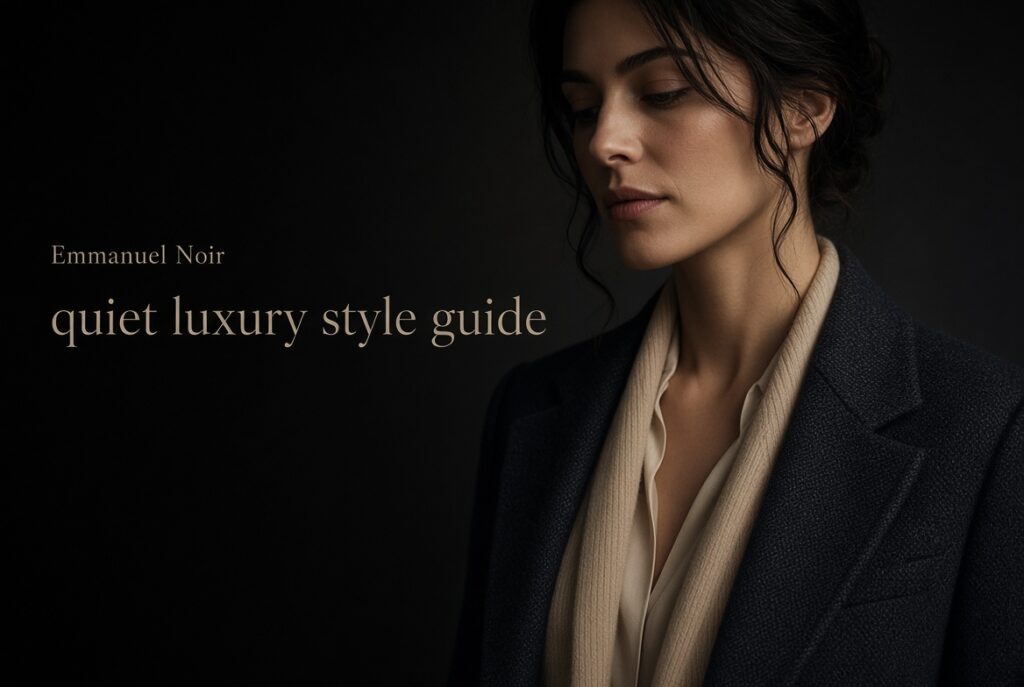
There is a particular kind of elegance that does not announce itself. The quiet luxury style guide begins with that idea: sophistication expressed through proportion, material, craftsmanship and personal confidence rather than conspicuous display.
It arrives in the cut of a jacket, the weight of a cashmere knit, the fall of a trouser, the discreet gleam of a watch or the way a leather handbag has softened through years of use. Nothing appears desperate for attention. Nothing needs to prove its price.
The phrase itself became a defining fashion conversation during the 2020s, although the underlying principles are considerably older. Vogue has described the movement through minimalist silhouettes, subtle styling and an emphasis on quality and cut, while also noting that the aesthetic is more complicated than simply removing logos.
For readers exploring the wider world of Luxury Fashion, the distinction matters. Quiet luxury is not a uniform of beige cashmere, white shirts and expensive loafers. Nor is it an instruction to dress anonymously. At its most sophisticated, it is the discipline of knowing exactly what deserves attention — and what does not.
What Quiet Luxury Really Means
A truly refined wardrobe can therefore contain drama. It can contain black silk, sculptural tailoring, a remarkable jewel, an unusual texture or a beautifully cut evening coat. The difference is that the object speaks through design rather than depending on a logo to complete the sentence.
That distinction becomes particularly important in 2026. Fashion has already begun moving beyond the idea that minimalism alone defines sophistication. Recent collections have placed renewed emphasis on individuality, craftsmanship and expressive design, suggesting that quiet luxury is better understood as a method of dressing than as a rigid visual trend.
The enduring principle is simple:
Luxury becomes quieter when the wearer no longer needs the garment to speak on their behalf.
Quick Reference: The Quiet Luxury Style Guide
| Element | Quiet Luxury Principle | What to Look For |
|---|---|---|
| Silhouette | Precise rather than exaggerated | Clean shoulders, balanced proportions and graceful lines |
| Colour | Restrained but not lifeless | Ivory, camel, charcoal, navy, chocolate, black and muted earth tones |
| Fabric | Tactile quality over visual noise | Cashmere, fine wool, silk, linen, suede and exceptional cotton |
| Tailoring | Fit creates authority | Correct shoulder, sleeve, rise, waist and trouser break |
| Branding | Recognition should remain secondary | Discreet hardware, minimal logos and distinctive construction |
| Accessories | Fewer, stronger pieces | Fine leather, restrained jewellery, elegant shoes and considered eyewear |
| Jewellery | Personal rather than excessive | Pieces with proportion, provenance and lasting design language |
| Footwear | Construction and silhouette first | Loafers, pumps, boots and understated trainers with excellent finishing |
| Handbags | Structure and longevity | Strong materials, coherent proportions and enduring house codes |
| Grooming | Completes the composition | Polished, controlled and appropriate to the occasion |
| Styling | Repetition becomes a strength | Reliable outfit formulas refined through small changes |
| Personality | Essential | Quiet luxury should reflect the wearer rather than erase them |
The table reveals the central paradox of understated dressing: simplicity makes imperfections more visible.
A poorly fitted jacket cannot hide behind a dramatic print. Cheap-looking fabric becomes obvious when there is nothing else competing for attention. Incorrect trouser proportions can undermine an otherwise beautiful outfit. A handbag with excessive hardware can disturb an otherwise disciplined composition.
Quiet luxury therefore demands more attention, not less.
Key Specifications: What Defines Quiet Luxury Style?
1. Proportion Comes Before Price
The first principle of a quiet luxury wardrobe is proportion.
A beautifully made garment that fits badly remains a poorly resolved garment. The shoulder line, sleeve length, trouser rise, jacket length and relationship between upper and lower proportions determine how an outfit communicates before fabric or brand enters the discussion.
This is why an impeccably tailored jacket can appear more sophisticated than a far more expensive garment worn in the wrong size.
Proportion creates silence.
It allows the clothes to sit naturally on the body rather than competing with it.
For anyone building a wardrobe from the ground up, Emmanuel Noir’s guide to how to build a luxury wardrobe offers a broader framework for deciding which foundational pieces deserve priority before major statement acquisitions.
2. Material Should Be Experienced Before It Is Recognised
Quiet luxury relies heavily on touch.
Fine wool has a particular density. Cashmere has a particular softness and drape. Silk catches light differently from synthetic fibres. Suede develops character. High-quality leather changes through use.
These distinctions may not be visible from across a room, and that is precisely the point.
The finest materials reward proximity.
That idea separates understated luxury from simple minimalism. Minimalism can concern the reduction of visual elements. Quiet luxury goes further by asking what remains after unnecessary elements have been removed.
The answer should be substance.
3. Colour Creates the Atmosphere
Neutral dressing has become almost synonymous with quiet luxury, but treating neutrality as a strict palette misses the deeper principle.
The objective is harmony.
Cream can sit beside tobacco. Charcoal can meet soft white. Chocolate brown can deepen navy. Black can become more complex when paired with different textures rather than different colours.
The sophisticated wardrobe therefore does not need dozens of shades. It needs a controlled relationship between them.
A monochromatic look can be exceptionally powerful when the materials change within the same tonal family: brushed wool beside polished leather, matte cashmere beside silk, suede beside cotton.
The eye discovers the difference through texture.
4. Branding Should Never Carry the Outfit
A logo is not inherently incompatible with quiet luxury.
The problem begins when the logo becomes the principal design feature.
Some of the world’s most recognisable houses have built their identities around discreet codes that can be understood without excessive lettering. Vogue’s analysis of quiet luxury and understated elegance similarly highlights the importance of subtle styling, quality, cut and details that communicate sophistication without relying on conspicuous branding. A distinctive clasp, stitch pattern, equestrian reference, weave, silhouette or piece of hardware can communicate heritage more elegantly than repeated branding.
This is one reason certain maisons remain powerful within understated dressing. Their visual language has become sufficiently established that recognition can occur through form rather than declaration.
The result feels more permanent.
5. Craftsmanship Must Survive Close Inspection
Quiet luxury is often discussed as an aesthetic, but its strongest expression is physical.
Look inside the garment.
Examine the seams.
Study the lining.
Feel the fabric.
Check the buttons, closures, stitching and finishing.
On tailored clothing, inspect how the garment moves when the wearer walks, sits and raises an arm. On leather goods, examine edge finishing and structural integrity. On footwear, consider the construction, leather and sole rather than simply the silhouette.
The more restrained the design, the more important these details become.
A heavily embellished garment can conceal construction beneath spectacle.
An understated garment has nowhere to hide.
Quiet Luxury vs. Minimalism: They Are Not the Same Thing
The two ideas overlap, but they are not interchangeable.
Minimalism generally concerns reduction: fewer colours, fewer details, simpler forms.
Quiet luxury concerns quality expressed through restraint.
A quiet luxury wardrobe can therefore include an elaborate silk dress if its construction, proportion and styling remain controlled. It can include a highly distinctive piece of jewellery. It can include a richly textured coat or an exceptional leather handbag.
What matters is not the absence of personality.
It is the absence of unnecessary noise.
Vogue’s earlier analysis of the movement similarly emphasised that quiet luxury had become associated with expert cutting, fine materials and understated presentation rather than a single mandatory silhouette.
That distinction is crucial for women building a wardrobe that should feel personal rather than algorithmically assembled.
The Historical Background of Quiet Luxury
Before the Phrase, There Was the Practice
The expression quiet luxury became a major fashion term during the 2020s, but the behaviour it describes has existed for generations.
Certain wardrobes have always communicated wealth, education, professional authority or connoisseurship without relying on prominent branding. Tailoring, fine fabrics, handmade shoes, discreet jewellery and beautifully maintained leather goods have long allowed quality to function as a form of visual language.
The modern phrase gave that language a name.
Its rapid popularity was accelerated by fashion coverage, social media and television culture, particularly the restrained wardrobes associated with characters in Succession. Vogue identified the aesthetic as a logo-light approach built around expensive materials, neutral palettes and understated silhouettes.
Yet the historical roots run deeper than a television wardrobe.
British tailoring, Italian textile traditions, French maison culture and American minimalism each contributed different pieces of the modern vocabulary. The resulting style is not owned by one country, one designer or one generation.
It is a convergence.
The Tailoring Tradition
Tailoring provides perhaps the clearest historical foundation.
A well-made jacket has always communicated through proportion rather than decoration. Shoulder construction, canvas, lapel shape, sleeve pitch and cloth selection can dramatically alter the character of a garment without requiring visible branding.
That is why bespoke traditions remain relevant to the quiet luxury conversation.
The garment becomes personal because it has been shaped around the wearer.
For readers interested in the deeper craft of tailored clothing, Emmanuel Noir’s Savile Row bespoke tailoring guide provides a natural companion to this philosophy.
Savile Row represents one particularly important expression of this principle because bespoke tailoring turns fit into part of the luxury itself. The finished garment does not merely carry a designer’s signature. It reflects the relationship between cloth, cutter, maker and wearer.
That is fundamentally different from buying visibility.
The Italian Contribution: Fabric, Softness and Ease
Italian luxury introduced another dimension to understated dressing: softness.
Where traditional British tailoring can emphasise structure and formality, Italian houses helped establish a vocabulary in which tailoring could become more relaxed without losing precision.
Fine wool, cashmere, suede, brushed cotton, silk and lightweight tailoring allow the wearer to appear composed without appearing rigid.
This is one of the most important lessons in contemporary quiet luxury.
Elegance does not require discomfort.
The best garments should make refined dressing feel natural.
The Rise of Minimalist Luxury
By the late twentieth century, designers such as Jil Sander and later houses associated with minimalist fashion helped demonstrate how an absence of decoration could itself become a powerful design language.
The Row later became strongly associated with exceptionally restrained silhouettes and discreet luxury, while brands such as Loro Piana and Brunello Cucinelli developed identities strongly connected with fine materials, craftsmanship and understated presentation.
The vocabulary expanded.
Quiet luxury no longer meant only traditional tailoring.
It could mean a long coat with almost architectural simplicity, a beautifully cut knit, a sculptural leather bag or a monochromatic ensemble whose sophistication becomes visible only through proportion and texture.
From Trend to Philosophy
The danger came when the term became too successful.
Once quiet luxury became a social-media aesthetic, the possibility of reducing it to a checklist emerged: beige trousers, white shirt, cashmere sweater, loafers, expensive handbag.
That is where the philosophy begins to fail.
If everyone wears the same supposedly discreet uniform, discretion becomes another form of trend participation.
Fashion itself has recognised this tension. Vogue’s examination of the aesthetics and microtrends that defined 2023 places quiet luxury within a broader cultural movement toward understated presentation, while the saturation of the aesthetic also helped encourage renewed interest in individuality and craftsmanship rather than endless repetition of the same minimalist codes.
The future of quiet luxury is therefore unlikely to be a stricter uniform.
It is more likely to be a return to the underlying principle:
Know the value of what you wear, and let that knowledge influence how you dress.
The 2026 Interpretation: Quiet Luxury Without the Costume
The modern interpretation should be more intelligent than simply recreating the wardrobes associated with the original trend.
In 2026, fashion remains highly dynamic. Recent Financial Times coverage of Paris Fashion Week reflects this broader movement, examining how major houses are exploring lighter and more expressive approaches alongside established fashion codes. Recent collections across Paris and Milan have demonstrated a broader appetite for expressive silhouettes, craftsmanship, heritage references and individual interpretation.
That creates an opportunity.
The woman building a quiet luxury wardrobe today does not need to reject fashion.
She needs to control her relationship with it.
A sculptural jacket can coexist with classic trousers. A dramatic jewel can sit against an otherwise restrained outfit. A vintage handbag can be worn with contemporary tailoring. A pair of beautifully constructed shoes can provide the only visual punctuation in an otherwise monochromatic ensemble.
The wardrobe becomes quieter because the wearer chooses where the volume belongs.
That is a more sophisticated definition of understated elegance.
It is not invisibility.
It is authorship.
The First Rule: Dress for the Eye That Notices
Quiet luxury works best at close range.
A stranger may notice a silhouette.
Someone standing beside you may notice the fabric.
A knowledgeable observer may recognise the construction.
A collector may recognise the provenance.
The most sophisticated wardrobe therefore operates on several levels simultaneously.
From a distance, it looks composed.
Up close, it becomes interesting.
And after years of wear, it becomes personal.
That is the standard Emmanuel Noir will use throughout this guide: not whether a garment looks expensive at first glance, but whether its design, construction and relationship with the wearer remain convincing after the first impression has disappeared.
Design & Craftsmanship: Where Quiet Luxury Becomes Visible
Quiet luxury is ultimately a design discipline.
The strongest pieces do not depend on decoration to create desirability. Their appeal comes from the relationship between line, material, construction and movement. A coat should fall correctly when the wearer walks. A trouser should create a clean line without appearing rigid. A shirt should maintain its structure while remaining comfortable. A handbag should hold its shape without becoming architectural for its own sake.
This is why quiet luxury style guide principles are inseparable from craftsmanship.
The restraint of the design exposes the quality of its execution.
Brunello Cucinelli’s account of Italian craftsmanship and manual skills provides a useful real-world illustration of this principle, explicitly placing manual skills, material selection and craftsmanship at the centre of its design philosophy, while maintaining specialist artisan workshops in Italy. Its approach illustrates an important distinction: quiet luxury is not merely about reducing visible branding; it can be grounded in an entire production culture.
The Architecture of a Quiet Luxury Garment
A sophisticated wardrobe begins with architecture.
Consider the jacket.
Its shoulder determines the first impression. Its lapel controls the visual direction of the torso. Its length affects the relationship between jacket and leg. The sleeve establishes the amount of shirt or jewellery visible at the wrist. The button stance influences the perceived height and proportion of the wearer.
None of these details needs to announce itself.
Together, however, they determine whether the garment feels ordinary or exceptional.
The same principle applies to womenswear. A column dress, cashmere cardigan, silk blouse or tailored trouser can appear almost effortless when the pattern has been carefully engineered around the body.
That apparent effortlessness is not accidental.
It is the result of decisions made long before the garment reaches the wardrobe.
Fabric Is Part of the Design Language
The quiet luxury wardrobe should be tactile before it becomes recognisable.
Cashmere, fine merino, silk, linen, suede and carefully selected cottons each create a different relationship with light and movement. The objective is not to collect the most expensive fibres available. It is to understand how material behaves.
A dense wool coat creates authority through weight.
A fine cashmere knit creates softness.
Silk introduces movement and reflection.
Suede absorbs light and adds depth.
Linen creates a different kind of sophistication because its natural irregularity prevents an outfit from becoming overly polished.
This is why the most compelling understated wardrobes rarely rely on one texture.
They layer them.
A charcoal wool trouser beside a cashmere knit and polished leather shoe can create far more visual interest than three competing colours. The richness comes from contrast that reveals itself slowly.
Hardware Should Whisper
Hardware is one of the easiest ways for a quiet wardrobe to become unnecessarily loud.
A handbag does not need an enormous logo clasp. A belt does not require an oversized buckle. Jewellery does not need to cover every available surface.
Instead, hardware should contribute to the object.
A beautifully proportioned clasp, a discreet metal detail or a distinctive fastening can become part of the design’s identity without dominating it.
This principle is particularly useful when evaluating handbags. The question should not be whether the hardware is recognisable from several metres away. The better question is whether it remains beautiful after years of handling.
That distinction turns fashion consumption into collecting.
The Quiet Luxury Wardrobe for Women
For women, understated elegance becomes especially interesting because there is no single silhouette capable of defining the wardrobe.
A sophisticated quiet luxury wardrobe may include tailoring, knitwear, dresses, skirts, denim, evening pieces and statement accessories. Its coherence comes from the relationship between them.
The wardrobe should feel like a private language.
A woman might wear the same cream cashmere knit with wide-leg trousers on Monday, under a tailored jacket on Wednesday and with a silk skirt at dinner. The garment becomes valuable because it creates multiple possibilities rather than demanding a single occasion.
This is where disciplined purchasing becomes important.
Instead of asking, What is fashionable this season?, ask:
Will this piece still make sense when the season has changed?
That question does not require avoiding fashion. It simply gives the wearer control over it.
For a deeper framework around pieces that combine wardrobe utility with enduring desirability, see Emmanuel Noir’s guide to women’s luxury fashion investment pieces.
The strongest candidates are usually garments and accessories with several lives: a beautifully cut blazer, a refined leather handbag, a cashmere coat, an elegant pump, a silk dress or a restrained piece of jewellery.
Their value does not depend entirely on resale.
Their first return is use.
The Art of the Quiet Luxury Handbag
Few accessories expose the difference between understated sophistication and conspicuous consumption more clearly than the handbag.
The finest handbag does not merely complete an outfit.
It establishes proportion.
A structured bag can sharpen soft tailoring. A supple leather bag can soften a severe silhouette. A compact evening bag can create punctuation against an otherwise monochromatic ensemble.
The mistake is to treat the handbag as a billboard.
A discreet bag with exceptional leather, intelligent construction and a recognisable but restrained design language can remain relevant long after a louder seasonal style has disappeared.
For women building a wardrobe around longevity, this is why the secondary-market conversation matters as well. A handbag’s desirability can be influenced by construction, provenance, condition, scarcity, house reputation and enduring design rather than simply its original retail price. For a deeper examination of the characteristics that can make certain pieces more enduring in the resale market, explore designer handbags that hold their value.
Quiet luxury does not guarantee financial appreciation.
It does, however, encourage a more thoughtful way of buying.
Jewellery: The Exception to the Rule
Quiet luxury does not mean quiet jewellery.
That distinction deserves emphasis.
A woman can wear a remarkable diamond, an exceptional coloured stone or a sculptural gold bracelet with an understated wardrobe and create an extraordinary result.
The secret is hierarchy.
If the jewellery is the statement, the clothing can become the frame.
If the clothing carries the drama, the jewellery should support it.
This is where restraint becomes a form of editing rather than limitation.
A single significant piece can possess more presence than an accumulation of lesser accessories.
The most sophisticated wardrobes understand negative space.
They allow an object to breathe.
Performance & Ownership: How Quiet Luxury Should Live
A garment’s quality cannot be judged solely from the hanger.
It has to perform.
The jacket needs to move with the wearer. The trouser must remain comfortable after hours of sitting. The shoe needs to balance appearance with construction. The handbag must survive daily handling. The knit needs to recover after wear rather than immediately losing its shape.
This is particularly important because luxury clothing can create a dangerous illusion: the higher the price, the more durable the garment must be.
That is not necessarily true.
Price reflects many variables, including brand positioning, retail structure, materials, labour, design, scarcity and distribution.
The sophisticated buyer therefore separates price from quality.
The Five-Year Test
Before purchasing a major wardrobe piece, imagine it five years from now.
Would the silhouette still feel intelligent?
Would the colour still integrate with the rest of the wardrobe?
Would the material improve with use?
Could it be altered or repaired?
Would you still choose it if the brand name disappeared?
That final question is particularly revealing.
If the answer is no, the object may be carrying too much of the decision.
Care Is Part of Luxury
Ownership changes the meaning of a luxury garment.
Fine leather needs conditioning and appropriate storage. Cashmere needs careful washing and protection from moths. Tailoring may require periodic pressing, repair or alteration. Shoes benefit from rotation, appropriate storage and maintenance.
The objective is not to preserve everything in museum condition.
Luxury should be lived with.
A beautiful leather bag that develops a patina can become more personal through use. A tailored jacket that has been altered over the years can fit more precisely than when it was purchased. A cashmere sweater that has been carefully maintained can become part of a wardrobe’s emotional architecture.
The signs of life are not necessarily defects.
Sometimes they are provenance.
Repair Before Replacement
The quiet luxury philosophy naturally supports a slower relationship with clothing.
Before replacing an expensive garment because of a loose button, worn lining, small tear or altered fit, investigate whether it can be repaired.
A skilled tailor can change the proportions of a garment dramatically.
A specialist leather artisan can restore certain bags and shoes.
A jeweller can often repair or resize pieces that have been worn for decades.
This creates an important shift in thinking.
The wardrobe becomes a collection of objects with histories rather than a sequence of purchases.
That is closer to the culture of collecting than to conventional seasonal consumption.
Market Position & Competition: What Quiet Luxury Actually Competes With
Quiet luxury occupies an unusual position in the contemporary fashion market.
It competes simultaneously with three different ideas.
The first is logo-driven luxury, where brand recognition forms a significant part of the visual proposition.
The second is minimalist fashion, where reduction and simplicity are primary design principles.
The third is trend-led fashion, where novelty and rapid cultural relevance drive purchasing.
Quiet luxury borrows from all three while remaining distinct from each.
From logo-driven luxury, it retains craftsmanship and heritage but reduces overt identification.
From minimalism, it adopts clarity and restraint but places greater emphasis on material and construction.
From trend-led fashion, it can borrow silhouettes or colours, but it filters them through longevity.
The result is less a single market segment than a purchasing philosophy.
Quiet Luxury vs. Logo-Driven Luxury
The distinction is easiest to see in accessories.
A highly recognisable monogram can communicate immediately.
A discreetly branded handbag may communicate only to someone familiar with its construction or design history.
Neither approach is inherently superior.
They simply perform different cultural functions.
Quiet luxury asks the wearer to derive satisfaction from the object itself rather than from immediate recognition by everyone around them.
That makes provenance, craftsmanship and personal taste more important.
Quiet Luxury vs. Minimalism
Minimalism can be inexpensive or extremely costly.
A simple white shirt can cost very little or represent exceptional craftsmanship.
Quiet luxury sits closer to the latter proposition because the quality of the underlying object becomes central.
That is why the distinction between simple and refined matters.
Simple removes.
Refined selects.
A refined wardrobe may contain fewer objects, but each object has a reason for being there.
Quiet Luxury vs. Trend Cycles
Fashion inevitably changes.
Silhouettes expand and contract. Hemlines move. Colours return. Accessories grow or shrink. Designers reinterpret familiar codes.
A quiet wardrobe does not need to ignore these movements.
Instead, it should absorb them selectively.
One seasonal piece can refresh an otherwise established wardrobe. A new trouser silhouette can change the proportions of familiar jackets. A contemporary shoe can modernise a classic coat.
The key is proportion.
The wardrobe should evolve without losing its identity.
The New Competition: Personal Style
The most important competitor to quiet luxury may not be maximalism, minimalism or visible branding.
It is individuality.
The fashion landscape in 2026 is increasingly comfortable with different aesthetic languages existing simultaneously. Current runway coverage shows strong interest in personal interpretation, expressive styling and the tension between polished classics and more unconventional forms.
That matters because a rigid quiet-luxury uniform can become its own form of conformity.
The sophisticated woman should therefore resist the temptation to purchase an entire aesthetic.
She should purchase pieces that belong to her.
A woman who naturally prefers dramatic jewellery should not remove it simply because social media has declared understatement fashionable.
A woman who loves colour should not force herself into beige.
A woman who prefers tailoring should not abandon structure because relaxed silhouettes are currently popular.
The objective is not to disappear into the trend.
It is to make the trend disappear into the wardrobe.
The Collector’s Perspective
Collectors understand something that ordinary fashion consumption often overlooks: objects become more interesting when context accumulates around them.
A watch carries its history.
A jewel carries its provenance.
A classic car carries its mechanical and cultural narrative.
A beautifully made garment can do the same, although fashion has traditionally been treated as more ephemeral.
The quiet luxury wardrobe challenges that assumption.
A hand-finished coat worn for fifteen years can tell a story.
A vintage handbag acquired after years of research can become more meaningful than a brand-new seasonal purchase.
A tailored jacket altered across different stages of life can become a physical record of the wearer.
That is where fashion becomes more than styling.
It becomes personal archive.
The Ultimate Test
There is one final test for any quiet luxury purchase:
Would you want the object if nobody knew what it was?
If the answer is yes, something important has happened.
The purchase has moved beyond recognition.
It has become appreciation.
And that is the point at which quiet luxury stops being a trend and becomes a way of seeing.
Buying Considerations: How to Build a Quiet Luxury Wardrobe
The most important decision in quiet luxury is not where to shop.
It is what to buy.
A wardrobe becomes refined through selection long before it becomes refined through expenditure. The objective is to create a collection of pieces that work together, age gracefully and remain convincing when seasonal fashion moves elsewhere.
For that reason, the most useful quiet luxury style guide begins with a hierarchy of purchasing decisions rather than a list of brands.
1. Start With the Silhouette
Before considering fabric, label or colour, consider shape.
Look at the relationship between the shoulder and waist. Examine the length of a coat against the leg. Consider whether a trouser creates the intended line. Check whether a skirt balances the proportions of the upper body.
The garment should work with the wearer.
A beautiful piece that creates an awkward silhouette is not rescued by its price.
This is especially important when buying online. Product photography can disguise proportions because garments are often photographed on models whose height and measurements differ substantially from those of the buyer.
Always consult the garment measurements rather than relying exclusively on the nominal size.
2. Examine the Fabric Before the Label
When comparing two similar pieces, ask what the material contributes.
Does it drape?
Does it recover its shape?
Does it have depth?
Does it feel appropriate to the climate in which it will actually be worn?
Will it require specialist care?
Will that care be realistic?
These questions matter more than the prestige of a label.
A beautifully constructed wool coat that becomes a wardrobe staple can create more long-term value than an expensive novelty piece that rarely leaves the wardrobe.
3. Buy for the Existing Wardrobe
One of the quietest forms of luxury is compatibility.
Before purchasing a major piece, identify at least three outfits already possible with it.
If the answer is difficult to find, pause.
The garment may still be exceptional, but it is probably not an efficient addition to the wardrobe.
This principle becomes particularly powerful with expensive accessories. A handbag that works with tailoring, knitwear, evening dressing and travel can justify its place more convincingly than one that functions only with a single look.
4. Consider Cost Per Wear — But Do Not Worship It
Cost per wear is a useful decision-making tool, but it should not become an excuse to buy unnecessarily.
A £2,000 coat worn for ten years may ultimately be used more than a £400 coat worn twice.
Yet the calculation only matters if the wearer genuinely loves the object.
A garment purchased because it appears to be “investment worthy” but remains unworn is not an intelligent acquisition.
The wardrobe should serve the life.
5. Prioritise Alterability
A garment that can be altered has a significant advantage.
Trousers can sometimes be adjusted at the waist or hem. Jackets can often receive sleeve or waist alterations within reasonable limits. Dresses may be altered depending on their construction.
This does not mean buying the wrong size and assuming a tailor can solve everything.
Some proportions cannot be changed economically or without compromising the original design.
Instead, look for garments whose construction gives a skilled professional room to work.
6. Investigate the House Before Buying the Object
A quiet luxury purchase should not be based entirely on reputation.
Research the house.
Understand its design language.
Look at previous collections.
Examine how it constructs comparable pieces.
Read the care instructions.
Investigate whether repair services exist.
For a significant purchase, provenance and authenticity also deserve attention, particularly in the secondary market.
A sophisticated buyer researches before the transaction.
7. Shop Through the Right Channels
For readers ready to explore current designer collections, a carefully edited retailer can make the search more efficient than navigating dozens of individual brand sites. MR PORTER is particularly relevant for menswear, accessories and selected luxury lifestyle pieces, while NET-A-PORTER provides a substantial womenswear and accessories selection.
For women’s quiet luxury dressing specifically, NET-A-PORTER can be useful when comparing designers, tailoring, knitwear, footwear and accessories within a single curated environment.
The editorial principle remains unchanged: the retailer is a research and purchasing resource, not a substitute for judgement. The right acquisition is the piece that earns its place in the wardrobe.
8. Use the Secondary Market Intelligently
The second-hand market can be particularly interesting for quiet luxury because established design codes often remain relevant long after a collection disappears from boutiques.
Vintage cashmere, archival tailoring, discontinued handbags and older jewellery can offer access to materials and construction that are difficult to find in current seasonal collections.
But the secondary market demands greater diligence.
Condition matters.
Authenticity matters.
Provenance matters.
Alterations matter.
And the original retail price should never be treated as proof of present value.
A collector approaches the secondary market differently from a bargain hunter.
The question is not simply, How much did this cost?
It is, What exactly am I acquiring?
Quiet Luxury Buying Comparison
| Buying Priority | What Matters Most | What to Avoid | Why It Matters |
|---|---|---|---|
| Tailoring | Shoulder, proportion, construction and fit | Buying by label alone | Silhouette determines the visual authority of the garment |
| Knitwear | Fibre quality, density, recovery and finish | Extremely soft fabric with no structural resilience | Softness alone does not establish quality |
| Outerwear | Cloth, construction, proportions and versatility | Trend-dependent shapes with limited use | Coats often become long-term wardrobe anchors |
| Handbags | Leather, construction, hardware and proportion | Excessive branding or novelty hardware | The bag should complement rather than dominate |
| Footwear | Last, leather, construction and comfort | Buying solely for appearance | Poorly constructed shoes undermine otherwise refined dressing |
| Jewellery | Design, materials, provenance and wearability | Excessive accumulation | A strong piece creates more impact than clutter |
| Colour | Compatibility and tonal harmony | Building around one temporary trend | A coherent palette increases wardrobe versatility |
| Accessories | Restraint and repetition | Buying every seasonal statement | Consistency creates personal style |
| Retailer | Selection, service and authenticity safeguards | Impulse purchasing | The buying environment influences decision quality |
| Secondary market | Condition, authenticity and provenance | Assuming age equals value | Vintage requires investigation |
The Quiet Luxury Capsule: What Deserves Priority?
A sophisticated wardrobe does not need to begin with dozens of pieces.
It can begin with a small architecture.
The Foundation
Consider a refined foundation of:
- one excellent tailored jacket
- one versatile wool or cashmere coat
- several beautifully made knitwear pieces
- well-cut trousers
- an elegant skirt or dress
- a refined white or ivory shirt
- high-quality denim
- understated leather footwear
- one versatile handbag
- a small selection of jewellery
- a carefully chosen evening piece
The precise quantities should reflect the woman’s lifestyle.
Someone working in a corporate environment will need a different wardrobe from someone whose life revolves around travel, creative work, private events or social occasions.
The philosophy remains consistent.
Buy fewer pieces that perform better.
The Accent
Once the foundation works, introduce personality.
This is where colour, jewellery, unusual texture, vintage pieces and distinctive accessories can enter.
The accent should feel intentional.
A burgundy handbag against camel tailoring.
An emerald ring against black silk.
A sculptural gold earring with a simple ivory dress.
A beautifully cut red coat over a restrained neutral wardrobe.
These pieces do not contradict quiet luxury.
They make it personal.
Quiet Luxury Style Guide: Pros and Cons
The Advantages
Longevity.
A restrained wardrobe can remain relevant across multiple fashion cycles.
Versatility.
Well-designed pieces tend to work across several settings.
Lower visual dependence on branding.
The wardrobe can communicate quality without requiring immediate recognition.
Greater emphasis on craftsmanship.
The buyer becomes more attentive to fabric, construction, fit and finishing.
Personal continuity.
A consistent wardrobe language can become recognisable as the wearer’s own.
Potential for strong cost-per-wear.
Versatile, durable pieces can be worn repeatedly over many years.
The Limitations
Higher initial expenditure.
Quality materials and skilled construction can require substantial investment.
Maintenance demands.
Fine fabrics, leather and tailoring may require specialist care.
The aesthetic can become repetitive.
If interpreted too literally, quiet luxury can produce a wardrobe lacking personality.
Minimal branding does not guarantee quality.
An understated garment can still be poorly constructed.
Trend resistance can become trend avoidance.
Refusing every contemporary influence can make the wardrobe feel static.
The aesthetic can become another form of status signalling.
Quiet luxury is not automatically free from social signalling simply because logos are absent.
The final point is perhaps the most important.
No wardrobe is culturally neutral.
Clothing communicates.
Quiet luxury simply chooses a subtler vocabulary.
Who Should Buy Into Quiet Luxury?
Quiet luxury is particularly suited to women who want their wardrobes to become more coherent rather than simply larger.
It can work especially well for readers who:
- value craftsmanship over conspicuous branding
- prefer timeless silhouettes
- want garments that work across multiple occasions
- appreciate fine fabrics and construction
- are prepared to maintain their clothing properly
- want to develop a recognisable personal style
- enjoy buying fewer, more considered pieces
- value heritage and provenance
- prefer understated accessories
- want fashion to complement rather than dominate their identity
It is also particularly relevant to professionals whose wardrobes need to move between business, travel, dining and social settings without requiring a complete change of visual language.
The underlying advantage is flexibility.
A carefully constructed wardrobe can adapt to the life around it.
Who Should Skip the Quiet Luxury Formula?
Not everyone needs to dress this way.
A woman whose personal style is built around maximal colour, avant-garde silhouettes, visible logos, streetwear or theatrical dressing does not need to abandon those preferences simply because quiet luxury became culturally prominent.
Likewise, anyone who finds neutral palettes restrictive should not force herself into them.
Quiet luxury works best when it becomes a framework for editing rather than a costume.
If the aesthetic suppresses individuality, it has already misunderstood its own purpose.
The same applies to purchasing.
Do not buy an expensive cashmere sweater because the internet has declared cashmere synonymous with sophistication. Do not buy a discreet handbag simply because its logo is less visible. Do not purchase a neutral wardrobe because you believe visible branding is somehow less sophisticated.
Buy what is beautiful.
Buy what is well made.
Buy what you will actually wear.
Then refine.
The Most Important Buying Rule
There is a useful hierarchy for major fashion purchases:
Fit → Material → Construction → Versatility → Personal relevance → Brand → Trend.
The order matters.
A respected brand cannot repair an incorrect silhouette.
A fashionable colour cannot compensate for poor construction.
A recognisable logo cannot create personal relevance.
And a high price cannot guarantee craftsmanship.
When the first five elements are right, the brand becomes confirmation rather than justification.
That is the purchasing discipline at the heart of quiet luxury.
The Difference Between Expensive and Extraordinary
The most expensive wardrobe is not necessarily the most sophisticated.
Extraordinary style emerges when every element has a reason.
The coat has the right volume.
The trousers create the correct line.
The handbag has the correct scale.
The jewellery has enough space around it.
The shoe completes the proportion.
The colours belong together.
The materials create contrast.
Nothing competes unnecessarily.
Nothing feels accidental.
And yet the final impression does not feel calculated.
That is the paradox of the quiet luxury style guide: the more intelligently the wardrobe is constructed, the less constructed it appears.
The wearer simply looks composed.
And composition, ultimately, is the real luxury.
Frequently Asked Questions About Quiet Luxury Style
What is quiet luxury?
Quiet luxury is an approach to dressing that emphasises craftsmanship, quality materials, considered proportions, restrained branding and longevity rather than conspicuous logos or overt displays of price. It is less a fixed uniform than a philosophy of selecting and wearing clothing with intention.
Is quiet luxury only about neutral colours?
No. Neutral colours are common because they create versatility, but they are not a requirement. Burgundy, emerald, deep red, chocolate, navy and other rich tones can work beautifully within an understated wardrobe. The defining principle is harmony rather than a particular colour palette.
Is quiet luxury the same as minimalist fashion?
Not exactly. Minimalism generally focuses on reduction and simplicity, while quiet luxury places greater emphasis on material quality, craftsmanship, fit, longevity and discreet sophistication. A quiet luxury wardrobe can therefore contain distinctive jewellery, expressive colour or an elaborate garment without losing its underlying restraint.
Does quiet luxury mean avoiding designer logos?
Not necessarily. A visible logo is not inherently incompatible with sophisticated dressing. The distinction lies in whether branding supports the design or dominates it. Many luxury houses have developed recognisable signatures that can be appreciated through silhouette, construction, materials or hardware rather than prominent lettering.
What fabrics work best for quiet luxury dressing?
Cashmere, fine wool, silk, linen, high-quality cotton, suede and well-made leather are useful foundations. However, the fibre alone does not determine quality. Construction, finishing, weight, drape, durability and suitability for the intended use matter just as much.
How can I create a quiet luxury wardrobe without replacing everything I own?
Begin by editing rather than replacing. Identify the pieces you already wear repeatedly, remove items that no longer fit your lifestyle and gradually upgrade the areas where quality or versatility is lacking. A well-cut jacket, excellent trousers, refined footwear and one strong handbag can transform an existing wardrobe without requiring a complete restart.
Is quiet luxury expensive?
It can be, but the philosophy does not require constant high expenditure. The principle is to make considered purchases and prioritise quality where it genuinely affects longevity, comfort and appearance. A smaller wardrobe of carefully chosen pieces can sometimes be more useful than a much larger collection of expensive but incompatible garments.
Can quiet luxury include vintage and pre-owned fashion?
Absolutely. Vintage and pre-owned pieces can be particularly compelling when their design, construction, condition and provenance justify the purchase. They can also introduce individuality into a wardrobe and prevent the aesthetic from becoming a replica of current-season styling.
How should jewellery be worn with quiet luxury clothing?
Think in terms of hierarchy rather than quantity. A significant necklace, bracelet, ring or pair of earrings can become the focal point against a restrained outfit. Conversely, when the clothing is highly distinctive, simpler jewellery may create better balance.
What is the biggest mistake people make with quiet luxury?
Turning it into a uniform.
Beige trousers, a cashmere sweater, loafers and a discreet handbag do not automatically create sophisticated style. Without proper fit, material quality, proportion and personal expression, the result can become another form of trend dressing.
Can quiet luxury work with bold personal style?
Yes. Quiet luxury is most useful when treated as an editing principle rather than a restriction. A woman who loves colour, statement jewellery, dramatic coats or unusual silhouettes can still apply the philosophy by paying attention to quality, proportion and intentionality.
Does quiet luxury clothing hold its value?
Some luxury fashion pieces can retain meaningful resale value, but quiet luxury itself does not guarantee financial appreciation. Brand desirability, condition, rarity, provenance, material, construction, market demand and timing can all influence resale performance. Clothing should therefore be purchased primarily for its use and personal value rather than treated automatically as an investment.
How to Dress With Extraordinary Elegance Without Saying a Word
The most enduring lesson of quiet luxury is not that women should dress quietly.
It is that clothing does not need to shout to possess presence.
Extraordinary elegance can exist in a beautifully cut coat, a perfectly proportioned trouser, a silk blouse that moves naturally, a discreet leather bag or a single piece of jewellery chosen with conviction.
The difference lies in intention.
A wardrobe built around intention does not chase every trend. It studies proportion. It understands materials. It respects craftsmanship. It allows garments to age. It recognises when an object deserves maintenance rather than replacement.
Most importantly, it leaves room for the woman herself.
That is why the best interpretation of a quiet luxury style guide should never produce identical wardrobes.
It should produce better decisions.
The objective is not to look wealthy.
It is to look considered.
Emmanuel Noir Verdict
Quiet luxury is most compelling when understood not as an aesthetic costume but as a philosophy of discernment.
Its strongest principles are remarkably durable: buy with intention, prioritise fit, understand materials, respect craftsmanship, maintain what you own and allow personal character to remain visible.
The wardrobe should not become a collection of anonymous beige garments simply because the culture has attached a new name to understatement.
Instead, build slowly.
Choose pieces that earn repeated wear.
Let craftsmanship reveal itself through proximity.
Allow one exceptional object to command attention when the moment calls for it.
And remember that the quietest wardrobe can still possess extraordinary character.
The ultimate expression of luxury is not the ability to make everyone notice what you are wearing.
It is the confidence to know exactly why you chose it.
“True elegance does not ask to be recognised. It leaves enough silence for discernment to do the recognising.”
— Emmanuel Noir
Affiliate Disclosure
Some product and retailer links within Emmanuel Noir articles may be affiliate links. If you purchase through an eligible link, Emmanuel Noir may receive a commission at no additional cost to you. Editorial inclusion is based on relevance to the subject and reader, not solely on commercial relationships.