
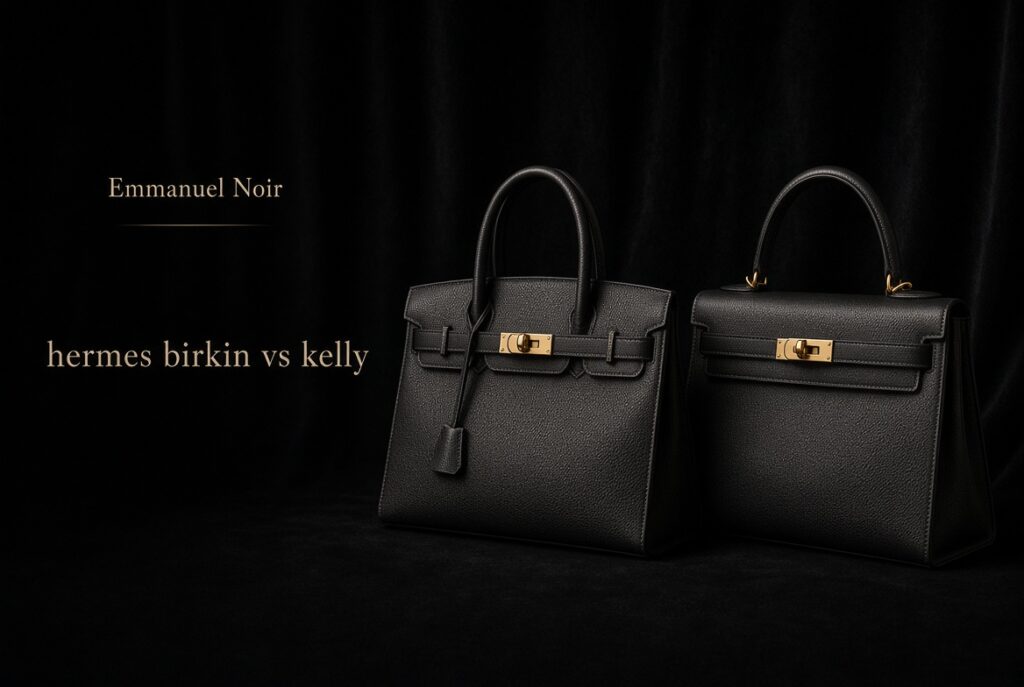
Few handbags occupy the luxury market with the gravity of an Hermès Birkin or Kelly. They are not merely accessories. They are objects of design, craftsmanship, cultural memory and, increasingly, serious collector interest. Yet the question of hermes birkin vs kelly investment is more complicated than choosing between two famous names. The real question is how construction, size, leather, rarity, condition, provenance and secondary-market demand interact over time.
For the collector entering this territory, that distinction matters. A handbag can be extraordinarily desirable without being equally desirable in every configuration. A Birkin 25 in one leather and colour can behave very differently from a Birkin 35 in another. A Kelly Sellier can occupy an entirely different market position from a Kelly Retourne. Even age, accessories and condition can materially alter the resale equation.
That makes this less a contest between two icons than an examination of two different collecting philosophies. The Birkin represents relaxed authority: generous proportions, unmistakable hardware and an open, highly recognisable silhouette. The Kelly is more architectural, more formal and, in many configurations, more discreet. Both carry extraordinary heritage, but they communicate it differently.
For readers exploring the wider world of Luxury Fashion, Emmanuel Noir places the Birkin and Kelly within the larger discipline of collecting exceptional fashion objects—not simply buying something expensive but understanding why certain pieces continue to command attention.
Investment Begins With the Object
The investment case begins with one important distinction: these handbags should not be treated as conventional financial assets. They do not produce income, carry guaranteed returns or behave like securities. Their value is determined by a specialised luxury market in which scarcity, desirability, condition and provenance intersect. Secondary-market results can therefore be strong without making future appreciation predictable.
For the serious collector, the more useful question is not whether either model will appreciate, but which characteristics consistently influence demand. Size, leather, colour, construction, condition, provenance and market scarcity can all change the position of an individual bag. The object itself matters more than the name stamped across it.
What the Market Can Actually Tell Us
Observable secondary-market behaviour provides a more useful starting point than broad claims about which model is “better.” Recent auction and resale data show meaningful demand for selected Birkin and Kelly configurations, while also demonstrating why performance should be assessed at the level of the individual reference rather than the model name alone.
The Birkin and Kelly therefore enter this comparison on different terms. One offers breadth of recognition and a deep collector market; the other combines architectural design, heritage and scarcity in ways that can create intense demand for particular configurations.
The question that follows is not simply which handbag is the better investment. It is which model, configuration and provenance best align with the collecting strategy of the person acquiring it.
Quick Reference: Birkin vs Kelly Investment
| Factor | Hermès Birkin | Hermès Kelly |
|---|---|---|
| Original creation | 1984 | Design dates to the 1930s; officially named Kelly in 1956 |
| Foundational association | Jane Birkin | Grace Kelly |
| Signature character | Structured but comparatively relaxed | Architectural and formal |
| Typical construction | Retourne; Sellier also exists | Sellier and Retourne |
| Collector strengths | Birkin 25/30, rare editions, exceptional exotics | Mini Kelly 20, Kelly 25, Sellier examples |
| Core investment variables | Size, condition, colour, leather, rarity, provenance | Size, construction, condition, colour, leather, rarity, provenance |
| Current market observation | Strong secondary demand | Strong secondary demand, particularly smaller formats |
| Principal risk | Paying a premium for fashion-driven rarity | Paying a premium for scarcity without sufficient broader demand |
| Collector personality | Iconic, relaxed, unmistakable | Architectural, discreet, highly formal |
The table should be read as a framework rather than a ranking. The secondary market changes constantly, and an exceptional example can overturn broad assumptions about an entire category.
Key Specifications: What Actually Defines the Two Icons?
Hermès Birkin
The Birkin emerged in 1984 following a chance meeting between actress Jane Birkin and Jean-Louis Dumas, then chairman of Hermès. According to Hermès’ official Birkin history, the conversation took place during a flight from Paris to London and led Dumas to sketch a spacious handbag designed around Birkin’s practical needs. The resulting concept became the Birkin.
The classic Birkin architecture is immediately recognisable: two rolled handles, a flap, clochette, lock and distinctive protective feet beneath the bag. Its proportions allow the design to move naturally between day and evening, although the larger sizes have increasingly become specialist collector territory rather than universal everyday choices.
The standard Birkin family includes sizes such as 25, 30, 35 and 40, with additional limited and miniature formats. Current market evidence places particular emphasis on the Birkin 25 and 30, whose proportions align closely with contemporary usage while remaining sufficiently substantial to retain the visual authority associated with the original design. Sotheby’s identifies these smaller formats as among the most sought-after Birkin configurations.
The 2026 boutique pricing provides another useful benchmark. Sotheby’s reports a U.S. retail price of approximately $13,500 for a Birkin 25 in Togo and $14,900 for a Birkin 30 in Togo. These are retail reference points, not investment forecasts, and secondary-market prices can vary considerably according to condition, colour, material and provenance.
Hermès Kelly
The Kelly has the deeper historical lineage. Hermès’ official history of the Kelly traces the design to Robert Dumas and the 1930s, while its transformation into an international cultural icon came through Grace Kelly. Hermès notes that a photograph of the Princess of Monaco carrying the bag in 1956 helped establish its legendary identity, after which the house officially adopted the name Kelly.
Its silhouette is immediately different from the Birkin. The Kelly is defined by a trapezoidal profile, a single top handle and a sophisticated closure system built around the central turnlock. The proportions create a more deliberate, almost architectural impression.
The Kelly also offers two important construction philosophies: Sellier and Retourne.
Sellier construction presents sharper exterior edges and a more pronounced architectural profile. Retourne turns the construction inward, creating softer edges and a more relaxed appearance. This difference is not merely cosmetic. It changes how the handbag wears, how it presents itself visually and, importantly for collectors, how particular examples behave in the secondary market.
Hermès’ own craftsmanship documentation illustrates the complexity involved. The house states that approximately forty leather pieces are assembled in making a Kelly, with artisans joining the components using the traditional saddle stitch. Hermès also states that its bags are handcrafted in France.
For a collector, that level of construction matters because investment appeal is inseparable from the physical object. The market is not trading an abstract logo. It is trading a carefully constructed leather object whose condition, material and workmanship remain visible decades after purchase.
Historical Background: Two Icons, Two Different Origins
The Birkin and Kelly are often discussed as though they were created from the same blueprint. They were not.
The Kelly began life as a practical Hermès design in the 1930s. Robert Dumas developed the ladies’ bag with straps during an era when Hermès’ equestrian heritage continued to influence its leather goods. Its later association with Grace Kelly transformed a functional design into an international symbol of elegance. Hermès’ historical account places the naming of the Kelly in 1956.
The Birkin arrived almost half a century later. Its origin was unusually personal: Jane Birkin described the difficulty of finding a sufficiently practical yet elegant handbag, and Jean-Louis Dumas responded by creating a design around those requirements. Hermès dates the creation of the Birkin to 1984.
This difference in origin still echoes through their personalities.
The Kelly feels like a house classic that acquired celebrity mythology.
The Birkin feels like a modern icon that was born from celebrity conversation.
Neither story makes one inherently superior. Instead, they create different forms of collectability.
The Kelly carries the romance of mid-century European elegance, royal association and an older design vocabulary. The Birkin carries the cultural force of late twentieth-century celebrity, contemporary collecting and the extraordinary visibility that followed its creation.
For investors who care about provenance, these histories are more than decorative details. They explain why both bags have remained relevant through changing fashion cycles.
The Jane Birkin Effect and the Grace Kelly Legacy
Luxury collecting is often shaped by provenance in ways that conventional product analysis cannot fully capture.
The Kelly’s relationship with Grace Kelly became part of its mythology because the association emerged organically through an image that travelled around the world. Hermès itself identifies the 1956 photograph as a decisive moment in the bag’s transformation into a legend.
The Birkin’s relationship with Jane Birkin is different because the bag was created specifically from an encounter with her. The design was born from her stated needs and subsequently carried her name.
That distinction becomes particularly powerful when provenance enters the auction room.
In June 2025, Sotheby’s record-setting sale of Jane Birkin’s original Hermès Birkin reached €8.6 million, or approximately $10.1 million, making it the most valuable handbag ever sold at auction at that time. Sotheby’s also noted that the previous handbag auction record had been established in 2021 by a Hermès White Himalaya Niloticus Crocodile Diamond Kelly 28, which sold for $513,040.
These are exceptional historical objects, not benchmarks for an ordinary Birkin or Kelly. Their importance lies elsewhere: they demonstrate how provenance, scarcity and cultural history can transform an already valuable luxury object into something belonging to an entirely different collecting tier.
That is the crucial lesson for the serious collector.
A handbag becomes more than a handbag when the story surrounding it becomes impossible to reproduce.
What Makes a Hermès Bag Collectible?
The most sophisticated approach to hermes birkin vs kelly investment begins by separating brand prestige from collectible quality.
Hermès creates the foundation, but the secondary market determines how individual examples behave.
Five variables deserve particular attention:
1. Size
Size can have a counterintuitive relationship with value.
A larger bag may command a higher boutique price because it contains more material and represents a larger format. Yet collectors do not necessarily value larger dimensions more highly. Current Sotheby’s data indicates particularly strong demand for smaller Birkin and Kelly formats, including the Birkin 25 and Mini Kelly 20.
The reason is partly practical. Smaller handbags fit contemporary wardrobes more easily. They also possess an element of scarcity and visual delicacy that can appeal strongly to collectors.
2. Condition
Condition is one of the most important variables in the entire Hermès secondary market.
Sotheby’s identifies condition as the strongest determinant in its Birkin valuation framework. Store-fresh examples with original packaging and minimal or no signs of wear command substantial premiums over otherwise comparable bags showing visible use.
For the collector, this changes the meaning of “investment.”
A bag that is purchased with an assumption of appreciation but carried heavily may follow a very different resale path from one maintained meticulously and preserved with complete accessories.
3. Leather
Leather changes the physical character of a Hermès handbag.
Togo, Epsom, Chevre, Box and exotic skins each offer different combinations of texture, structure, ageing characteristics and market appeal. Sotheby’s identifies Togo and Epsom among the leathers with particularly strong secondary-market relevance, while more specialised materials attract narrower collector audiences.
The collector should therefore avoid asking simply, “Which leather is most expensive?”
The better question is: “Which leather best combines desirability, durability, rarity and long-term collector demand for this particular model?”
4. Colour
Colour is one of the clearest examples of the difference between fashion and collecting.
A highly fashionable seasonal shade may command attention when introduced yet experience changing demand later. Conversely, established neutrals can remain desirable across decades because they integrate naturally into a wider range of wardrobes.
Sotheby’s identifies colours such as Black, Gold, Etoupe and other enduring neutrals among those that consistently attract secondary-market interest.
For a collector thinking beyond the current season, timelessness can matter as much as rarity.
5. Provenance and Completeness
Boxes, dust bags, receipts, accessories and documented provenance can strengthen the presentation and credibility of a resale offering.
The effect becomes even more pronounced with historically significant pieces. Once provenance connects a handbag to a notable person, event or chapter in fashion history, the object can move beyond conventional resale economics.
That is why serious collecting requires documentation from the moment of acquisition.
A Collector’s First Principle: Buy the Object, Not the Prediction
There is a seductive danger in the language of luxury investment.
Once a handbag reaches a certain level of resale demand, it becomes tempting to treat every purchase as an appreciating asset. That is not a disciplined approach.
Secondary-market prices move. Fashion changes. Currency values fluctuate. Auction results vary. Transaction costs reduce realised returns. Condition deteriorates through use. And the rarest configurations do not necessarily possess the broadest pool of future buyers.
The stronger collecting philosophy is therefore to acquire an object whose design, craftsmanship and provenance you would value even if its resale price remained unchanged.
That principle is particularly relevant to the Birkin and Kelly because both can be enjoyed as functional objects while also participating in a sophisticated collector market.
A serious collector should be able to answer three questions before purchase:
Would I still want this bag if I never sold it?
Does this particular configuration have enduring demand rather than temporary fashion momentum?
Can I document its authenticity, provenance and condition throughout ownership?
If the answer to all three is yes, the acquisition begins from a more rational foundation.
A Market Built on Scarcity
Scarcity is central to the Hermès mythology, but serious collectors should distinguish between limited availability and true rarity.
Hermès states that Birkin, Kelly and Constance handbags are sold exclusively through Hermès stores, while availability varies by store and assortment. The house also explains that its leather goods are handmade and subject to strict quality criteria.
This controlled retail environment contributes to the difficulty of acquiring certain configurations directly.
The secondary market consequently performs an important function. It provides access to pieces that may be unavailable at boutiques, discontinued references, unusual colours, earlier production years and collector-specific configurations.
That market is not uniform, however.
A store-fresh Birkin 25 in a classic colour belongs to a different liquidity environment from a heavily used Birkin 40 in a seasonal shade. A Mini Kelly Sellier in a highly sought-after combination can command a very different premium from a larger Retourne example.
The collector who understands this distinction has already moved beyond the superficial Birkin-versus-Kelly debate.
The First Investment Question: Birkin or Kelly?
At this stage, the evidence does not justify a universal answer.
The Birkin currently demonstrates exceptionally deep secondary-market demand, with Sotheby’s reporting substantial growth in its Birkin sales during 2025 and strong average prices for core configurations.
The Kelly, meanwhile, continues to command substantial collector attention, with particular strength in smaller formats and Sellier construction. Sotheby’s reported 10% growth in Kelly sales during 2025 compared with 2024 and identified the Mini Kelly and Kelly 25 as important areas of demand.
Those observations establish the market context.
They do not establish a guaranteed winner.
The more interesting question is what happens when craftsmanship, construction, size, colour and ownership strategy are examined together. That is where the distinction between the two icons becomes much sharper.
And that is where the serious collector should begin.
Design & Craftsmanship: Where the Investment Story Really Begins
The most important mistake in a hermes birkin vs kelly investment comparison is to begin with resale prices rather than the objects themselves.
Hermès handbags are unusually dependent on the relationship between design and craftsmanship. The house states that its leather goods are made by hand, with strict quality controls applied from the selection of natural materials through to the completed object. Hermès also notes that several months may be required to produce a leather-goods piece.
That matters because collectability is not created by scarcity alone. A collectible object needs a physical identity strong enough to survive changing fashion cycles. The Birkin and Kelly have that quality in different ways.
The Birkin is visually expansive. Its twin handles, flap, sangles, lock and clochette create a vocabulary that remains recognisable even at a distance. Hermès’ own historical account describes the original Birkin concept as rectangular, supple and spacious, with saddle stitching at its core.
The Kelly is more architectural. Its trapezoidal profile, single handle, shoulder strap and signature closure produce a sharper silhouette. Hermès describes the Kelly’s distinctive clasp, padlock and intersecting sangles as central elements of its identity.
That difference becomes significant when a collector considers longevity.
The Birkin tends to announce itself.
The Kelly tends to frame itself.
One is expansive and unmistakable; the other is composed and almost sculptural.
Neither approach is inherently more collectible. They simply appeal to different instincts.
Sellier vs Retourne: The Construction Decision Collectors Should Understand
For the Kelly especially, construction can materially alter the character of the bag.
Sellier construction places greater emphasis on defined edges and a crisp exterior profile. The seams and contours appear more deliberate, giving the bag a distinctly architectural presence.
Retourne construction produces a softer exterior. The leather is turned inward during construction, creating rounder edges and a less rigid visual impression.
For collectors, this is more than a technical distinction.
A Sellier Kelly often feels closer to an object of design. Its geometry is immediately visible. A Retourne Kelly feels more organic and relaxed, allowing the leather itself to become a greater part of the aesthetic.
That distinction can also influence wear.
A sharply structured bag makes changes to its edges and corners particularly visible. A softer construction can develop a different character as the leather ages. The collector should therefore consider not only which construction is currently fashionable, but how the particular example is likely to look after years of ownership.
The Birkin offers its own construction variations, but its visual language remains more closely associated with the spacious, softly structured architecture that defined the original design.
The result is an important collecting principle:
Construction should be evaluated as part of the asset, not treated as a technical footnote.
Leather Is Not a Footnote — It Is Part of the Identity
Two identical Birkin sizes can occupy very different positions in the market because their leathers behave differently.
Togo, for example, is prized for its pronounced grain and comparatively resilient character. Epsom has a more defined printed grain and retains its structure particularly well. Hermès describes Epsom as firm, with a regular grain and strong shape retention.
Other leathers create different experiences.
Box calfskin develops a distinctive surface character with age. Chevre offers a finer, lighter grain and a different tactile quality. Exotic skins move the conversation into an entirely different collecting category, where rarity and material provenance become substantially more important.
The serious collector should therefore avoid the simplistic equation:
rarer leather = better investment.
Rarity can increase desirability, but a narrower pool of potential buyers can also affect liquidity. A rare object may be extraordinarily valuable while still requiring a more specialised buyer.
That is why the strongest acquisitions often sit at the intersection of rarity and recognisable demand.
The sweet spot is not necessarily the strangest bag in existence.
It can be the exceptional example that a large number of knowledgeable collectors would still recognise as desirable.
The Birkin’s Strength: Recognition, Versatility and Market Depth
The Birkin possesses a remarkable advantage in collector psychology: immediate recognition.
Its silhouette has become one of the most identifiable forms in modern luxury. That recognition creates a broad cultural market around the object, extending beyond specialists into fashion, entertainment, design and popular culture. Sotheby’s Birkin market analysis reported that Birkin sales grew by more than 70% in 2025 compared with 2024 and that the house had sold nearly $100 million in Birkins since 2021. Its September 2026 guide also reports that the average selling price for a Birkin 30 in Togo reached $22,300 in 2025.
Current secondary-market evidence reinforces the depth of demand. Sotheby’s reported that Birkin sales grew by more than 70% in 2025 compared with 2024 and that the house had sold nearly $100 million in Birkins since 2021. Its September 2026 guide also reports that the average selling price for a Birkin 30 in Togo reached $22,300 in 2025.
Those figures should be interpreted carefully.
They describe Sotheby’s market activity, not the entire global Hermès resale market. They also describe past transactions rather than future returns.
Nevertheless, they demonstrate something important for collectors: the Birkin has substantial depth in the secondary market.
That depth can matter when an owner eventually decides to sell.
A collector does not simply want an expensive object. They want an object for which a sufficiently sophisticated market exists when liquidity becomes important.
The Kelly’s Strength: Architecture, Heritage and Scarcity
The Kelly operates differently.
Its silhouette has extraordinary historical depth, and the Grace Kelly connection gives it an unusually powerful cultural narrative. Hermès traces the design to the 1930s and identifies 1956 as the year in which the name Kelly became established following Princess Grace’s public association with the bag.
But its collector appeal is not dependent solely on celebrity history.
The Kelly’s construction creates an especially strong relationship between proportion and design. The trapezoidal body, top handle and closure give even relatively small examples a formal presence.
This becomes particularly apparent with the Mini Kelly.
Sotheby’s 2026 Kelly market analysis reported that Kelly sales grew 10% in 2025 compared with 2024, with particular strength in the Mini Kelly and Kelly 25 categories. The same source reported leather Mini Kelly resale prices holding around $30,000–$36,000 following Hermès’ 2026 boutique price increases.
Again, this does not make every Mini Kelly an investment winner.
It does, however, illustrate how a specific configuration can acquire a market identity of its own.
The Kelly therefore rewards collectors who think in terms of architecture and configuration rather than simply model names.
Performance & Ownership: What Happens After the Purchase?
The investment conversation becomes more interesting once the handbag leaves the boutique.
A collector must then manage an object made from natural materials, exposed to light, humidity, friction, handling and the ordinary consequences of use.
This creates a paradox.
The handbag is valuable because it can be used.
Yet use can reduce the condition that supports its resale value.
That tension makes ownership discipline essential.
Condition Management
A serious collector should think about storage before purchase rather than after the first signs of wear appear.
The bag should be protected from prolonged exposure to direct sunlight, excessive moisture and environments that can distort its leather. Handles deserve particular attention because oils, friction and repeated contact can change their appearance over time.
The interior also matters.
A pristine exterior cannot fully compensate for careless interior storage, ink marks, excessive stretching or missing accessories.
The original packaging and accompanying materials should be preserved where possible.
This does not mean every collector should place a Birkin or Kelly behind glass.
Quite the opposite.
The most compelling luxury objects are often those that have been lived with intelligently.
The objective is controlled enjoyment.
The Cost of Ownership
An investment-minded collector should also consider transaction costs.
Buying on the secondary market can mean paying a significant premium above boutique pricing. Selling can involve authentication, commissions, consignment costs, auction fees or marketplace spreads depending on the route chosen.
Taxes, insurance and secure storage can add further costs.
Consequently, a handbag that rises substantially in headline market value may produce a considerably smaller net financial gain after the full cost of ownership is considered.
This is why luxury handbag investment should be approached as collectible-asset ownership, not as a substitute for a conventional financial portfolio.
The distinction is important.
A collector can reasonably seek capital preservation and potential appreciation while still recognising that the handbag’s primary purpose remains cultural, aesthetic and functional.
Authenticity Becomes More Important as Prices Rise
The higher the value of the handbag, the greater the importance of authentication.
Hermès bags carry identifying characteristics that specialists examine across construction, stamping, hardware, stitching, materials, date-related identifiers and overall workmanship. A collector should not rely on a single feature or an internet checklist.
This is especially important because the secondary market includes altered, repaired, counterfeit and misrepresented examples.
Documentation should therefore be retained from the beginning.
Keep the original receipt where available, purchase documentation, photographs, accessories and any professional authentication or servicing records.
For especially valuable pieces, a documented chain of ownership can become part of the handbag’s commercial story.
That is one reason a serious collector should regard paperwork as part of the object rather than administrative clutter.
Market Position & Competition
The Hermès Birkin and Kelly occupy an unusual position in the luxury handbag market.
They are expensive relative to almost every mainstream designer handbag, but their collector status comes from something more complex than price.
The market combines:
- controlled boutique availability;
- established house heritage;
- recognisable design;
- skilled craftsmanship;
- material variation;
- scarcity;
- celebrity and cultural provenance;
- international secondary-market demand.
Hermès itself confirms that Birkin and Kelly handbags are sold exclusively through its physical stores, while noting that availability can vary and that the bags are handmade according to strict quality standards.
That structure creates an unusual relationship between primary and secondary markets.
The boutique establishes the official retail environment.
The secondary market establishes a parallel price-discovery mechanism.
For the collector, the relationship between the two is more informative than either market alone.
What the 2026 Market Is Actually Saying
The current evidence points toward a more nuanced Hermès market than the old mythology suggests.
Sotheby’s first-half 2026 analysis reported that collector demand was broadening beyond traditional Himalayan Birkin and Kelly examples. Smaller bags remained highly sought after, neutral colours continued to command attention, and rare leather Birkins, limited editions and unusual designs were attracting increasing collector interest.
This is significant.
It suggests that the future of Hermès collecting is not necessarily about finding the single most famous reference.
Instead, the market is increasingly rewarding combinations of:
rarity + craftsmanship + cultural significance + desirability.
That combination is important because it changes how collectors should think about special editions.
A limited edition may be rare.
But rarity without design significance can become a niche.
A classic Birkin may be less technically unusual.
But its broad recognition can create greater market depth.
The collector must understand the difference.
Birkin vs Kelly: The Competition Is Within Hermès Itself
The most interesting competition is not necessarily between Hermès and another fashion house.
It is between different versions of Hermès itself.
A pristine Birkin 25 can compete for collector attention with a Mini Kelly.
A rare Sellier Kelly can compete with an exotic Birkin.
A special-order Birkin can sit in a completely different category from a standard neutral Birkin 30.
This means that the phrase “Birkin investment” or “Kelly investment” is incomplete without the configuration.
The market does not price a name alone.
It prices an object.
The Role of Size in the Current Market
Size is one of the clearest areas where contemporary taste has shifted.
Historically, larger handbags carried practical prestige. Today, smaller formats have acquired a stronger collector presence.
Sotheby’s 2026 analysis identifies Birkin 20, Birkin 25, Mini Kelly 20 and Kelly 25 among the smaller formats attracting significant collector demand.
There is an obvious aesthetic explanation.
Smaller bags preserve the visual language of the icon while fitting more easily into modern wardrobes.
There is also a scarcity dynamic.
The smallest formats can be less practical, yet their proportions create an object-like quality that appeals strongly to collectors.
This does not mean large Birkins or Kellys are obsolete.
Rather, the collector should distinguish between functional demand and collector demand.
The two can overlap, but they are not identical.
Where Birkin and Kelly Meet
The strongest examples of both models share several characteristics.
They are:
- authentic;
- well preserved;
- clearly documented;
- desirable in colour;
- compelling in leather;
- proportionally relevant;
- scarce enough to attract collector attention;
- sufficiently recognisable to maintain a broad buyer base.
That convergence is where the hermes birkin vs kelly investment debate becomes genuinely useful.
The serious collector is not choosing between two logos.
They are choosing between two philosophies of luxury ownership.
The Birkin offers a language of recognition and abundance.
The Kelly offers a language of architecture and restraint.
Both can become exceptional collector objects.
The difference lies in the specific example—and in the collector’s reason for owning it.
A More Sophisticated Definition of “Investment”
In the luxury world, investment has several meanings.
There is financial investment, where appreciation and resale proceeds are the central concern.
There is cultural investment, where the collector acquires an object with historical significance.
There is aesthetic investment, where craftsmanship and design justify long-term ownership.
And there is portfolio investment, where a collection is deliberately constructed across categories, designers, periods and materials.
A Birkin or Kelly can participate in all four.
But only the first can be measured directly through realised financial returns.
That distinction protects the collector from one of the most persistent errors in luxury media: confusing desirability with guaranteed appreciation.
The evidence shows substantial demand.
It does not eliminate market risk.
And that is precisely why the serious collector should examine the object rather than the mythology surrounding it.
The Emmanuel Noir Collector’s Lens
When evaluating hermes birkin vs kelly investment, the most useful hierarchy is therefore not “Which name is stronger?”
It is:
Which configuration is strongest?
Then:
Which condition is strongest?
Then:
Which provenance is strongest?
Then:
Which market has sufficient depth to support an eventual exit?
That sequence moves the discussion from fashion enthusiasm toward collector discipline.
It also reveals why two bags with the same Hermès name can have radically different outcomes.
The logo opens the door.
The object determines what happens next.
Buying Considerations: How a Serious Collector Should Approach the Purchase
The most important stage in a hermes birkin vs kelly investment decision begins before the purchase. The collector should establish what kind of ownership is actually intended.
Is the objective to carry the bag regularly?
Is the objective to preserve it?
Is the objective to build a broader collection?
Or is the principal intention eventual resale?
Each answer changes the ideal acquisition.
A collector purchasing a Birkin for regular use may reasonably prioritise resilient leather, a practical size and a colour that integrates naturally into an existing wardrobe. Someone building a museum-like collection may instead prioritise rarity, provenance, unusual construction or historical importance.
That distinction should be made before comparing prices.
1. Start With the Configuration, Not the Model Name
“Birkin” and “Kelly” are categories, not individual investment propositions.
A collector should record the complete specification:
- model;
- size;
- year or production period;
- leather;
- colour;
- hardware;
- construction;
- condition;
- accessories;
- provenance;
- purchase source.
This level of detail may sound excessive when viewing a handbag through the lens of fashion.
It is not excessive when viewing it through the lens of collecting.
A useful comparison can be found in Emmanuel Noir’s wider examination of designer handbags that hold their value. where the distinction between brand recognition and the specific characteristics that support resale is equally important.
The same principle applies to watches, art and jewellery. The category may establish desirability, but the particular reference determines much of the collector’s experience.
2. Choose the Size With the Exit Market in Mind
For contemporary collectors, size deserves unusually careful consideration.
The smallest formats can command substantial attention because they combine recognisable design with scarcity and modern proportions. Yet a miniature bag is not automatically a better investment simply because it is difficult to obtain.
The question is whether the size has durable demand.
A Birkin 25 or 30 can offer an appealing balance between recognisability, usability and collector interest. On the Kelly side, the Mini Kelly and Kelly 25 have become especially visible in the secondary market.
Larger formats can still make sense for collectors who value historical proportions, practicality or particular vintage references.
The mistake is allowing current fashion to dictate a supposedly long-term acquisition.
3. Leather Should Match the Ownership Strategy
For an actively used handbag, durability deserves substantial weight.
For a display or collection piece, rarity and material character may carry greater importance.
Togo, Epsom, Box and exotic leathers each communicate something different. The collector should understand how the material responds to scratches, moisture, handling and ageing before paying a premium.
A resilient leather in an exceptional colour and condition may be more useful to a collector than an exotic material whose appeal depends upon a much narrower audience.
This is particularly important when considering resale.
The eventual buyer may appreciate rarity, but they will also evaluate practicality.
4. Colour: Timelessness vs Scarcity
Colour is one of the most difficult variables to quantify.
A classic neutral can offer broad wardrobe compatibility and long-standing demand. A highly unusual colour can create scarcity and visual distinction.
The danger lies at either extreme.
A neutral should not be purchased merely because someone describes it as “safe.”
A rare colour should not be purchased merely because it is rare.
The strongest acquisition is often a colour with both a compelling visual identity and an established collector audience.
For readers building an entire luxury wardrobe around fewer, more consequential pieces, Emmanuel Noir’s guide to women’s luxury fashion investment pieces provides a useful broader framework for distinguishing investment-minded purchases from transient fashion consumption.
5. Condition Is an Economic Variable
Condition deserves its own category because it can determine whether a bag remains desirable after years of ownership.
A collector should inspect:
- corners;
- handles;
- glazing;
- hardware;
- stitching;
- interior;
- leather surface;
- odour;
- structural integrity;
- signs of repair;
- missing accessories.
The phrase “excellent condition” should never be accepted without inspection.
Photographs can conceal edge wear, surface scratches, colour variation and structural deformation.
For significant purchases, independent authentication and specialist inspection can be justified.
A serious collector should also distinguish between unused, pristine, excellent, very good and well used rather than relying on vague seller terminology.
6. Provenance Should Be Treated as Part of the Asset
Provenance becomes increasingly important as value rises.
The original receipt, packaging, accessories and purchase documentation can establish a credible history. For older or particularly unusual pieces, previous ownership can become an important part of the story.
That does not mean every Birkin or Kelly requires celebrity provenance.
Most do not.
Instead, the principle is simple:
The more valuable the object, the more valuable its documentation becomes.
Collectors should retain records throughout ownership rather than attempting to reconstruct provenance when the bag is eventually offered for sale.
7. Buy Through a Market You Understand
The primary Hermès boutique environment and the secondary market serve different purposes.
Buying directly from Hermès provides the strongest primary-market provenance, but access to a specific configuration cannot be assumed. The secondary market offers a much wider historical selection, including discontinued sizes, colours and configurations.
That additional choice comes with additional responsibility.
The buyer must evaluate authentication, condition, seller reputation, pricing and documentation.
For collectors who are deliberately researching the wider luxury fashion landscape before committing capital, Emmanuel Noir’s guide to how to build a luxury wardrobe provides useful context for thinking about acquisition as a long-term curation exercise rather than a sequence of isolated purchases.
The Secondary-Market Premium: When Is It Rational?
A collector will sometimes encounter a Birkin or Kelly priced substantially above its historical boutique price.
The premium itself does not establish that the bag is overpriced.
Nor does the existence of a boutique price establish that the secondary-market example is a bargain.
The correct comparison is between the specific configuration and the current market for comparable examples.
Consider two hypothetical Kelly 25 handbags.
One is a classic neutral in excellent condition with complete accessories and compelling provenance.
The other is the same size but has substantial corner wear, missing accessories and an unusual colour with a smaller buyer base.
They may carry the same model name.
They should not be evaluated as equivalent assets.
This is why serious collectors should compare like with like.
Comparison Table: Hermès Birkin vs Kelly
| Investment factor | Hermès Birkin | Hermès Kelly |
|---|---|---|
| Historical origin | 1984 | 1930s design lineage |
| Celebrity association | Jane Birkin | Grace Kelly |
| Visual character | Relaxed, expansive, recognisable | Architectural, formal, refined |
| Main construction identity | Traditionally associated with Retourne | Strong Sellier and Retourne distinction |
| Smaller collector formats | Birkin 20/25 | Mini Kelly 20 |
| Core contemporary sizes | Birkin 25/30 | Kelly 25 |
| Larger-format appeal | Strong for certain vintage and functional collectors | More specialised |
| Market depth | Broad international recognition | Broad, with strong demand for selected configurations |
| Condition sensitivity | Very high | Very high |
| Colour sensitivity | High | High |
| Leather sensitivity | High | High |
| Provenance potential | Exceptional for historically important pieces | Exceptional for historically important pieces |
| Main collector appeal | Iconic recognition and versatility | Architecture, heritage and discretion |
| Principal acquisition challenge | Distinguishing enduring demand from hype | Distinguishing genuine scarcity from narrow demand |
| Investment interpretation | Strong collector-market participation, but configuration-specific | Strong collector-market participation, but configuration-specific |
The table deliberately avoids declaring an overall winner because the evidence does not support such a universal conclusion.
The more useful conclusion is that the two models offer different routes into Hermès collecting.
Birkin — Advantages and Limitations
Advantages
Exceptional recognition.
The Birkin is one of the most recognisable luxury handbags in the world, creating an unusually broad cultural and collector audience.
Strong secondary-market visibility.
Its auction and resale presence gives owners an extensive body of historical pricing information against which to compare individual examples.
Wide configuration range.
The collector can explore different sizes, leathers, colours, hardware combinations and special editions.
Strong provenance potential.
The original Jane Birkin association demonstrates how profoundly historical provenance can influence the value of an exceptional example.
Versatile collecting philosophy.
The Birkin can function as both a practical handbag and a significant collector object.
Limitations
Recognition can create inflated expectations.
The fame of the Birkin can encourage inexperienced buyers to assume that any Birkin will appreciate.
Condition can deteriorate through use.
The bag’s function as an everyday object creates a direct tension between enjoyment and preservation.
Premiums can be substantial.
Certain configurations may trade at significant secondary-market premiums, reducing the margin available to a buyer seeking future appreciation.
Configuration matters enormously.
The word “Birkin” alone provides insufficient information to assess an acquisition.
Kelly — Advantages and Limitations
Advantages
Exceptional historical depth.
The Kelly’s roots reach further back than the Birkin, giving it an unusually deep place in Hermès history.
Architectural design.
Its silhouette has a distinctive formal quality that can remain compelling even when fashion trends change.
Strong smaller-format demand.
The Mini Kelly and Kelly 25 have demonstrated significant contemporary collector attention.
Sellier collecting opportunities.
The construction creates a particularly broad field for collectors interested in structure, proportion and craftsmanship.
Powerful provenance.
The Grace Kelly connection gives the model one of the strongest historical narratives in luxury fashion.
Limitations
Configuration differences are substantial.
A Sellier Kelly and Retourne Kelly can appeal to very different collectors.
Smaller formats may carry substantial premiums.
Scarcity and demand can push secondary prices far above original retail levels.
Formal character can reduce everyday versatility.
Collectors seeking an all-purpose handbag may find the Kelly’s architecture less accommodating than the Birkin.
Rarity does not automatically equal liquidity.
A very unusual Kelly can have exceptional collector value while appealing to a smaller pool of buyers.
The Collector’s Decision Matrix
Instead of asking which handbag is “better,” the serious collector can examine the acquisition through five questions.
If Recognition Matters Most
The Birkin’s cultural visibility is difficult to match.
Its silhouette is instantly understood, even by people who are not serious handbag collectors.
If Architecture Matters Most
The Kelly offers a more pronounced relationship between structure, proportion and formal design.
Its Sellier construction can be particularly compelling for collectors who appreciate sharply defined leather architecture.
If Everyday Use Matters Most
The Birkin can offer greater flexibility for collectors who want the object to function naturally as a working handbag.
That does not make every Birkin more practical than every Kelly. Size and leather remain decisive.
If Historical Narrative Matters Most
Both models are exceptionally strong.
The Kelly carries its Grace Kelly association and earlier design lineage.
The Birkin carries the unusually direct story of a handbag conceived through the needs and personality of Jane Birkin.
If Resale Is the Primary Objective
The collector should stop thinking in model-level terms.
The relevant comparison becomes:
specific reference + condition + colour + leather + construction + provenance + purchase price + transaction costs.
That is the real investment equation.
A Note on Building a Collection Rather Than Buying a Single Trophy
The most sophisticated collector does not necessarily begin with the rarest possible example.
A collection benefits from coherence.
One Birkin or Kelly can establish the foundation. A second acquisition can introduce a different construction, colour or size. A third can provide historical contrast.
Over time, the collection becomes a narrative.
This approach mirrors the philosophy behind Emmanuel Noir’s broader quiet luxury style guide. where refinement is treated as a matter of discernment, proportion and longevity rather than conspicuous accumulation.
The same principle applies to handbags.
The strongest collection is not necessarily the largest.
It is the one in which every piece has a reason to exist.
Where an Affiliate Resource Can Add Genuine Value
For readers who want to explore the wider luxury-fashion market while considering how a Hermès acquisition fits into an existing wardrobe, a reputable luxury retailer can be useful for researching complementary pieces rather than substituting for specialist Hermès authentication.
One such resource is NET-A-PORTER, whose luxury fashion catalogue can help collectors examine contemporary ready-to-wear, shoes, accessories and other pieces around a major handbag acquisition.
The distinction is intentional. A general luxury retailer should not be presented as an authority on authenticating an expensive Hermès handbag. For that purpose, the collector should rely on specialist authentication and established auction or resale expertise.
Who Should Buy a Birkin or Kelly?
The Collector Who Values the Object First
This is the most important profile.
The ideal buyer genuinely appreciates the design, craftsmanship and history and would remain satisfied even if the resale market became less favourable.
That mindset reduces the temptation to chase short-term price movements.
The Collector With a Long Ownership Horizon
These handbags make greater sense when ownership is measured in years rather than months.
A long horizon allows the collector to enjoy the object while reducing pressure to respond to every movement in secondary-market pricing.
The Buyer Who Can Preserve Condition
A collector who has secure storage, insurance, appropriate handling habits and a disciplined documentation process is better positioned to preserve the qualities that support future resale.
The Buyer Who Understands Configuration
The sophisticated buyer knows that “Birkin” and “Kelly” are starting points.
They understand sizes, leathers, constructions, colours and provenance.
They compare like with like.
The Collector Building a Coherent Fashion Collection
A Birkin or Kelly can become particularly meaningful when it sits within a broader collection of exceptional fashion objects rather than existing as an isolated status purchase.
Who Should Skip It?
The Buyer Expecting Guaranteed Appreciation
Neither a Birkin nor a Kelly should be treated as a guaranteed-return instrument.
Past resale performance cannot establish future appreciation.
The Buyer Using Debt to Chase Scarcity
A luxury handbag should not create financial pressure simply because access to a particular configuration feels urgent.
Scarcity can influence purchasing psychology.
It should not override financial discipline.
The Buyer Unable to Verify Authenticity
An expensive counterfeit is still a counterfeit.
If the seller, provenance, documentation or authentication process cannot withstand scrutiny, the acquisition should not proceed.
The Buyer Who Wants an Ordinary Everyday Handbag
There are considerably less expensive ways to acquire a durable, practical handbag.
The Birkin and Kelly make sense when their craftsmanship, heritage, design and collector significance matter to the owner.
The Buyer Chasing the Current Trend
Today’s most photographed configuration may not be tomorrow’s most desirable.
The serious collector should distinguish enduring desirability from temporary visibility.
The Final Buying Test
Before committing to a major acquisition, place the handbag through a simple five-part test:
Authenticity: Can the bag be professionally authenticated?
Condition: Is its condition consistent with the asking price?
Configuration: Does its size, leather, colour and construction have a credible collector market?
Provenance: Can its ownership history and accompanying documentation be established?
Price: Is the acquisition sensible after considering transaction costs and a realistic holding period?
If any answer remains uncertain, the correct response is not necessarily to abandon the search.
It is to slow down.
In luxury collecting, patience is often more valuable than urgency.
The rare object will always be tempting.
The exceptional acquisition is the one that survives scrutiny.
A Collector’s Final Comparison
The Birkin and Kelly should therefore be understood as two expressions of the same house philosophy rather than interchangeable commodities.
The Birkin’s power lies in its recognition, versatility and immense cultural presence.
The Kelly’s power lies in its architecture, historical depth and controlled elegance.
Both can produce exceptional collector pieces.
Both can command substantial secondary-market premiums.
Both can also be poor purchases when the wrong configuration is bought at the wrong price in the wrong condition.
The serious collector therefore does not ask which handbag has the louder mythology.
The serious collector asks which individual object deserves a place in the collection.
That is the distinction between luxury consumption and luxury collecting.
The Emmanuel Noir Acquisition Checklist
Before purchasing, document:
- exact model;
- exact size;
- Sellier or Retourne construction where applicable;
- leather;
- colour;
- hardware;
- production year or relevant identifier;
- condition;
- provenance;
- original accessories;
- authentication;
- insurance;
- purchase price;
- comparable secondary-market transactions;
- anticipated transaction costs if sold.
Only after these variables are documented should the collector attempt to judge whether the asking price represents a compelling acquisition.
And even then, the final decision should be based on the quality of the object—not on a promise of future appreciation.
Frequently Asked Questions
Is a Hermès Birkin a good investment?
A Birkin can function as a collectible luxury asset with substantial secondary-market demand, but it should not be treated as a guaranteed investment. Resale performance depends heavily on the individual bag’s size, leather, colour, condition, provenance, rarity and purchase price. Sotheby’s reported strong Birkin sales growth in 2025, but historical market performance does not guarantee future appreciation.
For that reason, the strongest acquisition is generally one that the collector would be comfortable owning even without a future resale gain.
Is a Hermès Kelly a good investment?
The Kelly has a strong collector market and exceptional historical significance. Sotheby’s reported that Kelly sales increased in 2025 compared with 2024, with particular demand for smaller formats including the Mini Kelly and Kelly 25.
However, the same principle applies: a Kelly is not automatically a strong investment simply because it carries the Hermès name. Construction, size, leather, colour, condition, provenance and acquisition price remain decisive.
Is Birkin or Kelly more expensive?
There is no single answer because Hermès pricing varies according to model, size, leather, hardware and other specifications. Secondary-market prices can diverge even more dramatically.
A highly sought-after Mini Kelly, for example, can command a substantial premium, while a particular Birkin configuration may achieve a higher price because of rarity, provenance or exceptional material.
The correct comparison is therefore between specific references rather than the two model names alone.
Does a Birkin hold its value better than a Kelly?
Both can retain significant value, but available market evidence does not justify a universal rule that one model always retains value better than the other.
Sotheby’s 2025 data showed substantial Birkin activity as well as growth in Kelly sales, while its 2026 analysis identified continued collector demand for smaller formats across both families.
For an individual acquisition, condition and configuration can matter more than the model name.
Which Hermès Birkin size is most collectible?
The Birkin 25 and Birkin 30 occupy particularly important positions in the contemporary collector market. Smaller formats have benefited from modern demand for more compact handbags while retaining the recognisable Birkin silhouette.
That does not make either size universally superior. A vintage Birkin 35 or 40, for example, may have particular appeal because of its provenance, production period, colour or rarity.
Which Kelly size is most collectible?
The Mini Kelly 20 and Kelly 25 have attracted substantial contemporary collector attention. Sotheby’s specifically identifies smaller Kelly formats among the areas of strong current demand.
Collectors should nevertheless resist buying a small Kelly solely because it is fashionable. The acquisition still needs to make sense in terms of condition, configuration and price.
Is Sellier or Retourne better for investment?
Neither construction can be declared universally superior.
Sellier gives the Kelly a sharper, more architectural profile, while Retourne creates softer edges and a more relaxed appearance. The choice should reflect the collector’s aesthetic preference, intended use and understanding of the particular secondary-market segment.
For a collector who values structure and visual precision, Sellier may be especially compelling. For someone seeking a softer and more relaxed character, Retourne may be preferable.
Does Hermès leather affect resale value?
Yes. Leather can materially influence desirability and resale pricing.
Togo, Epsom, Box, Chevre and exotic skins possess different visual and physical characteristics. Collectors should consider durability, ageing, rarity and market demand rather than assuming that the most exotic material automatically represents the strongest acquisition.
Does buying a Hermès bag directly from the boutique make it a better investment?
Not automatically.
Primary-market provenance can be valuable, particularly when documentation is preserved, but the secondary-market value of the resulting handbag still depends on its specific configuration and condition.
A collector should never assume that the difference between boutique pricing and resale pricing represents guaranteed profit.
Can a used Birkin or Kelly still be a strong collector purchase?
Yes.
A pre-owned example can be particularly compelling when its condition remains strong, its provenance is credible and its configuration has established collector demand.
Vintage and discontinued references can also provide access to designs or materials that are no longer available in the current boutique assortment.
The critical distinction is between pre-owned and poorly preserved.
Age alone does not determine quality.
What makes a Hermès handbag truly rare?
Rarity can arise from several sources: unusual colour combinations, exotic materials, limited editions, special orders, discontinued references, unusual hardware, historically significant provenance or exceptionally scarce configurations.
But rarity should always be considered alongside desirability.
A handbag can be difficult to find without being broadly sought after.
For investment-minded collecting, the most interesting objects often combine scarcity with established recognition.
Should I buy a Birkin or Kelly purely for investment?
That is a difficult strategy to justify.
The strongest reason to acquire either model is that the collector genuinely values the object. Potential appreciation can be considered as part of the decision, but it should not be the sole foundation.
The luxury market rewards patience, knowledge and selectivity.
It punishes assumptions.
Conclusion: The Real Meaning of Hermès Birkin vs Kelly Investment
The debate surrounding hermes birkin vs kelly investment becomes much clearer once the mythology is removed.
Neither handbag is simply a fashion accessory.
Neither is simply a financial instrument.
Both are highly developed collector objects whose value sits at the intersection of craftsmanship, scarcity, cultural history, design and market demand.
The Birkin carries the extraordinary story of Jane Birkin and the design’s 1984 origins. Its expansive silhouette, recognisability and broad secondary-market presence have made it one of the defining objects of modern luxury.
The Kelly carries a deeper historical lineage. Its association with Grace Kelly transformed an established Hermès design into one of the world’s most recognisable symbols of refined femininity. Its architectural construction gives collectors a particularly rich field in which to explore size, leather and Sellier-versus-Retourne character.
The secondary market adds another layer.
Current evidence shows strong demand for selected examples of both families. Sotheby’s reported substantial Birkin growth during 2025 and continued strength in Kelly sales, while its 2026 market observations point toward strong collector interest in smaller formats, enduring colours, rare materials and unusual designs.
But none of that removes the need for judgement at the individual-object level.
A collector who pays an excessive premium for a fashionable configuration can make a poor acquisition even when the model itself is highly desirable.
Conversely, an intelligently sourced older or less obvious reference can become one of the most interesting pieces in a collection.
The distinction is subtle but fundamental.
A famous handbag is not necessarily a great collectible.
A great collectible is an object whose design, condition, provenance, rarity and desirability remain compelling when the fashion cycle moves on.
The Emmanuel Noir Verdict
There is no universal winner in the Hermès Birkin versus Kelly investment debate.
The evidence supports a more useful conclusion: the individual configuration matters more than the model name alone.
The Birkin offers extraordinary recognition, broad cultural reach and deep collector-market participation.
The Kelly offers architectural distinction, historical depth and an equally compelling collector ecosystem, with especially strong contemporary interest around selected smaller formats.
For the serious collector, the decision should therefore be framed around the desired experience of ownership.
Choose the Birkin when its distinctive combination of silhouette, practicality, configuration and provenance represents the object you genuinely want to preserve.
Choose the Kelly when its architectural character, historical lineage, construction and particular configuration better express what you collect.
And when the objective is financial preservation or potential appreciation, evaluate the individual handbag with the same discipline you would apply to any significant collectible:
condition before hype, provenance before storytelling, configuration before reputation, and price before prediction.
That is the more durable philosophy.
Not buying the handbag everyone says will appreciate.
Buying the handbag whose qualities remain convincing after the conversation has moved elsewhere.
Closing Perspective
The greatest luxury objects do not need to promise a return.
They need to remain worthy of being owned.
The Birkin and Kelly have achieved that distinction in different ways. One became a modern icon through an extraordinary meeting between a woman and a designer. The other evolved from a house classic into a symbol of elegance through history, craftsmanship and an unforgettable royal association.
Their markets will continue to change.
Their configurations will rise and fall in popularity.
But exceptional craftsmanship, authentic provenance and disciplined collecting remain remarkably resistant to fashion’s shorter cycles.
For the serious collector, that is where the real opportunity lies.
Not in predicting tomorrow’s price.
In recognising today’s exceptional object.
Dark. Refined. Extraordinary.
“Luxury collecting begins when desire becomes discernment.”
— Emmanuel Noir
Affiliate Disclosure
Emmanuel Noir may earn a commission when readers purchase through certain affiliate links published on this website. Affiliate relationships do not determine our editorial conclusions, and products or services are included only when they are relevant to the subject and potentially useful to our readers. Prices, availability and terms can change, so readers should verify current information directly with the relevant provider before making a purchase.